
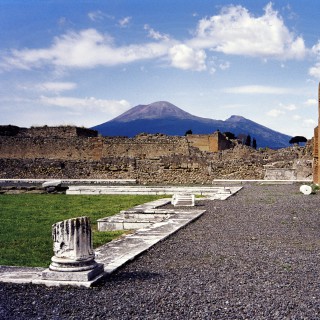
Stratovolcano in the Gulf of Naples, Italy
POPULARITY

For decades, writers and filmmakers have imagined worlds where characters can do things like watch a double sunset (on Tatooine, of course), or stand among the sand dunes of Arrakis, or gaze at the gas-giant planet Polyphemus from the moon Pandora. But even as works like Star Wars, Dune, and Avatar have enticed us with their fictional renditions of planets beyond our reach, astronomers have slowly begun to compile a set of scientific truths about the actual exoplanets. In this episode, Jacke talks to author Keith Cooper (Amazing Worlds of Science Fiction and Science Fact) about the realities beyond imaginary planets. PLUS Jacke takes a look at two AI-related pieces of news: the recovery of writing long thought to be lost on a scroll charred by Vesuvian ash, and a summer reading list that surprised everyone - including the authors who made the list for reasons they were not expecting. Additional listening: 282 Science Fiction 583 Margaret Cavendish (with Francesca Peacock) 693 Understanding the Wonders of Nature (with Alan Lightman) The music in this episode is by Gabriel Ruiz-Bernal. Learn more at gabrielruizbernal.com . "Two Butterflies" performed by Gabriel Ruiz-Bernal and Allison Hughes. Help support the show at patreon.com/literature or historyofliterature.com/donate . The History of Literature Podcast is a member of Lit Hub Radio and the Podglomerate Network. Learn more at thepodglomerate.com/historyofliterature . Learn more about your ad choices. Visit megaphone.fm/adchoices

Fang VonWrathenstein the man behind the Mad With Power Festival chats about the annual farmers market cheese curd takeover, the realities of being in a touring metal band, and of course this years festival that includes a great lineup and a vast assortment of arcade and pinball machines. Mad With Power 2024 August 2nd and 3rd, 2024 Madison Wisconsin- https://madwithpowerfest.com/index.php/get-tickets This years Lineup Lords of the Trident, Fellowship, Anthem, Magic Sword, Oceans of Slumber, Starkill, Vintersea, Vesuvian, Glyph, Dialith, Lame Genie, Celestial Wizard Learn more about your ad choices. Visit megaphone.fm/adchoices

@AnnieBergflamez and @CWCRadio meet up from opposite sides of the globe to talk about the thread of the week and discuss Annie catching the fitness bug. Listen to every Episode of Tweet Victory at: https://open.spotify.com/playlist/6mO4Bd0gh0sZUakz03A9gG?si=e4fc39c813e846d1

Kencan Dengan Tuhan - Selasa, 6 Desember 2022 Bacaan: "Dapatkah engkau menyaringkan suaramu sampai ke awan-awan, sehingga banjir meliputi engkau? Dapatkah engkau melepaskan kilat, sehingga sabung-menyabung, sambil berkata kepadamu: Ya?" (Ayub 38:34-35) Renungan: Gunung berapi merupakan sebuah rekahan di kulit bumi, tempat di mana larva keluar. Di bumi ini ada empat jenis gunung berapi. Pertama gunung berapi Hawaiian, yang tersusun dari lava basal. Gunung ini memiliki kawah yang luas dan bentuk kubah rendah yang terbentang hingga puluhan kilometer. Kedua gunung berapi Stromboly, yaitu gunung yang memiliki bentuk kerucut yang klasik. Letusannya cukup membahayakan karena mengandung larva, lapisan abu dan debu. Ketiga adalah gunung berapi Vesuvian, yaitu jenis gunung yang hanya meletus sekali setiap 10 tahun atau lebih. Lavanya bersifat lengket dan dapat menyumbat lubang yang terdapat di puncak gunung, sehingga dapat menciptakan letusan yang dahsyat. Keempat adalah gunung berapi Pelean. Dari semua jenis gunung berapi, Pelean adalah yang paling berbahaya. Letusannya berupa lava yang lengket, kaya akan silika dan sering mengeras di dalam gunung itu sendiri. Makin banyak lava yang mencoba keluar, makin besar tekanan yang dihasilkan. Dan pada akhirnya gunung itu sendiri akan hancur karenanya. Seperti yang kita ketahui salah satu letusan gunung berapi yang paling mengerikan terjadi di pulau Jawa pada tahun 1883. Waktu itu gunung Krakatau menembakkan awan debu yang sangat tebal ke atmosfer bumi. Hal ini memengaruhi iklim selama 3 tahun dan lebih dari 36.000 manusia tewas karena letusan itu. Manusia terasa begitu kecil jika dibandingkan dengan alam ini. Dengan hanya melihat kemegahan sebuah gunung saja, kita dapat menyadari bahwa kita tidak ada apa-apanya. Betapa dahsyat dan luar biasanya Tuhan. Dengan penuh keajaiban Ia menciptakan seluruh alam semesta. Dan tidak hanya gunung, ketika kita melihat hutan yang luas, lautan yang dalam dengan segala keindahannya, serta angkasa luar beserta deretan planet dan bintangnya, kita dapat terkagum-kagum oleh kuasa Tuhan. Kita dapat membaca perkataan Tuhan akan kuasanya atas alam semesta di dalam Ayub 38-39. Pada waktu itu Tuhan menantang Ayub yang marah kepada-Nya. Namun Ayub segera bertobat ketika Tuhan menunjukkan kuasa-Nya atas semesta. Siapakah kita ini sehingga menentang dan menolak Tuhan? Siapakah kita ini sehingga menyombongkan diri? Cukup dengan memberikan perintah Tuhan mampu membuat alam ini mengamuk dan mengizinkan dampak buruk terjadi untuk merusak bumi ini. Karena itu marilah merendahkan diri di hadapan Tuhan dan mensyukuri segala kebaikannya. Tuhan Yesus memberkati. Doa: Tuhan Yesus, aku hanyalah manusia yang lemah dan rapuh. Aku mau belajar untuk terus mengikuti engkau dan merendahkan diri di hadapan-Mu. Amin. (Dod).

Covert narcississts are a rare breed whom most poeple believe are fine human beings. While they are showing their enhanced false personas, everyone is buying their story and heaping on praise, You are married to this impossible person. Very few outside of the family will ever find out how psychologically toxic the covert narcissist is. Spouses are victims of narcissistic abuse---veiled threats to ruin your reputation, constant put downs and stunning humiliations, being told that you are at fault (when it is the narcissist who has made egregious mistakes), bout after bout of Vesuvian narcissistic rage. Some spouses feel that they deserve this horrendous treatment because they think little of themselves. They have been emotionally and psychologically pummeled all of their days and don't kow the difference. Some know that the marriage is a trvesty, that they are suffering from serious symptoms of stress--They are maxed out with chronic headaches, free floating anxiety, hyper-vigilance, chronic insomnia, intestinal discomforts and obsessive self doublt and lack of confidence. Those who recognize that they can no longer tolerate the emotional, psychological and physiological pain and stress chronically projected upon them, make the decision to sever the relationship through divorce or separation. As you awaken start with self care each day: getting the sleep and rest you need and deserve, nourishing food, pure water, sleep and rest that you need and deserve. Spend time with Nature for healing and restoration, expressive writing that expands your consciousness and restores your psycholgical grounding. Now you move forward in hope, creativity, personal freedom and the full expression of yourself as a unique, precious, extraordinary individual. Click on the link below for my book (Recovering and Healing After the Narcissist) on Amazon: https://tinyurl.com/46befxue Click on the link below for the Mental Health News Radio Network, a Global Network of Shows by Podcasters on every facet of Mental Health. www.mhnrnetwork.com

Some books lend themselves to creative collaborations and multimedia treatments. Lindy Ryan of Black Spot Books and Vesuvian Media Group outlines the key issues facing publishers today and talks about what makes some stories suitable for dramatic performance and other nonprint media.Topics CoveredTop issues for publishing todayConnecting books and readers while still supporting local indie booksellersOpportunities in digital publishing and other technologiesEmbracing and developing diversity in all areas of publishingNew media and ways of getting storytelling content to readersHow do stories break into new media?What makes a book suitable for adaptation into different media?Literary and visual qualityA fresh and unique voiceEnhanced ebook experiencesGrowth of the ebook and audiobook marketsThe challenge: making these expensive projects profitableWhy smaller is better: innovation and visionAdvocacy on the IBPA BoardLinksVesuvian Mediahttps://vesuvianmedia.com/ParticipantsLindy Ryan is an entrepreneur, award-winning professor, and an experienced publishing professional. In 2011, Ryan was part of the executive leadership team that founded Radiant Advisors, a data and business intelligence research and advisory firm, where Ryan developed and launched the company's editorial and research divisions, and later its data visualization practice, for clients that included household names in entertainment and media (21st Century Fox Films, Fox Networks, Warner Bros., Disney).In 2016, Ryan took her industry experience into academia, where she served as an active member of the New Jersey Big Data Alliance. She was previously an active researcher at the Rutgers Discovery Informatics Institute where she leads a team studying digital literacy.Ryan is an award-winning professor of data analysis and business communication at Rutgers University. She is a prolific speaker at conferences worldwide and the author of numerous papers and two textbooks, “The Visual Imperative: Creating a Culture of Visual Discovery" (Elsevier) and "Visual Data Storytelling with Tableau" (Pearson).In 2017, Ryan launched Black Spot Books, a traditional small press focused in speculative fiction. The company was acquired in 2019 as an imprint of multimedia corporation Vesuvian Media Group. In 2020, Ryan was named Chief Content Officer of Rosewind Books, Vesuvian’s clean romance division.Ryan currently serves on the Board of Directors for the Independent Book Publishers Association (IBPA). Ryan holds a Bachelor of Science degree in Business Administration: Entrepreneurship and Strategy, and a Master of Arts in Organizational Leadership and a Doctorate in Education, Organizational Leadership.Peter Goodman (host) is publisher of Stone Bridge Press (www.stonebridge.com) in Berkeley, California. He began his publishing career in Tokyo, Japan, in 1976. A longtime member of IBPA, he has served on the IBPA board and as IBPA board chair.For more information, go to IBPA at https://www.ibpa-online.org/.

Davide Carbone, music producer/DJ and label manager, born and raised in the Vesuvian area, he is now based in Berlin. Always passionate by the musical industry, he starts to develop several aliases and collaborations, working abreast with a musical collective, developing a strong circle of labels. Shares - REPITCH recordings and Cosmo Rhythmatic - with Ascion and Shapednoise, - 3TH Records - alongside Ascion and Lucindo. D. Carbone's sound can be described like Bold Industrial Techno, Hard and fast with Acid nuances. In Late 2016 founded his own Carbone Records to focus on own production and some collaboratives projects. Carbone's career is characterized by his close friendship with Ascion with which released under various projects and aliases like Repitch, 3TH, Ascion & D. Carbone. From 2013 he start to collaborate with the Mancunians duo - AnD - with whom released before under the name AD//DC on the English Label - Brothers - and the new - D.A.S. D.A. - project that take life on REPITCH and in which Ascion & Shapednoise are part of the project too. Honzo is the rappresentation of most experimental Davide's side. His liveset is an excursion from leftfield, to brokenbeat and straight beat, with an increasing/decreasing speed to give out the most sinister Davide's side. Honzo is accompained by the video artist FAX which you can easly discover the uncanny side of the performance through the Audio/Video. Davide is not only active part on his own labels but he also collaborate with Innersurface music, Ophism, Mord, Black Sun, Arboretum, Haunter records, just to mention some. https://soundcloud.com/d-carbone https://www.facebook.com/dcarbone87/ https://www.facebook.com/Carbonerecords/ Video Teaser Carbone01 https://vimeo.com/177999278 Snippets https://soundcloud.com/d-carbone/crbn01-snippets Bandcamp link https://carbonerecords.bandcamp.com/album/acid-life-ep

Brian Clegg reminisces about indoor fireworks and Vesuvian fire with this week's compound: Ammonium dichromate

Showcast Episode 38: Comic book talk runs amok as special guest Heath Corson ("Justice League: War") comes to The Admiral's Club for good movie chat and previews of "Pompeii" and "3 Days to Kill". Also, a look at Paul Thomas Anderson's "Pompeii", the Vesuvian weather forecast, and Karen comes back to the show just in time for a whole segment on "Ghostbusters". The Movie Guys are Paul Preston, Karen Volpe, Adam Witt & Lee KiasLike good movie talk? Please subscribe!www.themovieguys.net@TheMovieGuyswww.youtube.com/user/TheMovieGuysOnline

The story starts on a high-speed train and ends with six men in a crater, with hundreds of years and a number of explosions in between. Sean Cocco‘s rich new book uses Vesuvius as a focal point for exploring the histories of natural history, travel, observation, imaging, astronomy, and many other aspects of the places and identities of early modern history. Watching Vesuvius: A History of Science and Culture in Early Modern Italy (University of Chicago Press, 2013) pays special attention to the many resonances of emplacement and locality, and to the agency of the Vesuvian landscape, as it explores the continuities and transformations in the seventeenth and eighteenth century volcanic landscape. Volcanology emerged along with Neapolitan identity while volcanoes became emblematic of the south in the writings of European travelers: rumbling, unpredictable, given to heated eruptions. Cocco's account shows us the beauty of these transformations as they were embodied in paintings, poems, letters, and other media. Scholars and enthusiasts of the urban and political history of Europe will find much of interest here, as will readers interested in the history of vernacular understandings of nature. Enjoy! Learn more about your ad choices. Visit megaphone.fm/adchoices

The story starts on a high-speed train and ends with six men in a crater, with hundreds of years and a number of explosions in between. Sean Cocco‘s rich new book uses Vesuvius as a focal point for exploring the histories of natural history, travel, observation, imaging, astronomy, and many other aspects of the places and identities of early modern history. Watching Vesuvius: A History of Science and Culture in Early Modern Italy (University of Chicago Press, 2013) pays special attention to the many resonances of emplacement and locality, and to the agency of the Vesuvian landscape, as it explores the continuities and transformations in the seventeenth and eighteenth century volcanic landscape. Volcanology emerged along with Neapolitan identity while volcanoes became emblematic of the south in the writings of European travelers: rumbling, unpredictable, given to heated eruptions. Cocco's account shows us the beauty of these transformations as they were embodied in paintings, poems, letters, and other media. Scholars and enthusiasts of the urban and political history of Europe will find much of interest here, as will readers interested in the history of vernacular understandings of nature. Enjoy! Learn more about your ad choices. Visit megaphone.fm/adchoices

The story starts on a high-speed train and ends with six men in a crater, with hundreds of years and a number of explosions in between. Sean Cocco‘s rich new book uses Vesuvius as a focal point for exploring the histories of natural history, travel, observation, imaging, astronomy, and many other aspects of the places and identities of early modern history. Watching Vesuvius: A History of Science and Culture in Early Modern Italy (University of Chicago Press, 2013) pays special attention to the many resonances of emplacement and locality, and to the agency of the Vesuvian landscape, as it explores the continuities and transformations in the seventeenth and eighteenth century volcanic landscape. Volcanology emerged along with Neapolitan identity while volcanoes became emblematic of the south in the writings of European travelers: rumbling, unpredictable, given to heated eruptions. Cocco’s account shows us the beauty of these transformations as they were embodied in paintings, poems, letters, and other media. Scholars and enthusiasts of the urban and political history of Europe will find much of interest here, as will readers interested in the history of vernacular understandings of nature. Enjoy! Learn more about your ad choices. Visit megaphone.fm/adchoices

The story starts on a high-speed train and ends with six men in a crater, with hundreds of years and a number of explosions in between. Sean Cocco‘s rich new book uses Vesuvius as a focal point for exploring the histories of natural history, travel, observation, imaging, astronomy, and many other aspects of the places and identities of early modern history. Watching Vesuvius: A History of Science and Culture in Early Modern Italy (University of Chicago Press, 2013) pays special attention to the many resonances of emplacement and locality, and to the agency of the Vesuvian landscape, as it explores the continuities and transformations in the seventeenth and eighteenth century volcanic landscape. Volcanology emerged along with Neapolitan identity while volcanoes became emblematic of the south in the writings of European travelers: rumbling, unpredictable, given to heated eruptions. Cocco’s account shows us the beauty of these transformations as they were embodied in paintings, poems, letters, and other media. Scholars and enthusiasts of the urban and political history of Europe will find much of interest here, as will readers interested in the history of vernacular understandings of nature. Enjoy!

The story starts on a high-speed train and ends with six men in a crater, with hundreds of years and a number of explosions in between. Sean Cocco‘s rich new book uses Vesuvius as a focal point for exploring the histories of natural history, travel, observation, imaging, astronomy, and many other aspects of the places and identities of early modern history. Watching Vesuvius: A History of Science and Culture in Early Modern Italy (University of Chicago Press, 2013) pays special attention to the many resonances of emplacement and locality, and to the agency of the Vesuvian landscape, as it explores the continuities and transformations in the seventeenth and eighteenth century volcanic landscape. Volcanology emerged along with Neapolitan identity while volcanoes became emblematic of the south in the writings of European travelers: rumbling, unpredictable, given to heated eruptions. Cocco’s account shows us the beauty of these transformations as they were embodied in paintings, poems, letters, and other media. Scholars and enthusiasts of the urban and political history of Europe will find much of interest here, as will readers interested in the history of vernacular understandings of nature. Enjoy! Learn more about your ad choices. Visit megaphone.fm/adchoices

The story starts on a high-speed train and ends with six men in a crater, with hundreds of years and a number of explosions in between. Sean Cocco‘s rich new book uses Vesuvius as a focal point for exploring the histories of natural history, travel, observation, imaging, astronomy, and many other aspects of the places and identities of early modern history. Watching Vesuvius: A History of Science and Culture in Early Modern Italy (University of Chicago Press, 2013) pays special attention to the many resonances of emplacement and locality, and to the agency of the Vesuvian landscape, as it explores the continuities and transformations in the seventeenth and eighteenth century volcanic landscape. Volcanology emerged along with Neapolitan identity while volcanoes became emblematic of the south in the writings of European travelers: rumbling, unpredictable, given to heated eruptions. Cocco’s account shows us the beauty of these transformations as they were embodied in paintings, poems, letters, and other media. Scholars and enthusiasts of the urban and political history of Europe will find much of interest here, as will readers interested in the history of vernacular understandings of nature. Enjoy! Learn more about your ad choices. Visit megaphone.fm/adchoices

The story starts on a high-speed train and ends with six men in a crater, with hundreds of years and a number of explosions in between. Sean Cocco‘s rich new book uses Vesuvius as a focal point for exploring the histories of natural history, travel, observation, imaging, astronomy, and many other aspects of the places and identities of early modern history. Watching Vesuvius: A History of Science and Culture in Early Modern Italy (University of Chicago Press, 2013) pays special attention to the many resonances of emplacement and locality, and to the agency of the Vesuvian landscape, as it explores the continuities and transformations in the seventeenth and eighteenth century volcanic landscape. Volcanology emerged along with Neapolitan identity while volcanoes became emblematic of the south in the writings of European travelers: rumbling, unpredictable, given to heated eruptions. Cocco’s account shows us the beauty of these transformations as they were embodied in paintings, poems, letters, and other media. Scholars and enthusiasts of the urban and political history of Europe will find much of interest here, as will readers interested in the history of vernacular understandings of nature. Enjoy! Learn more about your ad choices. Visit megaphone.fm/adchoices
© 2020-2026 Ivy Podcast Discovery LLC
