
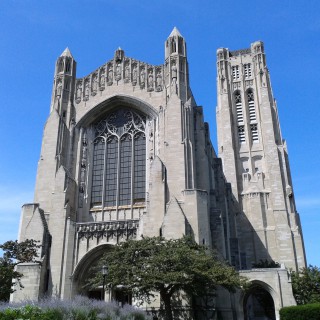
POPULARITY

5 episodes with Rockefeller Chapel

2 episodes with Rockefeller Chapel

3 episodes with Rockefeller Chapel

2 episodes with Rockefeller Chapel
![CHIASMOS: The University of Chicago International and Area Studies Multimedia Outreach Source [audio]](https://ivyfm.s3.amazonaws.com/i320/156657.jpg)
2 episodes with Rockefeller Chapel

2 episodes with Rockefeller Chapel
![CHIASMOS: The University of Chicago International and Area Studies Multimedia Outreach Source [video]](https://ivyfm.s3.amazonaws.com/i320/156658.jpg)
2 episodes with Rockefeller Chapel

Merry Christmas! In between looking at houses to rent and packing up the Granger house in Oklahoma City, Nick and John put together this yuletide conversation about perhaps the most neglected of Rowling's influences, Dodie Smith's I Capture the Castle. John was a reluctant reader, but, while listening to the audio book, reading the Gutenberg.com file on his computer, and digging the codex out of his packed boxes of books, the author of Harry Potter's Bookshelf was totally won over to Nick's enthusiasm for Castle.In fact, John now argues that, even if Rowling didn't read it until she was writing Goblet of Fire as some have claimed, I Capture the Castle may be the best single book to understand what it is that Rowling-Galbraith attempts to do in her fiction. Just as Dodie Smith has her characters explain overtly and the story itself delivers covertly, When Rowling writes a story, like Smith it is inevitably one that is a marriage of Bronte and Austen, wonderfully accessible and engaging, but with important touches in the ‘Enigmatist' style of Joyce and Nabokov, full of puzzles and twists in the fashion of God's creative work (from the Estecean logos within every man [John 1:9] continuous with the Logos) rather than a portrait of creation per se. Can you say ‘non liturgical Sacred Art'?And if you accept, per Nick's cogent argument, that Rowling read Castle many times as a young wannabe writer? Then this book becomes a touchstone of both Lake and Shed readings of Rowling's work — and Smith one of the the most important influences on The Presence.Merry Christmas, again, to all our faithful readers and listeners! Thank you for your prayers and notes of support and encouragement to John and for making 2025 a benchmark year at Hogwarts Professor. And just you wait for the exciting surprises we have in hand for 2026!Hogwarts Professor is a reader-supported publication. To receive new posts and support my work, consider becoming a free or paid subscriber.The Twelve Questions and ‘Links Down Below' Referred to in Nick and John's I Capture the Castle Conversation:Question 1. So, Nick, we spoke during our Aurora Leigh recording about your long term project to read all the books that Rowling has admitted to have read (link down below!), first question why? and secondly how is that going?Rowling's Admitted Literary InfluencesWhat I want is a single internet page reference, frankly, of ‘Rowling's Admitted Literary Influences' or ‘Confessed Favorites' or just ‘Books I have Read and Liked' for my thesis writing so I needn't do an information dump that will add fifty-plus citations to my Works Cited pages and do nothing for the argument I'm making.Here, then, is my best attempt at a collection, one in alphabetical order by last name of author cited, with a link to at least one source or interview in which Rowling is quoted as liking that writer. It is not meant as anything like a comprehensive gathering of Rowling's comments about any author; the Austen entry alone would be longer than the whole list should be if I went that route. Each author gets one, maybe two notes just to justify their entry on the list.‘A Rowling Reading of Aurora Leigh' Nick Jeffery Talking about ‘A Rowling Reading of Aurora Leigh' Question 2. ... which has led me to three works that she has read from the point of view of writers starting out, and growing in their craft. Which leads us to this series of three chats covering Aurora Leigh by Elizabeth Barrett Browning, I Capture the Castle by Dodie Smith and the Little Women series by Louisa May Alcott. I read Castle during the summer. Amid all the disruptions at Granger Towers, have you managed to read it yet? How did you find it?Capturing Dodie Smith's I Capture the Castle: Elizabeth Baird-Hardy (October 2011)Certain elements of the story will certainly resonate with those of us who have been to Hogwarts a fair few times: a castle with an odd combination of ancient and modern elements, but no electricity; eccentric family members who are all loved despite their individual oddities (including Topaz's resemblance to Fleur Delacour); travel by train; a character named Rose who may have been one of the reasons Rowling chose the name for Ron and Hermione's daughter; descriptions of food that make even somewhat questionable British cuisine sound tasty; and inanimate objects that have their own personalities (the old dress frame, which Rose and Cassandra call Miss Blossom, is voiced by Cassandra and sounds much like the talking mirror in Harry's room at the Leaky Caldron).But far more than some similar pieces, I Capture the Castle lends something less tangible to Rowling's writing. The novel has a tone that, like the Hogwarts adventures, seamlessly winds together the comic and the crushing in a way that is reflective of life, particularly life as we see it when we are younger. Cassandra's voice is, indeed, engaging, and readers will no doubt see how the narrative voice of Harry's story has some of the same features.A J. K. Rowling Reading of I Capture the Castle: Nick Jeffery (December 2025)Parallels abound for Potter fans. The Mortmain's eccentric household mirrors the Weasleys' chaotic warmth: loved despite quirks, from Topaz's nude communing with nature (evoking a less veiled Fleur Delacour) to Mortmain's intellectual withdrawal. Food descriptions—meagre yet tantalising—prefigure Hogwarts feasts, turning humble meals into sensory delights. Inanimate objects gain voice: the family dress-frame “Miss Blossom” offers advice, akin to the chatty mirrors or portraits in Rowling's world. Even names resonate—Rose Mortmain perhaps inspiring Ron and Hermione's daughter—and train journeys punctuate the plot.The Blocked Writer: James Mortmain, a father who spent his fame early and now reads detective novels in an irritable stupor, mirrors the “faded glory” or “lost genius” archetypes seen in Rowling's secondary characters, such as Xenophilius Lovegood and Jasper Chiswell.The Bohemian Stepmother: Topaz, who strides through the countryside in only wellington boots, shares the whimsical, slightly unhinged energy of a character like Luna Lovegood or Fleur Delacour.Material Yearning: The desperate desire of Cassandra's sister, Rose, to marry into wealth reflects the very real, non-magical pressures of class and poverty that Rowling weaves into Harry Potter, Casual Vacancy, Strike and The Ickabog.Leda Strike parallels: Leda Fox-Cotton the bohemian London photographer, adopts Stephen, the working-class orphan, and saves him from both unrequited love and the responsibility that comes with the Mortmain family.Question 3. [story of finishing the book last night by candle light in my electricity free castle] So, in short Nick, I thought it astonishing! I didn't read your piece until I'd finished reading Capture, of course, but I see there is some dispute about when Rowling first read it and its consequent influence on her as a writer. Can you bring us up to speed on the subject and where you land on this controversy?* She First Read It on her Prisoner of Azkaban Tour of United States?tom saysOctober 21, 2011 at 4:00 amIf I recall correctly, Rowling did not encounter this book until 1999 (between PoA & Goblet) when, on a book tour, a fan gave her a copy. This is pertinent to any speculation about how ‘Castle' might have influenced the Potter series.* Rowling Website: “Books I Read and Re-Read as a Child”Question 4. Which, when you consider the other books on that virtual bookshelf -- works by Colette, Austen, Shakespeare, Goudge, Nesbit, and Sewell's Black Beauty, something of a ‘Rowling's Favorite Books and Authors as a Young Reader' collection, I think we have to assume she is saying, “I read this book as a child or adolescent and loved it.” Taking that as our jumping off place, John, and having read my piece, do you wish you had read it before writing Harry Potter's Bookshelf?Harry Potter's Bookshelf: The Great Books behind the Hogwarts Adventures John Granger 2009Literary Allusion in Harry Potter Beatrice Groves 2017Question 5. So, yes, I certainly do think it belongs -- with Aurora Leigh and Little Women -- on the ‘Rowling Reader Essential Reading List.' The part I thought most interesting in your piece was, of course, the Shed elements I missed. Rowling famously said that she loved Jo Marsh in Little Women because, in addition to the shared name and the character being a wannabe writer, she was plain, a characteristic with which the young, plain Jane Rowling easily identified. What correspondences do you think Little Jo would have found between her life and Cassandra Mortmain's?* Nick Jeffery's Kanreki discussion of Rowling's House on Edge of Estate with Two Children, Bad Dad ‘Golden Thread' (Lethal White)Question 6. Have I missed any, John?* Rockefeller Chapel, University of ChicagoQuestion 7. Forgive me for thinking, Nick, that Cassandra's time in church taking in the silence there with all her senses may be the biggest take-away for the young Rowling; if the Church of England left their chapel doors open in the 70s as churches I grew up in did in the US, it's hard to imagine Jo the Reader not running next door to see what she felt there after reading that passage. (Chapter 13, conversation with vicar, pp 234-238). The correspondence with Beatrice Groves' favorite scene in the Strike novels was fairly plain, no? What other scenes and characters do you see in Rowling's work that echo those in Castle?* Chapter 13, I Capture the Castle: Cassandra's Conversation with the Vicar and time in the Chapel vis a vis Strike in the Chapel after Charlotte's Death* Beatrice Groves on Running Grave's Chapel Scene: ‘Strike's Church Going'Question 8. I'm guessing, John, you found some I have overlooked?Question 9. The Mortmain, Colly, and Cotton cryptonyms as well as Topaz and Cassandra, the embedded text complete with intratextuual references (Simon on psycho-analysis), the angelic servant-orphan living under the stairs (or Dobby's lair!) an orphan with a secret power he cannot see in himself, the great Transformation spell the children cast on their father, an experiment in psychomachia a la the Shrieking Shack or Chamber of Secrets, the hand-kiss we see at story's end from Smith, love delayed but expressed (Silkworm finish?), the haunting sense of the supernatural everywhere especially in the invocation that Rose makes to the gargoyle and Cassandra's Midsummer Night's Eve ritual with Simon, the parallels abound. Ghosts!* Please note that John gave “cotton” a different idiomatic meaning than it has; the correct meaning is at least as interesting given the Cotton family's remarkable fondness for all of the Mortmains!* Kanreki ‘Embedded Text' Golden Thread discussion 1: Crimes of Grindelwald* Kanreki ‘Embedded Text' Golden Thread discussion 2: Golden Thread Survey, Part II* Rose makes an elevated Faustian prayer to a Gargoyle Devil: Chapter IV, pp 43-46* Cassandra and Simon celebrate Midsummer Night's Eve: Chapter XII, pp 199-224Let's talk about the intersection of Lake and Shed, though, the shared space of Rowling's bibliography, works that shaped her core beliefs and act as springs in her Lake of inspiration and which give her many, even most of the tools of intentional artistry she deploys in the Shed. What did you make of the Bronte-Austen challenge that Rose makes explicitly in the story to her sister, the writer and avid reader?“How I wish I lived in a Jane Austen novel.” [said Rose]I said I'd rather be in a Charlotte Bronte.“Which would be nicest—Jane with a touch of Charlotte, or Charlotte with a touch of Jane?”This is the kind of discussion I like very much but I wanted to get on with my journal, so I just said: “Fifty percent each way would be perfect,” and started to write determinedly.Question 10. So, I'm deferring to both Elizabeth Barrett Browning and J. K Rowling. Elizabeth Barrett Browning valued intense emotion, social commentary, and a grand scope in literature, which led her to favour the passionate depth of the Brontës over the more restrained, ironical style of Jane Austen. Rowling about her two dogs: “Emma? She's a bundle of love and joy. Her sister, Bronte, is a bundle of opinions, stubbornness and hard boundaries.”Set in the 30s, written in the early 40s, but it seems astonishingly modern. Because her father is a writer, a literary novelist of the modern school, do you think there are other more contemporary novelists Dodie Smith was engaging than Austen and Bronte?Question 11. Mortmain is definitely Joyce, then, though Proust gets the call-out, and perhaps the most important possible take-away Rowling the attentive young reader would have made would have been Smith's embedded admiration for Joyce the “Enigmatist” she puts in Simon's mouth at story's end (Chapter XVI, pp 336-337) and her implicit criticism of literary novels and correction of that failing. Rowling's re-invention of the Schoolboy novel with its hidden alchemical, chiastic, soul-in-crisis-allegories and embedded Christian symbolism can all be seen as her brilliant interpretation of Simon's explanation of art to Cassandra and her dedication to writing a book like I Capture the Castle.* Reference to James Joyce by Simon Cotton, Chapter IX, p 139:* The Simon and Cassandra conversation about her father's novels, call it ‘The Writer as Enigmatist imitating God in His Work:' Chapter XVI, pp 331-334* On Imagination as Transpersonal Faculty and Non-Liturgical Sacred ArtSacred art differs from modern and postmodern conceptions of art most specifically, though, in what it is representing. Sacred art is not representing the natural world as the senses perceive it or abstractions of what the individual and subjective mind “sees,” but is an imitation of the Divine art of creation. The artist “therefore imitates nature not in its external forms but in its manner of operation as asserted so categorically by St. Thomas Aquinas [who] insists that the artist must not imitate nature but must be accomplished in ‘imitating nature in her manner of operation'” (Nasr 2007, 206, cf. “Art is the imitation of Nature in her manner of operation: Art is the principle of manufacture” (Summa Theologia Q. 117, a. I). Schuon described naturalist art which imitates God's creation in nature by faithful depiction of it, consequently, as “clearly luciferian.” “Man must imitate the creative act, not the thing created,” Aquinas' “manner of operation” rather than God's operation manifested in created things in order to produce ‘creations'which are not would-be duplications of those of God, but rather a reflection of them according to a real analogy, revealing the transcendental aspect of things; and this revelation is the only sufficient reason of art, apart from any practical uses such and such objects may serve. There is here a metaphysical inversion of relation [the inverse analogy connecting the principial and manifested orders in consequence of which the highest realities are manifested in their remotest reflections[1]]: for God, His creature is a reflection or an ‘exteriorized' aspect of Himself; for the artist, on the contrary, the work is a reflection of an inner reality of which he himself is only an outward aspect; God creates His own image, while man, so to speak, fashions his own essence, at least symbolically. On the principial plane, the inner manifests the outer, but on the manifested plane, the outer fashions the inner (Schuon 1953, 81, 96).The traditional artist, then, in imitation of God's “exteriorizing” His interior Logos in the manifested space-time plane, that is, nature, instead of depicting imitations of nature in his craft, submits to creating within the revealed forms of his craft, which forms qua intellections correspond to his inner essence or logos.[2] The work produced in imitation of God's “manner of operation” then resembles the symbolic or iconographic quality of everything existent in being a transparency whose allegorical and anagogical content within its traditional forms is relatively easy to access and a consequent support and edifying shock-reminder to man on his spiritual journey. The spiritual function of art is that “it exteriorizes truths and beauties in view of our interiorization… or simply, so that the human soul might, through given phenomena, make contact with the heavenly archetypes, and thereby with its own archetype” (Schuon 1995a, 45-46).Rowling in her novels, crafted with tools all taken from the chest of a traditional Sacred Artist, is writing non-liturgical Sacred Art. Films and all the story experiences derived of adaptations of imaginative literature to screened images, are by necessity Profane Art, which is to say per the meaning of “profane,” outside the temple or not edifying spiritually. Film making is the depiction of how human beings encounter the time-space world through the senses, not an imitation of how God creates and a depiction of the spiritual aspect of the world, a liminal point of entry to its spiritual dimension. Whence my describing it as a “neo-iconoclasm.”I want to close this off with our sharing our favorite scene or conversation in Castle with the hope that our Serious Reader audience will read Capture and share their favorites. You go first, Nick.* Cassandra and Rose Mortmain, country hicks in the Big City of London: Chapter VI, pp 76-77Question 12. And yours, John?* Cassandra Mortmain ‘Moat Swimming' with Neil Cotton, Chapter X, 170-174* Cassandra seeing her dead mother (think Harry before the Mirror of Erised at Christmas time?): Chapter XV, pp 306-308Hogwarts Professor is a reader-supported publication. To receive new posts and support my work, consider becoming a free or paid subscriber. This is a public episode. If you'd like to discuss this with other subscribers or get access to bonus episodes, visit hogwartsprofessor.substack.com/subscribe

This lecture is entitled Singing the Sacred: Music and the Holy in Ancient Christianity. It was presented by Susan Ashbrook Harvey of Brown University on May 15, 2022, at the University of Chicago's Rockefeller Chapel.

For the first time, the Chief Change Officer podcast returns to its birthplace—Hong Kong—to spotlight local artist and community builder May Yeung.From doodling on walls at age two to sculpting giant dim sum steamers for public exhibitions, May's journey is anything but typical. She swapped Goldman Sachs for gallery spaces, battled cancer with faith (and clay), and now leads Art of My Family, a charity that brings art, healing, and heritage to underprivileged youth across Hong Kong. Whether it's mental wellness programs, intergenerational education, or marine-themed installations made from recycled shells, May turns every life experience into a canvas for good. Bonus: her baby son Archer makes a surprise guest appearance—arguably stealing the show.Key Highlights of Our Interview:Draw First, Write Later: A Childhood in Color“I drew on walls before I could write my name… by twelve, I knew I'd be an artist.”When Music Shapes the ClayFrom piano lessons with Hong Kong's top musicians to dance-sculpture mashups, May's art listens before it speaks.The Goldman Pivot: Finding Purpose Through CSR“I helped organize community art after Hurricane Sandy. That's when the impact bug bit.”From Cancer to Conviction: The ALT of Art“Faith, feeling alive, touching lives—cancer gave me a new mission, not just new scars.”Archer Joins the Show: A Toddler-Sized Shift in Artistic Purpose“Motherhood made me realize: my art must nourish the next generation—his and others'.”Dim Sum, Ping Pong, and Bamboo DreamsFrom Chinese checkers to handmade steamers, May's art honors Hong Kong's everyday beauty.‘What If' and ‘Blossom Love': Sculpting Global Conversations“What If” made her the first Asian sculptor to exhibit at Rockefeller Chapel; “Blossom Love” built a cultural bridge between Hong Kong and the Netherlands.Why ‘Art of My Family' Isn't Just a NameMay's nonprofit uses art to serve mental health, sustainability, and inclusion—with the three C's: co-design, co-create, co-learn.Mission: Teaching Artists Who Teach From Life“I'm not just instructing—I'm modeling the mess, joy, and resilience of the creative path.”______________________Connect with us:Host: Vince Chan | Guest: May Yeung --Chief Change Officer--Change Ambitiously. Outgrow Yourself.Open a World of Expansive Human Intelligencefor Transformation Gurus, Black Sheep,Unsung Visionaries & Bold Hearts.EdTech Leadership Awards 2025 Finalist.18 Million+ All-Time Downloads.80+ Countries Reached Daily.Global Top 1.5% Podcast.Top 10 US Business.Top 1 US Careers.>>>170,000+ are outgrowing. Act Today.

Rev. D. Maurice CharlesSubscribe to the podcast here! 2:33 - Dean Charles talks about his growing up in the church and how his family migrated from the Jim Crow South. How his family's stories of slavery and survival and faith make up the story of his heritage.5:12 - When and how Dean Charles was called to the ministry. His background in microbiology, psychology, and sociology. How he became a university chaplain. "Human beings are stranger than microbes."7:31 - What is a university chaplain? "Helping communities process trauma."11:05 - What it means to be the first African American chaplain at the University of Chicago. "Chicago is a challenging place to be a black male."18:18 - How Dean Charles's childhood experiences of the turbulent 1960's led to his scholarly work in religion and violence. "What is the religious response to violence? Can we reform policing?"26:00 - Protest songs and why music is important during social movements: "One cannot live on rage alone....Defiant joy keeps things moving forward."27:49 - [Music] presents an image to us of the kind of community that we're striving for. It also names community pain."28:07 - "We need poets and musicians to help us name our reality." How the arts help us process trauma.28:54 - "We need artists and musicians now more than ever because there is a certain level of pain and rupture that defies prose."29:44 - On Rabbi Abraham Joshua Heschel's essay, "The Vocation of the Cantor": "Music has a shattering quality; it allows the soul to have an encounter with reality that is beyond what we have simply by mere cognition."31:32 - "You can be aware of the barriers to access and to advancement while at the same time being told by the people on the other side of those barriers that they don't exist. It is absolutely crazy-making."31:47 - Death as the universal experience that allows entry into "intimate settings you wouldn't normally be welcomed into" and how death breaks down barriers.34:07 - "A bad day if you're poor is much worse than a bad day if you're wealthy."38:09 - "Oppression Olympics" and how "we act in this country like empathy is the only impetus toward moral action...you don't have to feel what some else feels to do the right thing."43:25 - "We act in this country like empathy is the only impetus toward moral action. You don't have to feel what someone else feels to do the right thing."44:43 - "Treat others not only how we want to be treated but treat others the way they want to be treated."45:19 - "Create a society that makes space for all of us."48:18 - "When things don't make sense, we still resist because to resist absurdity is to live." What Dean Charles does to counterbalance his own despair in these difficult times.59: 35 - Dean Charles's advice to his younger self: "Take your experience of the world seriously. It's valuable. It's a gift to you and to those around you."

Jon Stewart, comedian, author, and former host and executive producer of "The Daily Show," chats with David in Rockefeller Chapel at the University of Chicago to talk about Donald Trump and the 2016 election, lessons from lobbying in Washington, what he's working on today, and more.

If you experience any technical difficulties with this video or would like to make an accessibility-related request, please send a message to digicomm@uchicago.edu. A tradition since 1987, the University of Chicago Scavenger Hunt, fondly known as “Scav,” is a four-day extravaganza held in May, when teams compete in a wildly creative quest to find, design, perform, build, or otherwise execute items from a designated list. Each year, Scav includes an Olympics, a road trip, and other favorites executed by teams and scrutinized by judges. But this year held a Scav first—on Friday night, Rockefeller Chapel played host to the first Scav wedding. UChicago alums Christian Kammerer, AB’03, SM’06, PhD’09, a longtime Scav judge, and Emily Pelka, AB’09, exchanged vows (for real) in a wedding ceremony that somehow managed to blend the Muppets, Iron Butterfly, and a Nativity re-enactment, and finish with the happy couple crowd surfing their way out of the chapel.

If you experience any technical difficulties with this video or would like to make an accessibility-related request, please send a message to digicomm@uchicago.edu. The Latke-Hamantash Debate has been a University of Chicago tradition since 1946. UChicago faculty members apply the knowledge and tools of their disciplines to resolve this age-old question in an evening of fun and frivolity! Past participants have included Nobel Prize winners and University presidents. This year's debate is brought to you by the brothers of the Alpha Epsilon Pi fraternity. AEPi is the International Jewish fraternity with hundreds of chapters across five countries. The debate is supported by the Spiritual Life Office at Rockefeller Chapel and Campus and Student Life, along with Jewish community organizations on campus.
If you experience any technical difficulties with this video or would like to make an accessibility-related request, please send a message to digicomm@uchicago.edu. Since opening in 1928, Rockefeller Memorial Chapel has served as a vital spiritual, ceremonial, and artistic home for the University of Chicago. Students begin their journey at UChicago by gathering in Rockefeller Chapel for opening convocation and return throughout their time at the University.
If you experience any technical difficulties with this video or would like to make an accessibility-related request, please send a message to digicomm@uchicago.edu. Since his adoption in 2010, Quasimodo "Modo" Rockefeller has become a beloved figure on the University of Chicago campus—and on Facebook, where he entertains his more than 600 friends with regular updates. The black-and-white cat roams freely throughout the chapel and greets its many visitors. Elizabeth Davenport, dean of Rockefeller Chapel, says Modo is a fitting addition to the historic building. "Every great cathedral has always had its cat," she says.
Eric Karpeles Jozef Czapski's 20th Century Life Polish painter and writer Jozef Czapski (pronounced CHAP-skee) is virtually unknown to American artists and readers of the English language, though he is a figure of considerable historical, political, and cultural importance in both Western and Eastern Europe. Moved by the quality of Czapski’s work and the integrity of his life, Commonweal Board Member Eric Karpeles is writing a book that will be both an introduction to his character and achievements, and a critical assessment of his painting and writing, placing this creative legacy into an historical context. Fresh from his return after a long research trip to Poland, Eric presents an illustrated talk about Czapski to TNS, followed by a conversation with Michael Lerner. Eric Karpeles Commonweal Board Member Eric Karpeles is a painter and writer. Born and raised in New York, he has also lived in India and in France, settling in Bolinas in 2007. His painting career has been shaped by the quest for a spiritual presence in art, and by a negative response to the elitism of the contemporary marketplace. The Rockefeller Chapel is a room-sized painting he completed in 1996, a permanent installation at the HealthCare Chaplaincy in New York City. Karpeles writes about painting and the intersection of literature and visual aesthetics; his book, Paintings in Proust, translated into several languages, was a “book of the year” in the NY Times, the Times of London, and The Wall Street Journal. Find out more about The New School at tns.commonweal.org.
If you experience any technical difficulties with this video or would like to make an accessibility-related request, please send a message to digicomm@uchicago.edu. Dazzling young organist Christopher Houlihan returns to Rockefeller Chapel to play a virtuoso recital of music by J.S. Bach, Debussy, Duruflé, Saint-Saëns, and Liszt. This is the fourth annual recital in the Brian Gerrish Organ Performance Series. The Brian Gerrish Organ Performance Series is made possible by a generous endowment given to honor Divinity School professor emeritus Brian Gerrish and to promote the joy of listening to world-class organ performances.
If you experience any technical difficulties with this video or would like to make an accessibility-related request, please send a message to digicomm@uchicago.edu. Dazzling young organist Christopher Houlihan returns to Rockefeller Chapel to play a virtuoso recital of music by J.S. Bach, Debussy, Duruflé, Saint-Saëns, and Liszt. This is the fourth annual recital in the Brian Gerrish Organ Performance Series. The Brian Gerrish Organ Performance Series is made possible by a generous endowment given to honor Divinity School professor emeritus Brian Gerrish and to promote the joy of listening to world-class organ performances.
If you experience any technical difficulties with this video or would like to make an accessibility-related request, please send a message to digicomm@uchicago.edu. On June 4, 2011, the University celebrated the achievements of the 2011 Alumni Award winners. Hosted by the Alumni Board of Governors, the 70th Annual Alumni Awards ceremony took place at Rockefeller Chapel during Alumni Weekend. Alumni and faculty were honored for their tremendous contributions to society, to the University, and to their professions.
If you experience any technical difficulties with this video or would like to make an accessibility-related request, please send a message to digicomm@uchicago.edu. On June 4, 2011, the University celebrated the achievements of the 2011 Alumni Award winners. Hosted by the Alumni Board of Governors, the 70th Annual Alumni Awards ceremony took place at Rockefeller Chapel during Alumni Weekend. Alumni and faculty were honored for their tremendous contributions to society, to the University, and to their professions.
Eric Karpeles The Last Threshold: Artists and Mortality Bolinas painter and writer Eric Karpeles will talk about the role that artists have played in helping to imaginatively frame and comprehend the idea of how we cease to be. How is it that artists, engaged in the most willful need to express their very beings, seem to overcome the fear of the loss of self? Focusing on three distinct art forms—painting, poetry and music—and three supreme practitioners—Mark Rothko, Emily Dickinson and Gustav Mahler—Karpeles will attempt to create an awareness of how, in their struggle to give voice, artists make use of their accumulated subjective experience to look and listen and learn with acute attention and focus, navigating between the physical world and the life of the mind. The boundary between what we know and what we cannot know is a minefield of stimulation for artists, who help teach us by example how to meaningfully embrace the end that awaits us all. Erik Karpeles Commonweal Board Member Eric Karpeles is a painter and writer. Born and raised in New York, he has also lived in India and in France, settling in Bolinas in 2007. His painting career has been shaped by the quest for a spiritual presence in art, and by a negative response to the elitism of the contemporary marketplace. The Rockefeller Chapel is a room-sized painting he completed in 1996, a permanent installation at the HealthCare Chaplaincy in New York City. Karpeles writes about painting and the intersection of literature and visual aesthetics; his book, Paintings in Proust, translated into several languages, was a “book of the year” in the NY Times, the Times of London, and The Wall Street Journal. Find out more about The New School at tns.commonweal.org.
If you experience any technical difficulties with this video or would like to make an accessibility-related request, please send a message to digicomm@uchicago.edu. The Chairman of the Board of Trustees, Andrew M. Alper A.B. '80 , M.B.A. '81, will offer remarks, as will the President of the Alumni Board of Governors, and a representative of the student body. The faculty address will be given by Martin E. Marty Ph.D. '56, Fairfax M. Cone Distinguished Service Professor Emeritus of the History of Modern Christianity in the Divinity School and in the Committee on the History of Culture. The President of the University, Robert J. Zimmer, will also give an address.9:45 a.m. Academic Procession from Main Quadrangle to Rockefeller Memorial Chapel.
Eric Karpeles It's About Lyme: Film Screening A two-part community awareness program for the town of Bolinas, this was a community discussion, film screening of Under Our Skin, and conversation with film producer Andy Abrahams Wilson to learn more about one of the fast growing epidemics in our world today. How does one contract Lyme? What is the protocol once one is infected? What is the long range prognosis for recovery? What is the nature of chronic Lyme disease? These are among the issues to be raised and discussed, in a context of information presented and treatments explored. Join artist and Commonweal Board Member Eric Karpeles as he facilitates this community forum about Lyme Disease. Eric Karpeles Commonweal Board Member Eric Karpeles is a painter and writer. Born and raised in New York, he has also lived in India and in France, settling in Bolinas in 2007. His painting career has been shaped by the quest for a spiritual presence in art, and by a negative response to the elitism of the contemporary marketplace. The Rockefeller Chapel is a room-sized painting he completed in 1996, a permanent installation at the HealthCare Chaplaincy in New York City. Karpeles writes about painting and the intersection of literature and visual aesthetics; his book, Paintings in Proust, translated into several languages, was a “book of the year” in the NY Times, the Times of London, and The Wall Street Journal. Find out more about The New School at tns.commonweal.org.
If you experience any technical difficulties with this video or would like to make an accessibility-related request, please send a message to digicomm@uchicago.edu. Two panels on academic freedom, chaired by Tariq Ali, editor of Verso Books and New Left Review.The growing evidence of outside interference in the hiring process at universities and the recent tenure denials at DePaul University, has prompted leading scholars across the nation to begin to speak out in defense of academic freedom. The DePaul University Academic Freedom Committee, Verso Books, and Diskord Journal sponsored a public symposium held in Rockefeller Chapel at the University of Chicago.

If you experience any technical difficulties with this video or would like to make an accessibility-related request, please send a message to digicomm@uchicago.edu. Two panels on academic freedom, chaired by Tariq Ali, editor of Verso Books and New Left Review.The growing evidence of outside interference in the hiring process at universities and the recent tenure denials at DePaul University, has prompted leading scholars across the nation to begin to speak out in defense of academic freedom. The DePaul University Academic Freedom Committee, Verso Books, and Diskord Journal sponsored a public symposium held in Rockefeller Chapel at the University of Chicago.
Hanford Woods and Eric Karpeles What Is Art? Reading Shakespeare and Tolstoy Join Michael Lerner in conversation with Shakespearean professor Hanford Woods and artist Eric Karpeles about Shakespeare’s Hamlet and Tolstoy’s What Is Art. Familiarity with both works of art is optional but recommended. Hanford Woods Hanford teaches Shakespeare at Dawson College in Montreal and is a longtime Bolinas resident. Eric Karpeles Commonweal Board Member Eric Karpeles is a painter and writer. Born and raised in New York, he has also lived in India and in France, settling in Bolinas in 2007. His painting career has been shaped by the quest for a spiritual presence in art, and by a negative response to the elitism of the contemporary marketplace. The Rockefeller Chapel is a room-sized painting he completed in 1996, a permanent installation at the HealthCare Chaplaincy in New York City. Karpeles writes about painting and the intersection of literature and visual aesthetics; his book, Paintings in Proust, translated into several languages, was a “book of the year” in the NY Times, the Times of London, and The Wall Street Journal. Find out more about The New School at tns.commonweal.org.
Eric Karpeles My Book Is A Painting: Marcel Proust and the Resonance of the Visual Image Artist and Commonweal Board Member Eric Karpeles, author of Paintings in Proust, presents this illustrated talk about the visual images alluded to in Marcel Proust’s writing. Paintings in Proust has received considerable acclaim in the United States, Britain, and France, where the French edition sold out its first printing in three weeks. Salman Rushdie called it his favorite book of the year. The New York Times claimed the book elicited “the literary equivalent of a hosanna.” A New York Observer critic wrote that the work is “authoritative, intelligent, amusing, and can be enjoyed without prior exposure to Proust.” The same can be said about Eric’s talk, which, while specifically about Proust, is also generally about the mind of the artist and the creative process. Eric Karpeles Commonweal Board Member Eric Karpeles is a painter and writer. Born and raised in New York, he has also lived in India and in France, settling in Bolinas in 2007. His painting career has been shaped by the quest for a spiritual presence in art, and by a negative response to the elitism of the contemporary marketplace. The Rockefeller Chapel is a room-sized painting he completed in 1996, a permanent installation at the HealthCare Chaplaincy in New York City. Karpeles writes about painting and the intersection of literature and visual aesthetics; his book, Paintings in Proust, translated into several languages, was a “book of the year” in the NY Times, the Times of London, and The Wall Street Journal. Find out more about The New School at tns.commonweal.org.
Episode 27: Mozart's amazing Violin and Viola Duos with guest violist Eric Nowlin- Upcoming Events: March 18 - Haydn Seven Last Words of Christ at the University of Chicago’s Rockefeller Chapel with homilies by eight different faith leaders and speakers (with violinist Mathias Tacke and violist Richard Young from the Vermeer Quartet and cellist Wendy Warner), March 20, 21 and 22 - Corigliano's Red Violin Chaconne and Ravel's Tzigane with the Jacksonville Symphony (FL)- Inquires From My Inbox: sonofaguitar asks, “Where do you find the music for the Pibroch (Mackenzie’s Lament) that you play on your YouTube video??- Random Musical Thought: Another difference between classical and non-classical music: familiarity with the repertoire, and whether or not the audience is listening one step ahead or one step behind.- A discussion about Mozart's compositions for viola with guest artist, Eric Nowlin, particularly the Violin and Viola Duos. Includes musical examples (played by Rachel and Eric) from Mozart’s Violin and Viola Duos and Michael Haydn's earlier Duets. Rachel also tells the story of how Mozart came to the rescue of Michael Haydn by composing his duos.For more information about Eric Nowlin, please visit:http://www.rebf.org/ILP/EricNowlin.htmltotal playing time: 24:28SUBSCRIBE TO THIS PODCAST ON I-TUNES!Would you like to be featured on Violin Adventures? Just send your question via text or as an MP3 attachment to rachelbartonpine@aol.com and listen for you answer on Inquiries From My Inbox!Thanks for listening!visit Rachel online:www.rachelbartonpine.comwww.myspace.com/rachelbartonpinewww.youtube.com/RachelBartonPineViolin Adventures with Rachel Barton Pine is produced by Windy Apple Studios www.windyapple.com
Episode 26: Preparing for chamber music rehearsals - how to expedite the process - Upcoming Events: March 18 Haydn Seven Last Words of Christ at the University of Chicago’s Rockefeller Chapel with homilies by eight different faith leaders and speakers (with violinist Mathias Tacke and violist Richard Young from the Vermeer Quartet and cellist Wendy Warner) - Inquires From My Inbox: Fastopen asks "Who is your violin luthier?" - Random Musical Thought: I believe that musicians who are full of great joy can create music that is just as profound as that of musicians who are full of angst. - Learning chamber music in a hurry, a step-by-step process: Using highlighters, studying the score, marking things into your part, listening to recordings, and more. total playing time: 24:27 SUBSCRIBE TO THIS PODCAST ON I-TUNES! Would you like to be featured on Violin Adventures? Just send your question via text or as an MP3 attachment to rachelbartonpine@aol.com and listen for you answer on Inquiries From My Inbox! Thanks for listening! visit Rachel online: www.rachelbartonpine.comwww.myspace.com/rachelbartonpinewww.youtube.com/RachelBartonPine Violin Adventures with Rachel Barton Pine is produced by Windy Apple Studios www.windyapple.com
The World Beyond the Headlines from the University of Chicago
Wangari Maathai is a Kenyan politician and environmental activist who was awarded the 2004 Nobel Prize for Peace, the first black African woman to win a Nobel Prize. Maathai was elected to Kenya's National Assembly with 98 percent of the vote in 2002 and in 2003 was appointed assistant minister of environment, natural resources, and wildlife. She is the author of "The Green Belt Movement: Sharing the Approach and the Experience". Co-sponsors: The Division of the Humanities and Rockefeller Chapel.
Wangari Maathai is a Kenyan politician and environmental activist who was awarded the 2004 Nobel Prize for Peace, the first black African woman to win a Nobel Prize. Maathai was elected to Kenya's National Assembly with 98 percent of the vote in 2002 and in 2003 was appointed assistant minister of environment, natural resources, and wildlife. She is the author of "The Green Belt Movement: Sharing the Approach and the Experience". Co-sponsors: The Division of the Humanities and Rockefeller Chapel.
Wangari Maathai is a Kenyan politician and environmental activist who was awarded the 2004 Nobel Prize for Peace, the first black African woman to win a Nobel Prize. Maathai was elected to Kenya's National Assembly with 98 percent of the vote in 2002 and in 2003 was appointed assistant minister of environment, natural resources, and wildlife. She is the author of "The Green Belt Movement: Sharing the Approach and the Experience". Co-sponsors: The Division of the Humanities and Rockefeller Chapel.
A lecture by Jeffrey Sachs, Director of the Earth Institute and Professor of Sustainable Development and Health Policy and Management at Columbia University and the author of The End of Poverty: Economic Possibilities for Our Time. From the World Beyond the Headlines Series. Cosponsored by the University of Chicago's Human Rights Program, the School of Social Service Administration, Rockefeller Chapel, and Chicago Promise.
© 2020-2026 Ivy Podcast Discovery LLC
