
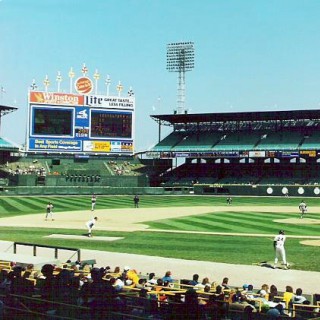
former baseball park
POPULARITY

9 episodes with Comiskey Park

6 episodes with Comiskey Park

5 episodes with Comiskey Park

5 episodes with Comiskey Park

5 episodes with Comiskey Park

3 episodes with Comiskey Park

2 episodes with Comiskey Park

3 episodes with Comiskey Park

4 episodes with Comiskey Park

Anybody remember the Chicago Cardinals or the Chicago Blitz? Or that football games were played at Comiskey Park? Those stories and more are part of the Elmhurst History Museum's "Bear Down: Football in the Windy City". The new exhibit features Chicago-area players, coaches and teams from neighborhoods, colleges and professional leagues. The exhibit---which is on display through January 24th---also has interactive touchscreen experiences for all ages. And of course, the exhibit includes "DAAH Bears!" More information is online at www.elmhursthistory.org

Anybody remember the Chicago Cardinals or the Chicago Blitz? Or that football games were played at Comiskey Park? Those stories and more are part of the Elmhurst History Museum's "Bear Down: Football in the Windy City". The new exhibit features Chicago-area players, coaches and teams from neighborhoods, colleges and professional leagues. The exhibit---which is on display through January 24th---also has interactive touchscreen experiences for all ages. And of course, the exhibit includes "DAAH Bears!" More information is online at www.elmhursthistory.org

Anybody remember the Chicago Cardinals or the Chicago Blitz? Or that football games were played at Comiskey Park? Those stories and more are part of the Elmhurst History Museum's "Bear Down: Football in the Windy City". The new exhibit features Chicago-area players, coaches and teams from neighborhoods, colleges and professional leagues. The exhibit---which is on display through January 24th---also has interactive touchscreen experiences for all ages. And of course, the exhibit includes "DAAH Bears!" More information is online at www.elmhursthistory.org

Anna Davlantes, WGN Radio's investigative correspondent, joins Bob Sirott to share what happened this week in Chicago history. Stories include Tom Skilling’s first total solar eclipse, the final ChicagoFest, The Beatles at Comiskey Park, and more.

Step into the bleachers of Comiskey Park, where the Boston Red Sox face off against the Chicago Cubs in the 1918 World Series. With America deep in the throes of World War I, baseball offers a brief escape from the harsh realities of war and loss. This pivotal game, featuring Babe Ruth as the Red Sox's starting pitcher, also marks the moment when the Star-Spangled Banner begins its journey to becoming an iconic part of American sports. Join Sportly host Kavitha Davidson as she explores the history of playing the national anthem at sporting events in the wake of World War II, the Civil Rights Movement, and 9/11. Davidson examines how these moments have sparked both unity and protest throughout U.S. history. Listen to how athletes have used their platforms to unite and challenge the status quo, shedding light on the complex relationship between national identity, patriotism, and sports ___ Hosts: Kavitha A. Davison | Producers: Saadia Khan & Shei Yu I Content Writers: Michaela Strauther & Kavitha A Davidson I Sound Designer & Editor: Paroma Chakravarty I Immigrantly Theme Music: Simon Hutchinson | Other Music: Epidemic Sound Sportly is an Immigrantly Media Production For advertising inquiries, you can contact us at info@immigrantlypod.com Learn more about your ad choices. Visit megaphone.fm/adchoices

Before he was a two-time World Series champion and four-time All-Star, Pepper Martin was jumping freight trains to spring training to save a dime. After he retired, he was choking out an umpire in Havana. In between: smoke bombs disguised as a fire emergency, a painting crew that wasn't hired to paint, a hospital room cowboy band concert nobody asked for, a stint running an Oklahoma City hockey team, and a batting line across two World Series that's still a Major League record today. Jeff traces the full career of Johnny Leonard Roosevelt "Pepper" Martin — the Wild Horse of the Osage — from a cotton farm in Temple, Oklahoma to a fistfight in Cuba, with stops at Comiskey Park, the Bellevue-Stratford Hotel (twice), and Branch Rickey's office. Also in this episode: Jeff and Mark remember Blue Jays closer Duane Ward, who passed away at 62 during a reunion for Toronto's back-to-back championship teams. A position player picks up a two-RBI single off a catcher making his first career pitching appearance. Mets utility man Jose Iglesias/Canelita heads to Broadway for the Buena Vista Social Club musical. And Wax Pack Heroes returns with a batch of 1972 Topps cards sent in by a listener. Topics: Pepper Martin, Wild Horse of the Osage, St. Louis Cardinals, Gas House Gang, 1931 World Series, 1934 World Series, Philadelphia Athletics, Connie Mack, Branch Rickey, Dizzy Dean, Leo Durocher, Frankie Frisch, Bellevue-Stratford Hotel, Mississippi Mudcats, Oklahoma City Warriors, Miami Sun Sox, Florida International League, Havana baseball history, Vallie Eaves, Duane Ward, Jose Iglesias, Buena Vista Social Club, 1972 Topps, Wax Pack Heroes 00:00 Cold Open Banter 01:31 Remembering Duane Ward 03:14 Pitcher Gets a Hit 05:41 Jose Iglesias Hits Broadway 08:32 Time Machine to Havana 11:17 Pepper Martin Revealed 12:28 From Oklahoma to the Cards 15:39 1931 Breakout World Series 16:46 Vaudeville and Sophomore Slump 21:07 Pranks and Gas House Gang 25:56 Barnstorming and Hospital Hijinks 27:50 Branch Rickey Lays Down Law 30:30 Final All Star and Mud Cats Band 32:23 Minor League Manager and 1944 Return 33:27 Pepper Martin Later Years 34:55 Freight Train To Spring 36:04 Clubhouse Legend Wrap 36:42 Wax Pack Heroes Begins 56:02 Scoreboard And Fan Poll 57:32 Outro And Socials Connect With Us: YouTube: www.youtube.com/@twostrikenoise Twitch: https://www.twitch.tv/twostrikenoise BlueSky: @twostrikenoise.bsky.social Email: twostrikenoise@gmail.com Support a Great Cause: Don't let your common cards collect dust! Donate them to help spark a child's interest in the game at http://commons4kids.org/. #baseballhistory #mlb #baseball #BaseballCards #TwoStrikeNoise #popculture

Send us Fan MailIf radio ever felt personal to you, this episode will bring back a lot of memories.This week on Here's What We Know, we sit down with Chicago radio legend Garry Meier, one half of the iconic Steve and Garry afternoon show that defined a generation of radio listeners. Garry opens up about how Larry Lujack's sarcasm on WLS first pulled him toward broadcasting, what it was actually like to work alongside his childhood radio hero, and the story that sparked his on-air partnership with Steve Dahl.The conversation moves into the night that made Garry Meier a piece of American pop culture history: Disco Demolition Night at Comiskey Park, where a stunt built around smashing records grew into a forfeited baseball game and international news coverage. Garry pushes back on how the event has been reframed over the decades and explains what he actually witnessed that summer night in 1979.From there, the two Garys talk about the business side of broadcasting: why big radio companies loaded themselves with debt buying up stations, why hiring managers now care more about a resume than a demo tape, and why podcasting has become the format radio should have evolved into decades ago.If you remember what radio felt like before it became all business and no personality, you're going to enjoy this one. Listen now!In This Episode:How Larry Lujack's WLS show inspired an entire generation of radio hostsThe real story behind meeting a childhood hero and finding out they're humanHow the Steve and Garry partnership started with an offhand comment about gas pricesThe night of Disco Demolition Night and what actually happened at Comiskey ParkWhy the disco backlash has been mischaracterized in the years sinceWhat went wrong with corporate radio consolidation after FCC ownership rules changedWhy podcasting outperforms traditional radio for long-form conversationBehind-the-scenes stories with Sam Kinison, Albert Brooks, Garry Marshall, and Paul McCartneyGarry Meier's induction into the Radio Hall of FameThis episode is sponsored by:Dignity MemorialReed Animal Hospital Bio:Garry Meier is a Radio Hall of Fame inductee and one of Chicago's most celebrated radio personalities. His legendary career includes groundbreaking partnerships with Steve Dahl, multiple No. 1 radio shows, five A.I.R. Awards for Best Afternoon Talk Show, and recognition by Talkers Magazine as one of America's most influential talk show hosts. Today, Garry brings the same sharp wit, curiosity, and engaging storytelling to The Garry Meier Show, where he continues to entertain audiences with thoughtful conversations, humor, and commentary on life and current events.Website: https://garrymeier.com/LinkedIn: https://www.linkedin.com/in/garry-meier-571478187/Facebook: https://www.facebook.com/TheGarryMeierShow/YouTube: https://www.youtube.com/c/garrforceliveConnect with Gary:Gary's WebsiteFollow Gary on InstagramGary's TiktokGary's FacebookWatch the episodes on YouTubeAdvertise on the PodcastThank you for listening. Let us know what you think about this episode. Leave us a review!

A Phoenix musician snapped two clear photos of a flying saucer in 1947 — then government agents with hidden names showed up, took his negatives, and made the evidence vanish into federal archives forever.EPISODE BLOG PAGE (includes sources): https://weirddarkness.com/RhodesMIBREAD or DOWNLOAD the full transcript of this episode: https://weirddarkness.tiny.us/2p8z656hFEATURED STORIES IN THIS EPISODE: Natalie Bollinger seemed to have her whole life ahead of her, but beneath the surface was a dark and tragic story that would end in obsession, danger, and a horrifying Craigslist ad that no one saw coming. (Natalie Bollinger – Stalked, Betrayed, and Forgotten) *** Oregon's scenic beauty hides a darker side, where ghostly encounters and eerie legends bring the state's haunted history to life. We'll look at five of the most haunted places in The Union State. (Five Haunted Locations in Oregon) *** Andrew Keegan went from '90s heartthrob to the charismatic leader of a crystal-charged spiritual group, where eerie rituals and strange coincidences blur the line between community and cult. (Teen Heartthrob to Cult Leader) *** The Dakota is more than just a historic NYC landmark—its dark history of ghostly encounters, untimely celebrity deaths, and eerie connections will leave you with chills. (Famous Phantoms of the Dark Dakota Building) *** A wild night in 1979 – Chicago's Comiskey Park turned into a chaotic battlefield as tens of thousands of disco-hating fans lit records on fire, sparked a riot, and may have sealed the fate of an entire music genre. It's the night “Disco Inferno” turned literal. (The Night Disco Burned) *** When a man in 1947 captured stunning photos of a UFO over Phoenix, he unknowingly invited the shadowy Men in Black into his life, sparking one of the earliest and most chilling accounts of government secrecy and dark intimidation. (First Documented Encounter With The Men In Black) *** The U.S. has a seven-step plan for meeting aliens, and it's a mix of science fiction, strategy, and some downright unsettling steps you won't believe. (First Contact or Planetary Catastrophe?)CHAPTERS & TIME STAMPS (All Times Approximate)…00:00:00.000 = The Foreboding00:01:56.144 = Show Open00:04:35.317 = The First Documented Encounter With The Men In Black00:18:57.349 = First Contact, Or Planetary Catastrophe ***00:26:17.432 = Natalie Bollinger – Stalked, Betrayed, and Forgotten00:35:41.483 = Five Haunted Locations in Oregon ***00:48:27.369 = The Night Disco Burned00:55:11.587 = Teen Heartthrob to Cult Leader01:03:27.692 = Famous Phantoms of the Dark Dakota Building ***01:07:45.841 = Facing Fear For Fun01:10:30.883 = Show Close*** = Begins immediately after inserted ad breakLISTEN ON PODCAST APPS: Look for this podcast on Apple Podcasts, Spotify, iHeart Radio, Amazon Music, Pandora, TuneIn Radio, and other podcast apps. Get a list of free listening apps here: https://weirddarkness.com/wdapps*No AI Voices Are Used In The Narration Of This Podcast*SOURCES and RESOURCES:“The First Documented Encounter With The Men In Black”: https://en.wikipedia.org/wiki/Rhodes_UFO_photographs,https://www.smithsonianmag.com/air-space-magazine/the-original-men-in-black-3849054,https://www.history.com/news/men-in-black-real-origins, https://mysteriousuniverse.org/2024/08/Are-Men-in-Black-Real-At-Least-One-Was/“Natalie Bollinger – Stalked, Betrayed, and Forgotten”: https://cattstruecrimecorner.com/the-case-of-natalie-bollinger/,https://genwhypod.com/blogs/the-generation-why-podcast-blog/the-murder-of-natalie-bollinger,https://lauthmissingpersons.com/murder-natalie-bollinger/, https://klakstrom.medium.com/the-strange-murder-of-natalie-bollinger-16110ddaefb7, https://www.truecasefiles.com/2019/12/the-murder-of-natalie-bollinger.html,https://bekah302.medium.com/of-stalking-craigslist-and-social-media-the-case-of-natalie-bollinger-6846c98a8cc5“Five Haunted Locations In Oregon”: https://the-line-up.com/haunted-places-in-oregon (used verbatim with permission)“Facing Fear For Fun”: https://www.southernfriedtruecrime.com/annalisa-netherly,https://en.wikipedia.org/wiki/The_Read_House_Hotel, https://www.clthomas.org/post/the-read-house-hauntings-and-legends, https://www.psychologytoday.com/us/blog/thoughts-thinking/201810/5-reasons-we-enjoy-being-scared,https://health.clevelandclinic.org/why-do-we-like-to-get-scared, https://www.healthline.com/health-news/why-we-like-to-be-scared, https://www.nationalgeographic.com/science/article/why-fear-feels-good“Teen Heartthrob To Cult Leader”: https://people.com/andrew-keegan-looks-back-insane-spirituality-venture-cost-tens-of-thousands-sparked-cult-rumors-8576493, https://ew.com/andrew-keegan-responds-rumors-he-started-cult-8576464,https://en.wikipedia.org/wiki/Andrew_Keegan, https://www.ranker.com/list/andrew-keegan-cult-facts/carly-silver“Famous Phantoms of the Dark Dakota Building”: https://en.wikipedia.org/wiki/Murder_of_John_Lennon,https://jessicajewettonline.com/ghosts-of-the-dakota-building, https://the-line-up.com/the-dakota-building,https://en.wikipedia.org/wiki/The_Dakota, https://www.ranker.com/list/dakota-building-curse/april-a-taylor,“First Contact or Planetary Catastrophe”: https://www.nsa.gov/portals/75/documents/news-features/declassified-documents/cryptologic-spectrum/communications_with_extraterrestrial.pdf, https://www.livescience.com/19360-humans-discover-aliens.html, https://listverse.com/2017/03/12/10-laws-rules-and-regulations-for-extraterrestrial-contact/, https://www.livescience.com/alien-contact-protocol.html, https://en.wikipedia.org/wiki/Post-detection_policy,https://www.ranker.com/list/facts-about-the-seven-steps-to-contact/laura-allan“The Night Disco Burned”: https://www.britannica.com/event/Disco-Demolition-Night,https://en.wikipedia.org/wiki/Disco_Demolition_Night, https://edm.com/features/remembering-disco-demolition-night-1979, https://www.ranker.com/list/facts-about-disco-demolition-night/melissa-sartore; Audio Clips: https://www.youtube.com/watch?v=fAJfOcnYYEQ; https://www.youtube.com/watch?v=NWCRu-yVEFU(Over time links may become invalid, disappear, or have different content. I always make sure to give authors credit for the material I use whenever possible. If I somehow overlooked doing so for a story, or if a credit is incorrect, please let me know and I will rectify it in these show notes immediately. Some links included

Guest Richard Vicek returns to Regional Rasslin' to discuss more Chicago Wrestling history with host Ray Russell. This week, we dive into two very important years in the growth of the CWC as we look at 1969 and 1970. Topics include the giant Comiskey Park event in the summer of 1970, the Chain Gang arrive and wreak havoc vs. Crusher & Bruiser, the real-life Hells Angels biker gang shooting Frank Dillinger and forcing his leg to be amputated, Chris Colt replacing Frank in the Chain Gang, Bobby Heenan's cleverness in his battles with Dick the Bruiser, Mad Dog & Butcher Vachon taking over the tag team scene, the unmasking of Dr. X (Dick Beyer), the arrival of Jim Valen (Jimmy Valiant) and Bob Windham (Blackjack Mulligan), promoter Fred Kohler passes away, Baron Von Raschke's big push towards AWA Champ Verne Gagne, Da Crusher's random absences, Angelo Poffo's shoot job, and so much more!If you're enjoying WrestleCopia and interested in helping us continue to grow, please consider Subscribing to our Patreon to help us cover some of our costs! https://www.patreon.com/wrestlecopiaYOU CAN ALSO GIFT SOMEONE A PATREON MEMBERSHIP (OR ASK THEM TO GIFT YOU ONE) AT https://www.patreon.com/WrestleCopia/giftIncludes the $5 “All Access” Tier $9 "VIP Superfan" Tier, and "The ULLLTIMATE Tier", featuring our various VIDEO-CAST Series, Early Show Releases, our insanely detailed show notes (for the Grenade, Monday Warfare, Regional Rasslin, Puro Academy, & Retro Re-View), monthly DIGITAL DOWNLOADS for your viewing and reading pleasure, & more!HELP SUPPORT THE SELF-FUNDED WRESTLECOPIA BRAND, CONSIDER DONATING TO OUR PAYPALWRESTLECOPIA MERCHANDISE - https://www.teepublic.com/user/wrestlecopiaVisit the WrestleCopia Podcast Network https://wrestlecopia.comFollow WrestleCopia on “X” (Formerly Twitter) @RasslinGrenadeFollow & LIKE our FACEBOOK PAGE – https://www.facebook.com/RasslinGrenadeSubscribe to the WrestleCopia Youtube Channel at https://www.youtube.com/RasslinGrenade ★ Support this podcast on Patreon ★
Chuck Garfien talks with legendary broadcaster Bob Costas to revisit iconic White Sox history, including the 1983 "Winning Ugly" team and the All-Star Game that lit up Comiskey Park that same summer. Bob also reflects on broadcasting giants Vin Scully and Harry Caray and shares his favorite memory from Later with Bob Costas: a sit-down with Paul McCartney that he calls the highlight of his career. Chuck gets Bob's thoughts on calling Bulls games at Chicago Stadium, the dynasty years with Michael Jordan, and the moment he realized he had just called a historic shot against the Utah Jazz. Plus, Bob weighs in on Ozzie Guillen, the upcoming 80s-themed game where he'll join Steve Stone in the booth, and whether this current White Sox team has a path to October.

Chosen by Justin, Only the Lonely arrived in 1991 as a gentler, more bittersweet John Candy vehicle than the broad comedy many audiences might have expected. Written and directed by Chris Columbus and produced by John Hughes and Hunt Lowry, the film brought together Candy, Maureen O'Hara, Ally Sheedy, Anthony Quinn, James Belushi and Kevin Dunn for a Chicago-set romantic comedy-drama with a softer heart than its VHS-era packaging probably suggested. A widely reported production budget is not readily available, but the film earned around $21.8 million domestically after opening wide through 20th Century Fox in May 1991.The production leaned heavily into real Chicago texture, with principal photography beginning on 1 October 1990 and running until 22 December 1990. Locations included North Avenue Beach, the Pump Room, St. John Cantius Church, Greektown and Comiskey Park, with additional interiors built at Chicago Metropolitan Studios. Reception was mixed-to-positive in the period, with particular praise for the performances, and the film has since picked up a modest legacy as one of John Candy's more tender, underrated leading roles: less “falling through furniture,” more “quietly breaking your heart while still making you laugh.”Trailer Guy SynopsisIn a city of crowded bars, roaring trains and overbearing family dinners, one Chicago cop is about to face the most terrifying case of his career: falling in love.Danny Muldoon is loyal, dependable, kind-hearted… and still very much under the command of his mother. But when he meets Theresa, a shy funeral home worker with a quiet charm, Danny sees the possibility of a life beyond guilt, duty and being emotionally handcuffed to the family sofa.Fun FactsOnly the Lonely was Maureen O'Hara's first feature film appearance in roughly two decades, bringing a classic Hollywood presence into a very early-90s comedy-drama.Chris Columbus reportedly wrote the role of Rose with Maureen O'Hara in mind, which is ambitious casting energy of the highest order.The film's title comes from Roy Orbison's famous song “Only the Lonely,” giving the movie an instant dose of old-school melancholy before anyone even says a word.John Candy plays a romantic lead here, which makes the film stand apart from many of his broader comic roles of the 1980s and early 1990s.The cast includes both Macaulay Culkin and Kieran Culkin in small roles, because apparently the early 90s had a legal requirement that at least one Culkin appear somewhere near a John Hughes production.Maurice Jarre, the Oscar-winning composer behind classics such as Lawrence of Arabia and Doctor Zhivago, provided the score.The film was shot in the same general Chicago orbit as several John Hughes-associated productions, helping give it that familiar neighbourhood feel rather than a glossy studio rom-com sheen.Anthony Quinn appears as Nick, the persistent neighbour with eyes for Rose, adding some old-school screen charisma to the film's family chaos.The story has often been compared to Marty, the 1955 romantic drama about a lonely bachelor trying to find love while dealing with family pressure.Support the ShowIf you enjoy the show and would like to support us, we have a Patreon here.If you're listening on Apple Podcasts or Spotify, leaving us a 5-star review (and a short comment) really helps more people discover the show. It's quick, free, and makes a huge difference.Referral links also help out the show if you were going to sign up:NordVPNNordPassthevhsstrikesback@gmail.comhttps://linktr.ee/vhsstrikesback

A stadium packed with thousands… and a bomb waiting at center field.They came to destroy disco but what erupted that night exposed something far deeper.On July 12, 1979, what started as a cheap baseball promotion at Chicago's Comiskey Park spiraled into chaos now known as Disco Demolition Night. Fans were promised discounted tickets if they brought disco records—records that would be blown up between games. But when the explosion hit, the crowd surged, the field was overtaken, and the night descended into a full-scale riot that forced a forfeited game. Beneath the surface, this wasn't just about music, it was a backlash against a culture rooted in Black, Latino, and LGBTQ+ communities, making it one of the most controversial moments in queer history. In this LGBTQ+ true crime podcast episode, we unpack the night disco “died”… and what was really being targeted.Hosted by Jordi and Brad, Beers With Queers dives into chilling true crime with a queer perspective, exposing the stories history tried to bury.Press play, grab a drink, and join us as we unravel the chaos, culture, and consequences behind one explosive night. Hosted on Acast. See acast.com/privacy for more information.
Donna Summer was a hit-maker for two decades and a dance floor deity for more than three. Her collaborations with Giorgio Moroder and Pete Bellotte were formative in dance, electronic, and rock music, influencing everyone from David Bowie and Blondie to Madonna and Moby. But the rock establishment was stinting in its appreciation—whether at Comiskey Park in Chicago in 1979 or the Rock and Roll Hall of Fame in the 2000s. In Part 2 of this encore episode from 2017, Chris Molanphy examines how Summer became the queen of disco … and then transcended that role altogether.Get more Hit Parade with Slate Plus! Join for monthly early-access episodes, bonus episodes of "The Bridge," and ad-free listening across all your favorite Slate podcasts. Subscribe directly from the Hit Parade show page on Apple Podcasts or Spotify. Or, visit slate.com/hitparadeplus to get access wherever you listen. Hosted on Acast. See acast.com/privacy for more information.

Donna Summer was a hit-maker for two decades and a dance floor deity for more than three. Her collaborations with Giorgio Moroder and Pete Bellotte were formative in dance, electronic, and rock music, influencing everyone from David Bowie and Blondie to Madonna and Moby. But the rock establishment was stinting in its appreciation—whether at Comiskey Park in Chicago in 1979 or the Rock and Roll Hall of Fame in the 2000s. In Part 2 of this encore episode from 2017, Chris Molanphy examines how Summer became the queen of disco … and then transcended that role altogether.Get more Hit Parade with Slate Plus! Join for monthly early-access episodes, bonus episodes of "The Bridge," and ad-free listening across all your favorite Slate podcasts. Subscribe directly from the Hit Parade show page on Apple Podcasts or Spotify. Or, visit slate.com/hitparadeplus to get access wherever you listen. Hosted on Acast. See acast.com/privacy for more information.

Donna Summer was a hit-maker for two decades and a dance floor deity for more than three. Her collaborations with Giorgio Moroder and Pete Bellotte were formative in dance, electronic, and rock music, influencing everyone from David Bowie and Blondie to Madonna and Moby. But the rock establishment was stinting in its appreciation—whether at Comiskey Park in Chicago in 1979 or the Rock and Roll Hall of Fame in the 2000s. In Part 2 of this encore episode from 2017, Chris Molanphy examines how Summer became the queen of disco … and then transcended that role altogether.Get more Hit Parade with Slate Plus! Join for monthly early-access episodes, bonus episodes of "The Bridge," and ad-free listening across all your favorite Slate podcasts. Subscribe directly from the Hit Parade show page on Apple Podcasts or Spotify. Or, visit slate.com/hitparadeplus to get access wherever you listen. Hosted on Acast. See acast.com/privacy for more information.
Donna Summer was a hit-maker for two decades and a dance floor deity for more than three. Her collaborations with Giorgio Moroder and Pete Bellotte were formative in dance, electronic, and rock music, influencing everyone from David Bowie and Blondie to Madonna and Moby. But the rock establishment was stinting in its appreciation—whether at Comiskey Park in Chicago in 1979 or the Rock and Roll Hall of Fame in the 2000s. In this encore episode from 2017, Chris Molanphy examines how Summer became the queen of disco … and then transcended that role altogether.Get more Hit Parade with Slate Plus! Join for monthly early-access episodes, bonus episodes of "The Bridge," and ad-free listening across all your favorite Slate podcasts. Subscribe directly from the Hit Parade show page on Apple Podcasts or Spotify. Or, visit slate.com/hitparadeplus to get access wherever you listen. Hosted on Acast. See acast.com/privacy for more information.
Donna Summer was a hit-maker for two decades and a dance floor deity for more than three. Her collaborations with Giorgio Moroder and Pete Bellotte were formative in dance, electronic, and rock music, influencing everyone from David Bowie and Blondie to Madonna and Moby. But the rock establishment was stinting in its appreciation—whether at Comiskey Park in Chicago in 1979 or the Rock and Roll Hall of Fame in the 2000s. In this encore episode from 2017, Chris Molanphy examines how Summer became the queen of disco … and then transcended that role altogether.Get more Hit Parade with Slate Plus! Join for monthly early-access episodes, bonus episodes of "The Bridge," and ad-free listening across all your favorite Slate podcasts. Subscribe directly from the Hit Parade show page on Apple Podcasts or Spotify. Or, visit slate.com/hitparadeplus to get access wherever you listen. Hosted on Acast. See acast.com/privacy for more information.
Donna Summer was a hit-maker for two decades and a dance floor deity for more than three. Her collaborations with Giorgio Moroder and Pete Bellotte were formative in dance, electronic, and rock music, influencing everyone from David Bowie and Blondie to Madonna and Moby. But the rock establishment was stinting in its appreciation—whether at Comiskey Park in Chicago in 1979 or the Rock and Roll Hall of Fame in the 2000s. In this encore episode from 2017, Chris Molanphy examines how Summer became the queen of disco … and then transcended that role altogether.Get more Hit Parade with Slate Plus! Join for monthly early-access episodes, bonus episodes of "The Bridge," and ad-free listening across all your favorite Slate podcasts. Subscribe directly from the Hit Parade show page on Apple Podcasts or Spotify. Or, visit slate.com/hitparadeplus to get access wherever you listen. Hosted on Acast. See acast.com/privacy for more information.

The March 15, 1976 issue of Sports Illustrated featured the ever-colorful and once again owner of the White Sox, Bill Veeck on the cover. One of baseball's most imaginative and controversial owners, Veeck's reputation for showmanship and fan-friendly ideas had already made him a legend in the game. Best known for stunts like sending Eddie Gaedel—the 3-foot-7 pinch hitter—to the plate in 1951 and for promoting fireworks, giveaways, and constant ballpark entertainment, Veeck believed baseball should always put the fans first. By 1976, as the sport wrestled with labor disputes and the emerging era of free agency, Veeck remained one of the few owners openly sympathetic to players while still championing the idea that baseball should be fun, unpredictable, and accessible. The article captured Veeck as a stubborn independent spirit—cigar in hand, wooden leg propped up—still convinced that the game needed more characters and fewer boardroom executives. Luckily for White Sox fans, Veeck was both. Nancy Faust became a beloved part of the game-day experience for the Chicago White Sox when she began playing organ at Comiskey Park in 1970. At a time when many ballparks treated organ music as quiet background noise, Faust turned it into a form of live entertainment, cleverly reacting to what was happening on the field with playful riffs, pop songs, and musical jokes that fans quickly learned to anticipate. Her quick timing and sense of humor helped energize crowds during some lean years for the White Sox, and she became one of the first ballpark organists to truly interact with the game and the fans. Over more than four decades with the team, Faust's music became as much a part of the White Sox identity as the crack of the bat, making her one of the most recognizable and influential organists in baseball history. After 41 seasons with the Sox, the Most Valuable Organist in baseball history called it a career but on the Past Our Prime podcast, Nancy tells us what it was like to work for the carnival show that was Bill Veeck. She talks about how she helped Harry Caray turn the 7th inning stretch into a nightly event and how taking the opposing pitcher out became an anthem( Na, na, na, on the South Side starting in 1977 and continuing to this day. And she recalls how she started a trend in baseball by combining Jesus Christ Superstar and future Hall of Fame slugger Dick Allen: the invention of the walk-up song. She's a true original spirit who played for the White Sox longer than any player in team history. The uber talented MVO, Nancy Faust on the Past Our Prime podcast. Learn more about your ad choices. Visit megaphone.fm/adchoices

A baseball promotion, a radio stunt, and a cultural war collide at Comiskey Park in 1979. What started as “Disco Sucks Night” turns into one of the most infamous riots in sports history. Records explode, fans storm the field, and a doubleheader dies in chaos. Titus and Mick unpack the night the disco went up in smoke and baseball lost control. If you’d like more Sports Bizarre, become a member of Bizarre Plus. Click here to join today As a member, you’ll get: A weekly bonus podcast Access to all past episodes Exclusive behind-the-scenes access Access to the members-only chatroom Ability to vote on future episodes Early access to any live show tickets See omnystudio.com/listener for privacy information.

Say She She’s album, Cut & Rewind is one of the most played albums on KEXP in 2025. Emily Fox speaks with the trio about how they met sharing a wall in a New York apartment building, their reflections on women’s rights in their song She Who Dares and about the racist history of Chicago’s 1979 Disco Demolition Night that shows up in their song, Disco Life. “Let's take what happened at Comiskey Park where people were really just finding an excuse to burn black records, black musicians' records. Got nothing to do with disco, nothing to with genre,” Piya Malik says.Support the show: https://www.kexp.org/sound/See omnystudio.com/listener for privacy information.

On July 12, 1979, Chicago's Comiskey Park erupted into chaos during what was supposed to be a quirky baseball promotion. Shock radio jock Steve Dahl's “Disco Demolition Night” incentivized listeners to bring disco records to a White Socks doubleheader, where, between games Dahl promised to blow them up in center field. Instead, the event descended into a riot, forcing the team to forfeit. On the surface, the incendiary event looked like a wild publicity stunt gone wrong — but in hindsight, it was tantamount to a book burning. In retrospect, the destruction of thousands of disco records was a symbolic rejection of the social meanings the sounds held, particularly for queer communities of color. The night marked not just the literal destruction of vinyl but a cultural turning point when disco's dazzling reign collapsed under backlash. Or did it? In this episode, we explore how a stadium stunt revealed the deeper racial, sexual, and generational tensions shaping American music at the dawn of the 1980s. In episode seven, host Ryan Purcell and Kristie Soares talk with Gillian Frank is a historian of gender, sexuality, religion, and politics in the twentieth-century United States at Trinity College, Dublin. He is a managing editor of NOTCHES: (re)marks on the history of sexuality and co-host of the podcast Sexing History, which explores how the past shapes contemporary debates about sex. Frank's scholarship has appeared in leading academic journals and edited volumes, and he has held research fellowships at Princeton and other institutions. His current book project examines the history of child adoption and foster care in the U.S., tracing how religion, race, and politics shaped family formation in modern America. Learn more about your ad choices. Visit megaphone.fm/adchoices Support our show by becoming a premium member! https://newbooksnetwork.supportingcast.fm/gender-studies

On July 12, 1979, Chicago's Comiskey Park erupted into chaos during what was supposed to be a quirky baseball promotion. Shock radio jock Steve Dahl's “Disco Demolition Night” incentivized listeners to bring disco records to a White Socks doubleheader, where, between games Dahl promised to blow them up in center field. Instead, the event descended into a riot, forcing the team to forfeit. On the surface, the incendiary event looked like a wild publicity stunt gone wrong — but in hindsight, it was tantamount to a book burning. In retrospect, the destruction of thousands of disco records was a symbolic rejection of the social meanings the sounds held, particularly for queer communities of color. The night marked not just the literal destruction of vinyl but a cultural turning point when disco's dazzling reign collapsed under backlash. Or did it? In this episode, we explore how a stadium stunt revealed the deeper racial, sexual, and generational tensions shaping American music at the dawn of the 1980s. In episode seven, host Ryan Purcell and Kristie Soares talk with Gillian Frank is a historian of gender, sexuality, religion, and politics in the twentieth-century United States at Trinity College, Dublin. He is a managing editor of NOTCHES: (re)marks on the history of sexuality and co-host of the podcast Sexing History, which explores how the past shapes contemporary debates about sex. Frank's scholarship has appeared in leading academic journals and edited volumes, and he has held research fellowships at Princeton and other institutions. His current book project examines the history of child adoption and foster care in the U.S., tracing how religion, race, and politics shaped family formation in modern America. Learn more about your ad choices. Visit megaphone.fm/adchoices Support our show by becoming a premium member! https://newbooksnetwork.supportingcast.fm/american-studies

On July 12, 1979, Chicago's Comiskey Park erupted into chaos during what was supposed to be a quirky baseball promotion. Shock radio jock Steve Dahl's “Disco Demolition Night” incentivized listeners to bring disco records to a White Socks doubleheader, where, between games Dahl promised to blow them up in center field. Instead, the event descended into a riot, forcing the team to forfeit. On the surface, the incendiary event looked like a wild publicity stunt gone wrong — but in hindsight, it was tantamount to a book burning. In retrospect, the destruction of thousands of disco records was a symbolic rejection of the social meanings the sounds held, particularly for queer communities of color. The night marked not just the literal destruction of vinyl but a cultural turning point when disco's dazzling reign collapsed under backlash. Or did it? In this episode, we explore how a stadium stunt revealed the deeper racial, sexual, and generational tensions shaping American music at the dawn of the 1980s. In episode seven, host Ryan Purcell and Kristie Soares talk with Gillian Frank is a historian of gender, sexuality, religion, and politics in the twentieth-century United States at Trinity College, Dublin. He is a managing editor of NOTCHES: (re)marks on the history of sexuality and co-host of the podcast Sexing History, which explores how the past shapes contemporary debates about sex. Frank's scholarship has appeared in leading academic journals and edited volumes, and he has held research fellowships at Princeton and other institutions. His current book project examines the history of child adoption and foster care in the U.S., tracing how religion, race, and politics shaped family formation in modern America. Learn more about your ad choices. Visit megaphone.fm/adchoices Support our show by becoming a premium member! https://newbooksnetwork.supportingcast.fm/music

On July 12, 1979, Chicago's Comiskey Park erupted into chaos during what was supposed to be a quirky baseball promotion. Shock radio jock Steve Dahl's “Disco Demolition Night” incentivized listeners to bring disco records to a White Socks doubleheader, where, between games Dahl promised to blow them up in center field. Instead, the event descended into a riot, forcing the team to forfeit. On the surface, the incendiary event looked like a wild publicity stunt gone wrong — but in hindsight, it was tantamount to a book burning. In retrospect, the destruction of thousands of disco records was a symbolic rejection of the social meanings the sounds held, particularly for queer communities of color. The night marked not just the literal destruction of vinyl but a cultural turning point when disco's dazzling reign collapsed under backlash. Or did it? In this episode, we explore how a stadium stunt revealed the deeper racial, sexual, and generational tensions shaping American music at the dawn of the 1980s. In episode seven, host Ryan Purcell and Kristie Soares talk with Gillian Frank is a historian of gender, sexuality, religion, and politics in the twentieth-century United States at Trinity College, Dublin. He is a managing editor of NOTCHES: (re)marks on the history of sexuality and co-host of the podcast Sexing History, which explores how the past shapes contemporary debates about sex. Frank's scholarship has appeared in leading academic journals and edited volumes, and he has held research fellowships at Princeton and other institutions. His current book project examines the history of child adoption and foster care in the U.S., tracing how religion, race, and politics shaped family formation in modern America. Learn more about your ad choices. Visit megaphone.fm/adchoices Support our show by becoming a premium member! https://newbooksnetwork.supportingcast.fm/lgbtq-studies

On July 12, 1979, Chicago's Comiskey Park erupted into chaos during what was supposed to be a quirky baseball promotion. Shock radio jock Steve Dahl's “Disco Demolition Night” incentivized listeners to bring disco records to a White Socks doubleheader, where, between games Dahl promised to blow them up in center field. Instead, the event descended into a riot, forcing the team to forfeit. On the surface, the incendiary event looked like a wild publicity stunt gone wrong — but in hindsight, it was tantamount to a book burning. In retrospect, the destruction of thousands of disco records was a symbolic rejection of the social meanings the sounds held, particularly for queer communities of color. The night marked not just the literal destruction of vinyl but a cultural turning point when disco's dazzling reign collapsed under backlash. Or did it? In this episode, we explore how a stadium stunt revealed the deeper racial, sexual, and generational tensions shaping American music at the dawn of the 1980s. In episode seven, host Ryan Purcell and Kristie Soares talk with Gillian Frank is a historian of gender, sexuality, religion, and politics in the twentieth-century United States at Trinity College, Dublin. He is a managing editor of NOTCHES: (re)marks on the history of sexuality and co-host of the podcast Sexing History, which explores how the past shapes contemporary debates about sex. Frank's scholarship has appeared in leading academic journals and edited volumes, and he has held research fellowships at Princeton and other institutions. His current book project examines the history of child adoption and foster care in the U.S., tracing how religion, race, and politics shaped family formation in modern America. Learn more about your ad choices. Visit megaphone.fm/adchoices Support our show by becoming a premium member! https://newbooksnetwork.supportingcast.fm/sound-studies

On July 12, 1979, Chicago's Comiskey Park erupted into chaos during what was supposed to be a quirky baseball promotion. Shock radio jock Steve Dahl's “Disco Demolition Night” incentivized listeners to bring disco records to a White Socks doubleheader, where, between games Dahl promised to blow them up in center field. Instead, the event descended into a riot, forcing the team to forfeit. On the surface, the incendiary event looked like a wild publicity stunt gone wrong — but in hindsight, it was tantamount to a book burning. In retrospect, the destruction of thousands of disco records was a symbolic rejection of the social meanings the sounds held, particularly for queer communities of color. The night marked not just the literal destruction of vinyl but a cultural turning point when disco's dazzling reign collapsed under backlash. Or did it? In this episode, we explore how a stadium stunt revealed the deeper racial, sexual, and generational tensions shaping American music at the dawn of the 1980s. In episode seven, host Ryan Purcell and Kristie Soares talk with Gillian Frank is a historian of gender, sexuality, religion, and politics in the twentieth-century United States at Trinity College, Dublin. He is a managing editor of NOTCHES: (re)marks on the history of sexuality and co-host of the podcast Sexing History, which explores how the past shapes contemporary debates about sex. Frank's scholarship has appeared in leading academic journals and edited volumes, and he has held research fellowships at Princeton and other institutions. His current book project examines the history of child adoption and foster care in the U.S., tracing how religion, race, and politics shaped family formation in modern America. Learn more about your ad choices. Visit megaphone.fm/adchoices Support our show by becoming a premium member! https://newbooksnetwork.supportingcast.fm/popular-culture

Brian Hoogeveen, ‘The Cash Man' from Americash Jewelry & Coin Buyers, joins Jon Hansen to discuss items that could be worth money. Listeners call in to ask about posters of The Beatles, stadium seats, and signed prints. If you think you have items you'd like to have appraised, visit TopCashBuyer.Com or call/text 630-969-9600.

Send us a textKelly Robinson shares his deep connection to baseball as a family tradition dating back to 1900 when the White Sox began, revealing how the sport has shaped his identity, relationships, and most meaningful life moments.• First baseball memory at age three at Comiskey Park seeing Harry Carey sing• White Sox family tradition spans multiple generations, unifying family members regardless of different beliefs• How Twitter and social media connected him with fellow minor league baseball fans during 2020• Experiencing the White Sox 2005 World Series victory after a personally difficult year• Getting married with a vintage 1953 baseball theme outside Guaranteed Rate Field• Baseball traditions including scoring every game since 2012 and walking the full concourse• The consistency of baseball's schedule providing comfort and structure unlike other sports• Finding happiness immediately upon entering any ballpark regardless of previous moodFollow Kelly on https://www.threads.com/@theminorleaguenerd and check out his Minor League Nerd YouTube channel and podcast to explore more baseball content.Support the showMake sure to follow the Dad Hat Chronicles: https://linktr.ee/TheDadHatChronicles

Bo Jackson - On July 15, 1951, the New York Yankees demote struggling rookie Mickey Mantle to their Kansas City farm team in the American Association. Mantle will return to the Yankees in August and finish his first major league season with 13 home runs and 65 RBIs.On July 15, 1967, St. Louis Cardinals ace Bob Gibson suffers a broken leg when he is struck by a line drive hit by another future Hall of Famer, Roberto Clemente. Incredibly, Gibson pitches to two more batters before leaving the game. Gibson was sidelined until Labor day. He would come back and would win 3 games in the World Series against the Red Sox.On July 15, 1973, Before 41,411 in Detroit, California Angels ace Nolan Ryan hurls his second no-hitter of the season in taming the Detroit Tigers, 6 - 0. Ryan fans 17 batters, the most ever in a 9-inning no-hitter, including eight straight, but only one over the last two innings. Nolan's arm stiffens while watching his team rally for five runs in the top of the 8th. With two outs in the 9th, Norm Cash, who had struck out his three other times at bat, comes to bat wielding a piano leg. Umpire Ron Luciano points out the illegality and Cash then pops out using a regulation bat. Ryan's eight strikeouts in a row ties the American League record he set last year. On July 15, 1990, Bo Jackson of the Kansas City Royals hits home runs in three consecutive at-bats before separating his shoulder trying to make a diving catch against Deion Sanders of the New York Yankees. Jackson's power surge helps the Royals to a 10-7 victory, but the two-sport star will miss the next six weeks.On July 15, 1994 - In the first inning at Comiskey Park, Chicago White Sox manager Gene Lamont accuses Cleveland Indians slugger Albert Belle of using a corked bat, and umpire Dave Phillips confiscates the bat and stores it in the umps' dressing room. In a Mission Impossible caper revealed in 1999, the Indians' Jason Grimsley crawls 100 feet along a ceiling, drops down into the dressing room, and exchanges Belle's bat for one of Paul Sorrento's. After the 3 - 2 Indians win, the switch is discovered to the consternation of the umps and the White Sox. The Indians subsequently turn over one of Belle's bats and Belle is given a 10-day suspension, later reduced to seven games.Historical Recap performed by:Robyn Newton from - Robyn SaysTrivia is provided by -Horseshide TriviaThis Day In Baseball is Sponsored by - www.vintagebaseballreflections.com - Join the membership today and listen to 50 years of baseball history told to you by the folks who were there! As a special offer, all our listeners can use the term - thisdayinbaseball at the membership check out. Mentioned in this episode:Classic Baseball BroadcastsClassic Baseball Broadcasts
On July 12, 1996, longtime Minnesota Twins star and future Hall of Famer Kirby Puckett announces his retirement due to glaucoma in his right eye. Over a 12-year career, the popular Puckett batted .318 with 207 home runs and 1,085 RBIs. He also helped the Twins to World Championships in 1987 and 1991.On July 12, 1979, the Chicago White Sox stage "Disco Demolition Night" at Comiskey Park. After the Sox lose the first game to the Detroit Tigers, 4-1, thousands of fans run onto the field. After a delay of more than an hour, the umpires rule the field unplayable, causing the ChiSox to forfeit the second game.On July 12, 1949, Larry Doby of the Cleveland Indians and Jackie Robinson, Roy Campanella, and Don Newcombe of the Brooklyn Dodgers become the first African Americans to play in an All-Star Game. The four black stars appear in the historic game at Ebbets Field, where the American League defeats the National League, 11-7.On July 12, 1921, Babe Ruth of the New York Yankees hits his 137th career home run, moving past fellow Hall of Famer Roger Connor on the all-time list. Connor hit 136 home runs during his career-all during the 19th century.On July 12, 1901, future Hall of Famer Cy Young of the Boston Beaneaters records the 300th win of his career. Young defeats the Philadelphia Aís, 5-3. Young will win 211 more games, for a total of 511, the most in major league history.Mentioned in this episode:Classic Baseball BroadcastsClassic Baseball Broadcasts
Jeff Schwartz, the former manager of sales and promotion at WLUP, joins Bob Sirott as they remember the Disco Demolition night at Comiskey Park in 1979. He explains how the radio stunt was created, the way it’s remembered, and provides a rebuttal for those who have called it controversial.

Lauretta hosts the program and has her guest Father Tom McCarthy join her to chat about Our New Pope, Pope Leo the XIV. Father McCarthy is a personal friend of Pope Leo. Lauretta guides their chat to highlight things everyday people may want to know about the Pope. Father McCarthy emphasizes that Pope Leo is a great guy and sees that many want to know if he is one of us….Father McCarthy says, He is! He encourages us to “watch what he does” so we can get to know him better. Lauretta promotes the Chicago Celebration of Pope Leo that will take place on June 14th at Guaranteed Rate Field (better known as Comiskey Park). She also reminds us about Worldwide/Nationwide Pentecost Vigil on Saturday June 7th at St. Luke Church in River Forest, Illinois. St. Stanislaus Kostka Parish
Birthday boy - Willie Randolph Todays debut - Stan Papi July 6, 1933, the first major league All-Star Game is played at Comiskey Park. Babe Ruth hits a two-run home run to give the American League a 4-2 win over the National League. Connie Mack comes out of retirement to manage the NL. This was the only Managerial apperence for both Hall of Fame managers, Casey Stengel holds the record for managing 10 All star games for the American League. July 6, 1953Ford Frick inaugurates the Cy Young Award, to honor the outstanding pitcher each year. The BBWAA will do the voting. Only one pitcher will be honored each year until 1967, when a pitcher will be selected in each league. Don Newcombe will be the first winner of the award, he became the only player to win a Rookie of the year, Cy Young and MVP in a career. July 6 , 1978 Steve Carlton becomes the major leagues' left-handed strikeout king, fanning seven Cardinals in a 8 - 3 Phillies win to bring his career total to 2,836. Mickey Lolich had held the record with 2,832.July 6 1986 Bob Horner becomes the 11th player to hit four home runs in a game, but it isn't enough as the Braves fall to the Expos, 11 - 8. Horner is only the second to hit his four home runs in a losing cause; Ed Delahanty of the Phillies on was the first, on July 13, 1896. In the same Game On the winning side, Al Newman cracks his first major league homer, off Zane Smith; it'll be the only homer of his career, as Newman will go to the American League next year and set the junior circuit record by going to bat 1,893 times without a 4-bagger.Mentioned in this episode:Classic Baseball BroadcastsClassic Baseball Broadcasts
Lauretta hosts the program and is joined by her guest, Joyce Duriga, Editor of the Chicago Catholic, the official newspaper of the Archdiocese of Chicago. They discuss the Celebration of Pope Leo's ascent to the Chair of Peter that took place in Chicago at Rate Field (formerly Comiskey Park) on June 14, 2025. The event came together fairly quickly and was just a nice day bringing people of the faith together. The celebration was varied and was a special time for Chicago residents. For more on that days' happenings please check out at the Chicago Catholic, Issue 12, Volume 133 at www.chicagocatholic.com St. Stanislaus Kostka Parish

Mike and Bill are off this week at SABR and are getting this classic episode up late. In that spirit, please enjoy this encore presentation of Episode 298: With the White Sox threatening to leave the Windy City and abscond to Tampa if they didn't get a new stadium 37 years ago this week, and with the Illinois legislative session winding down to the end of its session and the funding bill a few votes short, he weirdest thing happened. Time, on (and only on) the floor of the state legislature, stopped for three whole minutes, giving the Governor and House Majority Leader time to rally the support necessary to pass the bill. In honor of this miracle, of sorts, Mike and Bill look back at the history of the original Comiskey Park, and the hijinks that ultimately led to its replacement. Plus, happy birthday to Alejandro Peña and Howie Pollett!
Lauretta hosts the program and has her guest Father Tom McCarthy join her to chat about Our New Pope, Pope Leo the XIV. Father McCarthy is a personal friend of Pope Leo. Lauretta guides their chat to highlight things everyday people may want to know about the Pope. Father McCarthy emphasizes that Pope Leo is a great guy and sees that many want to know if he is one of us….Father McCarthy says, He is! He encourages us to “watch what he does” so we can get to know him better. Lauretta promotes the Chicago Celebration of Pope Leo that will take place on June 14th at Guaranteed Rate Field (better known as Comiskey Park). She also reminds us about Worldwide/Nationwide Pentecost Vigil on Saturday June 7th at St. Luke Church in River Forest, Illinois. St. Stanislaus Kostka Parish

A secret table with an add-on for your bobblehead. New special tickets that don't include watching the game. The new fan trend in the neighborhood. We've got some stories that popped up recently in and around the field some of us still call Comiskey Park. What is happening at Rate Field? Plus, the success of two Rule-5 players begs a new question for the White Sox front office. Brought to you by Cork & Kerry At The Park. Chris Lanuti and Ed Siebert sit at his 9-foot homemade oak bar in a basement on the South Side of Chicago to discuss their favorite team - The Chicago White Sox in a podcast "For Fans, By Fans!" Listen. Subscribe. Share. Video version now available on YouTube! Call 708-459-8406 and leave your comments and questions for the next episode! SUBSCRIBE NOW on Apple Podcasts, Spotify, everywhere podcasts can be found and always at SoxInTheBasement.com!
In 1947, William Rhodes captured stunning photos of a UFO, only to have mysterious government agents seize his evidence in a case shrouded in secrecy.Darkness Syndicate members get the ad-free version. https://weirddarkness.com/syndicateInfo on the next LIVE SCREAM event. https://weirddarkness.com/LiveScreamInfo on the next WEIRDO WATCH PARTY event. https://weirddarkness.com/TVIN THIS EPISODE: Natalie Bollinger seemed to have her whole life ahead of her, but beneath the surface was a dark and tragic story that would end in obsession, danger, and a horrifying Craigslist ad that no one saw coming. (Natalie Bollinger – Stalked, Betrayed, and Forgotten) *** Oregon's scenic beauty hides a darker side, where ghostly encounters and eerie legends bring the state's haunted history to life. We'll look at five of the most haunted places in The Union State. (Five Haunted Locations in Oregon) *** Andrew Keegan went from '90s heartthrob to the charismatic leader of a crystal-charged spiritual group, where eerie rituals and strange coincidences blur the line between community and cult. (Teen Heartthrob to Cult Leader) *** The Dakota is more than just a historic NYC landmark—its dark history of ghostly encounters, untimely celebrity deaths, and eerie connections will leave you with chills. (Famous Phantoms of the Dark Dakota Building) *** A wild night in 1979 – Chicago's Comiskey Park turned into a chaotic battlefield as tens of thousands of disco-hating fans lit records on fire, sparked a riot, and may have sealed the fate of an entire music genre. It's the night “Disco Inferno” turned literal. (The Night Disco Burned) *** When a man in 1947 captured stunning photos of a UFO over Phoenix, he unknowingly invited the shadowy Men in Black into his life, sparking one of the earliest and most chilling accounts of government secrecy and dark intimidation. (First Documented Encounter With The Men In Black) *** The U.S. has a seven-step plan for meeting aliens, and it's a mix of science fiction, strategy, and some downright unsettling steps you won't believe. (First Contact or Planetary Catastrophe?)CHAPTERS & TIME STAMPS (All Times Approximate)…00:00:00.000 = Disclaimer and Lead-In00:02:14.046 = Show Open00:04:53.661 = The First Documented Encounter With The Men In Black00:18:32.928 = First Contact, Or Planetary Catastrophe00:25:57.197 = Natalie Bollinger – Stalked, Betrayed, and Forgotten00:35:27.614 = Five Haunted Locations in Oregon00:48:15.382 = The Night Disco Burned00:54:58.464 = Teen Heartthrob to Cult Leader01:03:02.182 = Famous Phantoms of the Dark Dakota Building01:07:20.408 = Facing Fear For Fun01:10:02.981 = Show CloseSOURCES AND RESOURCES FROM THE EPISODE…“The First Documented Encounter With The Men In Black”: https://en.wikipedia.org/wiki/Rhodes_UFO_photographs,https://www.smithsonianmag.com/air-space-magazine/the-original-men-in-black-3849054,https://www.history.com/news/men-in-black-real-origins, https://mysteriousuniverse.org/2024/08/Are-Men-in-Black-Real-At-Least-One-Was/“Natalie Bollinger – Stalked, Betrayed, and Forgotten”: https://cattstruecrimecorner.com/the-case-of-natalie-bollinger/,https://genwhypod.com/blogs/the-generation-why-podcast-blog/the-murder-of-natalie-bollinger,https://lauthmissingpersons.com/murder-natalie-bollinger/, https://klakstrom.medium.com/the-strange-murder-of-natalie-bollinger-16110ddaefb7, https://www.truecasefiles.com/2019/12/the-murder-of-natalie-bollinger.html,https://bekah302.medium.com/of-stalking-craigslist-and-social-media-the-case-of-natalie-bollinger-6846c98a8cc5“Five Haunted Locations In Oregon”: https://the-line-up.com/haunted-places-in-oregon (used verbatim with permission)“Facing Fear For Fun”: https://www.southernfriedtruecrime.com/annalisa-netherly,https://en.wikipedia.org/wiki/The_Read_House_Hotel, https://www.clthomas.org/post/the-read-house-hauntings-and-legends, https://www.psychologytoday.com/us/blog/thoughts-thinking/201810/5-reasons-we-enjoy-being-scared,https://health.clevelandclinic.org/why-do-we-like-to-get-scared, https://www.healthline.com/health-news/why-we-like-to-be-scared, https://www.nationalgeographic.com/science/article/why-fear-feels-good“Teen Heartthrob To Cult Leader”: https://people.com/andrew-keegan-looks-back-insane-spirituality-venture-cost-tens-of-thousands-sparked-cult-rumors-8576493, https://ew.com/andrew-keegan-responds-rumors-he-started-cult-8576464,https://en.wikipedia.org/wiki/Andrew_Keegan, https://www.ranker.com/list/andrew-keegan-cult-facts/carly-silver“Famous Phantoms of the Dark Dakota Building”: https://en.wikipedia.org/wiki/Murder_of_John_Lennon,https://jessicajewettonline.com/ghosts-of-the-dakota-building, https://the-line-up.com/the-dakota-building,https://en.wikipedia.org/wiki/The_Dakota, https://www.ranker.com/list/dakota-building-curse/april-a-taylor,“First Contact or Planetary Catastrophe”: https://www.nsa.gov/portals/75/documents/news-features/declassified-documents/cryptologic-spectrum/communications_with_extraterrestrial.pdf, https://www.livescience.com/19360-humans-discover-aliens.html, https://listverse.com/2017/03/12/10-laws-rules-and-regulations-for-extraterrestrial-contact/, https://www.livescience.com/alien-contact-protocol.html, https://en.wikipedia.org/wiki/Post-detection_policy,https://www.ranker.com/list/facts-about-the-seven-steps-to-contact/laura-allan“The Night Disco Burned”: https://www.britannica.com/event/Disco-Demolition-Night,https://en.wikipedia.org/wiki/Disco_Demolition_Night, https://edm.com/features/remembering-disco-demolition-night-1979, https://www.ranker.com/list/facts-about-disco-demolition-night/melissa-sartore; Audio Clips: https://www.youtube.com/watch?v=fAJfOcnYYEQ; https://www.youtube.com/watch?v=NWCRu-yVEFU=====(Over time links seen above may become invalid, disappear, or have different content. I always make sure to give authors credit for the material I use whenever possible. If I somehow overlooked doing so for a story, or if a credit is incorrect, please let me know and I will rectify it in these show notes immediately. Some links included above may benefit me financially through qualifying purchases.)= = = = ="I have come into the world as a light, so that no one who believes in me should stay in darkness." — John 12:46= = = = =WeirdDarkness® is a registered trademark. Copyright ©2025, Weird Darkness.
It's a new project on Regional Rasslin' featuring Special Guest Richard Vicek joining to begin our discussion of the Chicago Wrestling Club (1966 - 1983). Promoters Verne Gagne, Dick the Bruiser & Wilbur Snyder combined their talent from the AWA & WWA respectively to form amazing events in the "Windy City". We also talk promoter Fred Kohler, Bob Luce, Bobby Heenan, Bruiser, Da Crusher, major events in Comiskey Park & Soldier Field, plus Richard shares TEN super rare audio interviews recorded back in the 60s & 70s featuring the likes of Verne Gagne, Dr. X (Dick Beyer), a young Dusty Rhodes, Superstar Graham, Bobby Heenan, & more! (Guest Note: Richard Vicek is the author of the book "BRUISER: The World's Most Dangerous Wrestler")Please Subscribe to our Patreon to help pay the bills, https://www.patreon.com/wrestlecopiaIncludes the $5 “All Access” Tier & $9 "VIP Superfan" Tier featuring our VIDEO CASTS, Patreon Watch-Along Series, our insanely detailed show notes (for the Grenade, Monday Warfare, Regional Rasslin, Puro Academy, & Retro Re-View), Early Show Releases! PLUS, monthly DIGITAL DOWNLOADS for your viewing and reading pleasure!WRESTLECOPIA MERCHANDISE - https://www.teepublic.com/user/wrestlecopiaVisit the WrestleCopia Podcast Network https://wrestlecopia.comFollow WrestleCopia on “X” (Formerly Twitter) @RasslinGrenadeFollow & LIKE our FACEBOOK PAGE – https://www.facebook.com/RasslinGrenadeSubscribe to the WrestleCopia Youtube Channel at https://www.youtube.com/RasslinGrenade ★ Support this podcast on Patreon ★
With Super Bowl week upon us and the new administration in the White House, we're resharing this vital episode from the Sportly archive—because sports have always been about more than just the game. Step into the bleachers of Comiskey Park, 1918, where the Boston Red Sox face the Chicago Cubs in a historic World Series matchup. With Babe Ruth on the mound and World War I casting a long shadow, baseball becomes a much-needed escape. But this game isn't just about the score—it marks the first time "The Star-Spangled Banner" is played at a sporting event, setting the stage for a tradition that would shape American sports forever. Fast forward through history: World War II solidifies the anthem's presence in stadiums. The Civil Rights Movement sees athletes using their platforms to call for justice. Post-9/11, America witnesses both unity and controversy over national symbols in sports. Sportly host Kavitha Davidson dives into the powerful intersection of sports, patriotism, and protest, exploring how athletes have sparked critical conversations about identity and justice. ___ Hosts: Kavitha A. Davison | Producers: Saadia Khan & Shei Yu I Content Writers: Michaela Strauther & Kavitha A Davidson I Sound Designer & Editor: Paroma Chakravarty I Immigrantly Theme Music: Simon Hutchinson | Other Music: Epidemic Sound Sportly is an Immigrantly Media Production For advertising inquiries, you can contact us at info@immigrantlypod.com Learn more about your ad choices. Visit megaphone.fm/adchoices

In the long and storied history of baseball, there have been a collection of street corners that have become synonymous with the throwback cribs that have claimed domain there. At the corner of Michigan and Trumbull once stood the iconic Tigers Stadium. 21st and Lehigh was the home of Shibe Park, You had the corner of Findlay and Western, where the Reds played at Crosley Field, and on the south side of Chicago, at the corner of 35th and Shields, stood Comiskey Park. Today that tradititon still holds firm with Clark and Addison housing the Cubs at Wrigley. To the old school St. Louis baseball fan, the corner of Grand and Dodier can be added to that list. This week we will examine the rise and fall of the structure that stood there, and housed two St. Louis MLB teams from 1860 to 1963, Sportsman Park. A plot of land, on the north side of the city, where the game takes it's roots, and fans of the game witness amazing chapters in the baseball story. #SportsmanPark #StLouis #StLouisBrowns #StLouisCardinals #GrandAvenue #DodierStreet #CharlesComiskey #AugustSolari #AugustBusch #BrownStockings #ChrisVanDerAhe #Perfectos #StanMusial #SamBreadon #UrbanShocker

On this episode, Dan Wallach talks with Nancy Faust, who is a legendary organist, most famous for her 41-year career playing for the Chicago White Sox from 1970 through 2010 during which she invented walk-up music and popularized the singing of "Take Me Out To The Ballgame" during the 7th inning stretch. Follow MBH on facebook, twitter, and instagram @shoelesspodcast and sign up for the email newsletter at shoelesspodcast.substack.com Don't forget to rate, review, and listen on iTunes, Google, Spotify, Stitcher, or your favorite podcast app. Thanks to: Ryan Starinsky for the opening theme and his acoustic version of "Take Me Out To The Ballgame" Randy Moore for his baseball organ version of "Kingpin" by Get Married Gary Cieradkowski at www.studiogaryc.com for creating the artwork Nancy Faust My mom
It's a special edition of the show, as host T.J. Rives is away this week, but still covers some relevant sports media news, etc. for the "Last Word on Sports Media Podcast."He talks recently concluded Big 12 media days with the premier insider of college football information, Brett McMurphy of the ActionNetwork.com. They go over the storylines from Las Vegas for the Big 12, plus is conference re-alignment about to crank up, yet again, with Florida State suing to get out of the ACC? And, just how many phones and cell batteries does Brett keep handy to break his info all the time, no matter the day or the hour?Then, some tremendous reminiscing about MLB All Star Games past, with George Ofman of the "Tell me a story I don't know" sports media interview pod from this feed. George talks famous World Series moments from the '83 ROMP in Chicago at old Comiskey Park by the American League, featuring the Fred Lynn grand slam. And, George also talks nostalgia from Wrigley Field in the 1990 ASG, as the A.L. won there, too. George also remembers the famous moments for Ryne Sandberg, too, especially, his spectacular and dramataic two late game tying homers in a rivalry game with the Cardinals, now 40 years ago with Bob Costas calling them nationally on NBC Sports.It's all great stuff for this week on the "Last Word on Sports Media Podcast" and make sure to follow/subscribe on Apple/Spreaker/Spotify, etc.!

Rerun: ‘Disco Demolition Night', the brainchild of 24 year-old shock jock Steve Dahl, caused mass hysteria at Comiskey Park, Chicago on 12th July, 1979 - causing a pitch invasion that lead to 39 arrests. Intended as a promotional event for a Tigers vs White Sox doubleheader, attendees were lured with discounted admission if they turned up to the game armed with disco records to be blown up with powerful explosives; an intermission entertainment that has since been contextualised as a racist, homophobic book-burning. In this episode, Olly, Rebecca and Arion examine why Chicago was caught in a rock/disco divide; revisit the club classics of 1979; and question the wisdom of sex on third base… Further Reading: • Broadcast footage from the night - from The Museum of Classic Chicago Television: https://www.youtube.com/watch?v=kqDkBM9vxw8 • ‘Disco Demolition: the night they tried to crush black music' (The Guardian, 2019): https://www.theguardian.com/music/2019/jul/19/disco-demolition-the-night-they-tried-to-crush-black-music • ‘July 12, 1979: 'The Night Disco Died' — Or Didn't' (NPR, 2016): https://www.npr.org/2016/07/16/485873750/july-12-1979-the-night-disco-died-or-didnt ‘Why am I hearing a rerun?' Each Thursday and Friday we repeat stories from our archive of 800+ episodes, so we can maintain the quality of our independent podcast and bring you fresh, free content every Monday-Wednesday… … But

We are the best in the world at what we do and whatcha gonna do when Debut Buddies Mania runs wild on you!? On this episode, we discuss what could, debatably, be the First Professional Wrestling Match (especially for Pro Wrestling as we know it today). We dig into some early history, then tackle the slobberknocker that was two bouts between Frank Gotch and George Hackenschmidt... plus so much more! Don't miss the MouthGarf Report and I See What You Did There, too!Sources:Our Fake History on Gotch and Hackenschmidt - https://www.youtube.com/watch?v=SFapnGKeBqAGustav Fristensky vs. Josef Smejkal - https://www.youtube.com/watch?v=CLNfu5GXuhQhttp://wesleyanargus.com/2022/12/05/a-history-of-pro-wrestling/https://en.wikipedia.org/wiki/Lucha_librehttps://en.wikipedia.org/wiki/File:Joe_Savoldi_vs_Man_Mountain_Dean,_Los_Angeles,_1934.webmhttps://www.youtube.com/watch?v=ehdxytFM2I0https://open.spotify.com/track/3cqtgtpgG4sLkwJjrQRIOMPlease give us a 5 star rating on Apple Podcasts! Are you wrestling with opponents? Yourself? Just want to ask us a question? Email us at debutbuddies@gmail.comListen to Kelly and Chelsea's awesome horror movie podcast, Never Show the Monster.Get some sci-fi from Spaceboy Books.Get down with Michael J. O'Connor's music!Next time: First U.S. Patent

Ken Smoller is a Chicago White Sox fan who now lives in the Boston area. His love for baseball started as a kid thanks to fond memories at Comiskey Park, like attending the team's photo day with his Kodak camera. Ken has now photographed over 2,300 stadiums and ballparks and shares his photos and sports travel experiences on his website, Stadium Vagabond. He also recently released Last Comiskey, which is a book highlighting the park's surprising last season. Based on the popular “Last Comiskey” documentary, the book contains over 400 full color photos Ken snapped of the “The Baseball Palace of the World” over the years. We also chat about the Cubs / Sox rivalry, what separates old from new ballparks, and how finding old ballparks and stadiums provides insight into what sports and the world used to be like. Find Ken Online: Buy The Book: lastcomiskeybook.comStadium Vagabond: stadiumvagabond.comTwitter: @StadiumVagabondInstagram: @stadiumvagabondFacebook: @StadiumVagabondFind Baseball Bucket List Online:Twitter: @BaseballBucketFacebook: @BaseballBucketListInstagram: @Baseball.Bucket.ListWebsite: baseballbucketlist.comThis podcast is part of the Curved Brim Media Network:Twitter: @CurvedBrimWebsite: curvedbrimmedia.com---Join us in Boston on June 8th to see the Savannah Bananas at iconic Fenway Park! Learn more at https://baseballbucketlist.com/boston

Show sponsored by Gametime. Save $20 off your next ticket purchase using promo code SOXMACHINE. Terms apply. Guest: Ken Smoller, Author of "Last Comiskey" Rundown [Intro] Chicago White Sox are swept again by Minnesota and manager Pedro Grifol can't be happy with how poorly the veterans are playing defense [10:36] Are the White Sox fun bad? [12:54] Andrew Vaughn had five hits against Minnesota. Is he beginning to show signs of life? [14:55] Can the White Sox play a big factor in who wins the AL Central in 2024? [18:44] Series Preview: St. Louis Cardinals [31:20] John Schriffen Minute with Jim Margalus [42:35] New book about the final days of Comiskey Park, "Last Comiskey" author Ken Smoller joins the show to reminisce about the old stadium Learn more about your ad choices. Visit podcastchoices.com/adchoices
With the White Sox looking to build a new ballpark in the South Loop for the future, Chuck Garfien goes back to the past, speaking with author Ken Smoller about Comiskey Park and why it holds such a special meaning for White Sox fans all these years later. Smoller has written a companion piece to the popular 2023 documentary "Last Comiskey" with never before seen photos of the old park at 35th and Shields. They talk about the book, the ballpark, the final season in 1990, if Guaranteed Rate Field will have a similar effect on Sox fans in the future and more.See Privacy Policy at https://art19.com/privacy and California Privacy Notice at https://art19.com/privacy#do-not-sell-my-info.

Joe, Vinnie & Zim welcome author Ken Smoller to the show to discuss his new book, "Last Comiskey". The book releases on April 28th and details the final season at old Comiskey Park in 1990. You don't want to miss this one!
© 2020-2026 Ivy Podcast Discovery LLC
