
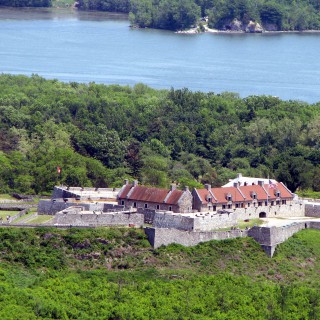
18th-century star fort in northern New York in the United States
POPULARITY

16 episodes with Fort Ticonderoga

5 episodes with Fort Ticonderoga

2 episodes with Fort Ticonderoga

3 episodes with Fort Ticonderoga

6 episodes with Fort Ticonderoga

3 episodes with Fort Ticonderoga

2 episodes with Fort Ticonderoga

2 episodes with Fort Ticonderoga

2 episodes with Fort Ticonderoga

How did Henry Knox, a 25-year-old Boston bookseller, move nearly 60 tons of artillery across 300 winter miles and help break the Siege of Boston without a costly ground battle? In this episode of America's Founding Series on The P.A.S. Report Podcast, Professor Nick Giordano reveals the incredible true story of Henry Knox and the Noble Train of Artillery. As America marks its 250th anniversary, discover how this largely self-taught Patriot transported 59 cannons, mortars, and howitzers from Fort Ticonderoga to Boston and gave George Washington the firepower to force a British evacuation. Knox's journey demonstrates how self-education, competence, perseverance, and civic responsibility helped transform a former bookseller into Washington's chief of artillery and one of the American Revolution's most consequential leaders. Most Americans know Fort Knox as a military installation associated with America's gold reserves. Few know the Revolutionary War hero whose name it bears. What You'll Learn In This Episode: The Bookseller Who Mastered Artillery: How Henry Knox educated himself and earned George Washington's trust The Noble Train of Artillery: How Knox moved nearly 60 tons of weapons across 300 miles of winter terrain The Hudson River Crisis: What happened when a cannon crashed through the ice The Victory at Dorchester Heights: Why the American position made British control of Boston untenable The Lesson for America Today: What Knox teaches us about preparation, initiative, competence, and civic duty Episode Chapters 00:00 Henry Knox and the Siege of Boston 00:53 From Boston Bookseller to Washington's Artillery Chief 02:02 Fort Ticonderoga and the Noble Train of Artillery 06:50 Henry Knox's 300 Mile Winter Artillery Mission 10:02 The Cannon Crisis on the Frozen Hudson River 14:32 Dorchester Heights Breaks the Siege of Boston 18:26 Henry Knox's Lessons for America Today ⭐ Help Keep Authentic American History Alive: If you believe the sacrifices that built this nation must never be forgotten, follow The P.A.S. Report Podcast, leave a 5-star rating on Apple Podcasts or Spotify, and text a link to this episode to 3 or 4 friends and family members right now.

Earlier in this special season of The Object of History, we discussed Ethan Allen and Benedict Arnold's capture of Fort Ticonderoga in May 1775. On this bonus episode, Fort Ticonderoga's Curator Dr. Matthew Keagle tells us about what happened after Henry Knox departed the Fort with seized artillery as well as how the Fort played a role in the remainder of the Revolution. Learn more about episode objects here: https://www.masshist.org/podcast/season-5-bonus-episode-Ticonderoga Email us at podcast@masshist.org. Listen to Season 5, Episode 3 Episode Special Guest: Dr. Matthew Keagle is the Curator at Fort Ticonderoga, where he oversees one of the largest collections of 18th-century military material culture in North America. He holds a PhD from the Bard Graduate Center, and his research focuses on the American Revolution and the material world of 18th-century warfare. This episode uses materials from: Cloudbank by Podington Bear (Attribution-NonCommercial 3.0 Unported) Psychic by Dominic Giam of Ketsa Music (licensed under a commercial non-exclusive license by the Massachusetts Historical Society through Ketsa.uk) Curious Nature by Dominic Giam of Ketsa Music (licensed under a commercial non-exclusive license by the Massachusetts Historical Society through Ketsa.uk)

What if the best therapy for a veteran wasn't in a clinic but in the ground?Stephen Humphreys is a former Air Force officer, PhD archaeologist, and co-founder of American Veterans Archaeological Recovery (AVAR) — the only organization in the United States using professional battlefield archaeology to build long-term careers for veterans. AVAR crews have worked Saratoga, Fort Ticonderoga, the Battle of Camden, and are headed to Bunker Hill. Through a partnership with the Defense POW/MIA Accounting Agency, they have helped bring home the remains of three WWII service members lost for eight decades.Humphreys talks about why veterans belong on these sites, what archaeology gives them that most programs can't, and why purpose — not sympathy — is what actually changes lives.Also in this episode: a myth-or-fact battlefield archaeology edition that covers what's still left to find at Revolutionary War sites and whether WWII remains can still come home after 80 years. Plus, a Navy sailor opens a Monster Energy drink and finds something that was definitely not on the label.Your stories. Your service. Your community. This is Tango Alpha Lima.SHOW NOTESLearn more about the birth of NASAAd Break: S.O.A.R.Learn more about Veterans Curation ProgramDig deeper into Stephen's work with AVAREnter the Drive for Freedom Sweepstakes for a chance to win a Humvee! Join The American Legion

In this episode, James and Audrey follow the American Revolution from the meeting of the Second Continental Congress to the bloody Battle of Bunker Hill. We explore the capture of Fort Ticonderoga, the growing siege of Boston, and the desperate struggle on Breed's Hill that proved colonial militiamen could stand against Britain's professional army. We also examine the staggering cost of Britain's victory and the profound impact the battle had on both sides of the conflict. Finally, we trace the creation of the Continental Army and the appointment of George Washington as commander-in-chief, setting the stage for the war's next chapter.See omnystudio.com/listener for privacy information.

Episode 4185 │ July 19, 2026 Washington said his men called themselves an army the way lumber calls itself a house. Unprepared for war with Britain — less one thing: their faith. WHAT THIS EPISODE COVERS Scott Kesterson and Rochelle Porto fill the gap between Lexington and Concord in April 1775 and the Declaration of Independence in July 1776 — the period nobody covers and everyone skips — tracing the Battle of Quebec in the December blizzard that killed Richard Montgomery, wounded Benedict Arnold before his betrayal, and left 400 American prisoners in British hands, alongside the prohibitory acts of December 1775 that blockaded every American merchant vessel at sea and led John Adams to declare that Britain had effectively declared independence from the colonies before the colonies declared it from Britain. The centerpiece of the episode is the Noble Train of Artillery — Henry Knox's 300-mile winter journey from Cambridge to Fort Ticonderoga and back, 59 pieces of heavy ordnance including a 5,000-pound brass cannon named Old Sable, moved by 60 men, teams of horses and oxen, across frozen rivers and mountain ridges through the same blizzard hitting Quebec, resupplied at every town by committees of safety who knew the convoy was coming and had fresh animals, food, and shelter waiting at each stop. The episode closes with Scott mapping the three pillars of colonial intelligence and organization — the Mechanics network, the committees of safety, and the Black Robe Regiment — against the current moment, arguing that the ragtag colonial force Washington inherited was the same structural problem America faces today, and that the difference between defeat and the crossing of the Delaware is almost always logistics, intelligence, and the willingness of ordinary people in ordinary towns to show up when the convoy passes through. KEY QUESTIONS ADDRESSED Why did the American invasion of Quebec fail — and what does the combination of a December blizzard, expiring enlistments, the death of Richard Montgomery by grapeshot, Benedict Arnold's leg wound, and 400 prisoners reveal about the structural limits of a colonial army organized by popularity rather than competence? What were the Prohibitory Acts of December 1775 — and why did John Adams call them Britain's own declaration of independence from the colonies, given that they placed a death sentence on every American merchant vessel at sea and made reconciliation structurally impossible? What made the Noble Train of Artillery succeed where the Quebec campaign failed — and what does Henry Knox's 300-mile winter journey, never losing a cannon, an animal, or a man, reveal about the role of the committees of safety as the logistical backbone that made every patriot operation in this period possible? ABOUT BARDSFM BardsFM is a daily independent podcast covering faith, liberty, history, and information warfare. Hosted by Scott Kesterson — combat veteran, documentary filmmaker, and rancher. Over 4,100 episodes and 50 million lifetime downloads. New episodes every weekday. bards.fm This episode was researched and produced under the Spatial Terra Intelligence Methodology (STIM v5) — the analytical framework built by Scott Kesterson — with AI-assisted research synthesis at a 70/30 human/AI authorship ratio, fully disclosed. All analysis, conclusions, and editorial judgments are those of Scott Kesterson. BardsFM's faith archive includes hundreds of episodes on prayer, scripture, and walking the Way of Christ — available free in the full episode catalog. AFFILIATE LINKS Bards Nation Health Store: www.bardsnationhealth.com MYPillow promo code: BARDS >> Go to https://www.mypillow.com/bards and use the promo code BARDS or... Call 1-800-975-2939. EMPShield protect your vehicles and home. Promo code BARDS: Click here Treadlite Broadforks...best garden tool EVER. Promo code BARDS26: TreadliteBroadforks.com EnviroKlenz Air Purification, promo code BARDS to save 10%: www.enviroklenz.com Morning Intro Music Provided by Brian Kahanek: www.briankahanek.com Founders Bible 20% discount code: BARDS >>> TheFoundersBible.com Windblown Media 20% Discount with promo code BARDS: windblownmedia.com White Oak Pastures Grassfed Meats, Get $20 off any order $150 or more. Promo Code BARDS: www.whiteoakpastures.com/BARDS Mission Darkness Faraday Bags and RF Shielding. Promo code BARDS: Click here DONATIONS: If you wish to support this podcast directly you can donate here... DONATE: Click here MAILING ADDRESS: Xpedition Cafe, LLC Attn. Scott Kesterson 591 E Central Ave, #740 Sutherlin, OR 97479

As the United States marks its 250th anniversary, Dr. Matthew Keagle, curator of the Fort Ticonderoga Museum, discusses the significance of Fort Ticonderoga during the American Revolution. The fort, captured by the Americans in 1775, provided crucial artillery that helped break the siege of Boston. Dr. Keagle explains the pivotal role of Fort Ticonderoga in the Revolutionary War, its importance in preserving American independence, and how visitors can experience history firsthand by exploring the historic site today. Learn more about your ad choices. Visit podcastchoices.com/adchoices

American Revolution (1765–1783) was a political conflict involving the Thirteen Colonies and Great Britain, culminating in the American Revolutionary War and the independence of the colonies as the United States. RW5. The Revolution DVD box-set available at https://amzn.to/4p8seIt American Revolution books at https://amzn.to/43DduIG Revolutionary War games and souvenirs at https://amzn.to/487e2YU ENJOY Ad-Free content, Bonus episodes, and Extra materials when joining our growing community on https://patreon.com/markvinet SUPPORT this channel by purchasing any product on Amazon using this FREE entry LINK https://amzn.to/3POlrUD (Amazon gives us credit at NO extra charge to you). Mark Vinet's TIMELINE video channel: https://youtube.com/c/TIMELINE_MarkVinet Mark's History of North America podcast: www.parthenonpodcast.com/history-of-north-america Mark's Historical Jesus podcast at https://parthenonpodcast.com/historical-jesus Website: https://markvinet.com/podcast Facebook: https://www.facebook.com/mark.vinet.9 X (twitter): https://twitter.com/MarkVinet_HNA Instagram: https://www.instagram.com/denarynovels Mark's books: https://amzn.to/3k8qrGM Audio credits: The History Channel Presents - The Revolution narrated by Edward Herrmann & directed by Peter Schnall (2006 A&E Television Networks). Audio excerpts reproduced under the Fair Use (Fair Dealings) Legal Doctrine for purposes such as criticism, comment, teaching, education, scholarship, research and news reporting. See omnystudio.com/listener for privacy information.

In Erfurt findet an diesem Wochenende der Bundesparteitag der AfD statt – auf den Tag genau 100 Jahre nach dem Reichsparteitag der NSDAP in Weimar. Die Stadt bereitet sich seit Wochen auf ein Ausnahmewochenende vor. Eine breite Allianz rief zu Protesten auf. Die Sorge vor Ausschreitungen ist gross. (00:00) Intro und Schlagzeilen (01:27 ) AfD-Parteitag in Erfurt weckt historische Assoziationen (06:34) Nachrichtenübersicht (11:14) Fort Ticonderoga erinnert an Amerikas Unabhängigkeitskrieg (16:39) Israels Wirtschaft wächst trotz des Krieges (23:49t) Papst Leo setzt in Lampedusa ein Zeichen gegen das Wegschauen

On this 250th anniversary of the Declaration of Independence, noted historian David McCullough joins Wayne Shepherd for Part 2 of 1776: George Washington. (click for more…)Website: www.simonandschuster.com/p/david-mcculloughRecorded in 2005, this is a continuation of last week's FIRST PERSON as the late David McCullough talked about his book, 1776, and the experiences of George Washington in that momentous year. The conversation centers on George Washington's leadership during the darkest days of the war. McCullough describes how Washington forgave Joseph Reed's disloyalty and Nathaniel Greene's costly mistake at Fort Washington, choosing loyalty and grace over punishment — a decision that deepened both men's devotion to him. He portrays Washington as a leader shaped more by character than intellect: not a brilliant orator or strategist, but someone who inspired trust through steadiness, humility, and self-sacrifice (leaving behind wealth and comfort to lead a ragged army). McCullough also highlights lesser-known figures — Henry Knox's astonishing winter trek hauling cannon from Fort Ticonderoga to Boston, and ordinary soldiers like Joseph Hodgkins and Jabez Fitch whose diaries, often scrawled on scraps of paper, McCullough treats as the "gold" of his research. The interview closes with McCullough reflecting on why he writes — to understand human sacrifice and courage — and calling Washington "the greatest American of all time," while noting the book deliberately ends with the pivotal victories at Trenton and Princeton rather than covering the full war. NEXT WEEK: Bill HendricksSend your support for FIRST PERSON to the Far East Broadcasting Company:FEBC National Processing Center Far East Broadcasting CompanyP.O. Box 6020 Albert Lea, MN 56007Please mention FIRST PERSON when you give. Thank you!

(Jul 2, 2026) North Country officials hope the recently completed state energy transmission upgrade will help boost the regional economy; ahead of the nation's 250th birthday, the curator from Fort Ticonderoga shares recent discoveries of artifacts from the American Revolution; and we take a look at a St. Lawrence County family's unique 4th of July tradition.

Send us Fan MailLet's celebrate 250! The legendary Rick Atkinson joins me to talk The Fate of the Day: The War for America, Fort Ticonderoga to Charleston, 1777-1780.Buy The Fate of the DayCheck out Rick's websiteSupport the show

H.W. Brands new book, 'American Patriarch,' turns to the nation's first president, George Washington. Rather than treating Washington as an untouchable icon, Brands explores the ambition, discipline, and restraint that shaped both the man and the new republic.Award-winning historian Rick Atkinson has spent decades bringing pivotal moments in American history to life through richly researched, compelling narrative. His latest book, The Fate of the Day: The War for America, Fort Ticonderoga to Charleston, 1777–1780, is the second volume of his acclaimed Revolution Trilogy, chronicling the critical middle years of the American Revolution as George Washington's army struggles to survive and the fight for independence hangs in the balance.
By winter 1777, the Continental Army was exhausted, having barely escaped annihilation by the world's most formidable fighting force. Two years into the war, King George, determined as ever to bring the rebellious American colonies to heel, faced a desperate set of foes in Benjamin Franklin and George Washington, to say nothing of rising wartime expenses and the threat of additional international rivals. Celebrated historian Rick Atkinson discusses this story, the subject of the second volume of his landmark American Revolution trilogy, with David M. Rubenstein.Recorded on June 11, 2025

The controversial 'Memorandum of Understanding with Iran' and a high-stakes standoff over FISA surveillance renewals are igniting sharp divisions between the White House and Senate Republicans. FOX News Sunday anchor Shannon Bream joins to discuss the economic and political fallout of lifting Iranian oil sanctions, the Supreme Court's looming decision on birthright citizenship, and how a late-night postponement of the confirmation of the Director of National Intelligence put a pause on national security legislation. As America approaches its 250th anniversary, how did a seemingly ragged group of Continental soldiers pull off an impossible victory against the world's greatest military superpower? Pulitzer Prize-winning military historian and best-selling author Rick Atkinson joins FOX News' Lucas Tomlinson to dive into the grueling, bloody middle years of the Revolutionary War. Drawing from his book, The Fate of the Day: The War for America, Fort Ticonderoga to Charleston, 1777–1780, Atkinson breaks down the mythology surrounding our nation's founding. PLUS, commentary by Tevi Troy, senior fellow at the Ronald Reagan Institute and a former senior White House aide. Learn more about your ad choices. Visit podcastchoices.com/adchoices

The controversial 'Memorandum of Understanding with Iran' and a high-stakes standoff over FISA surveillance renewals are igniting sharp divisions between the White House and Senate Republicans. FOX News Sunday anchor Shannon Bream joins to discuss the economic and political fallout of lifting Iranian oil sanctions, the Supreme Court's looming decision on birthright citizenship, and how a late-night postponement of the confirmation of the Director of National Intelligence put a pause on national security legislation. As America approaches its 250th anniversary, how did a seemingly ragged group of Continental soldiers pull off an impossible victory against the world's greatest military superpower? Pulitzer Prize-winning military historian and best-selling author Rick Atkinson joins FOX News' Lucas Tomlinson to dive into the grueling, bloody middle years of the Revolutionary War. Drawing from his book, The Fate of the Day: The War for America, Fort Ticonderoga to Charleston, 1777–1780, Atkinson breaks down the mythology surrounding our nation's founding. PLUS, commentary by Tevi Troy, senior fellow at the Ronald Reagan Institute and a former senior White House aide. Learn more about your ad choices. Visit podcastchoices.com/adchoices

The controversial 'Memorandum of Understanding with Iran' and a high-stakes standoff over FISA surveillance renewals are igniting sharp divisions between the White House and Senate Republicans. FOX News Sunday anchor Shannon Bream joins to discuss the economic and political fallout of lifting Iranian oil sanctions, the Supreme Court's looming decision on birthright citizenship, and how a late-night postponement of the confirmation of the Director of National Intelligence put a pause on national security legislation. As America approaches its 250th anniversary, how did a seemingly ragged group of Continental soldiers pull off an impossible victory against the world's greatest military superpower? Pulitzer Prize-winning military historian and best-selling author Rick Atkinson joins FOX News' Lucas Tomlinson to dive into the grueling, bloody middle years of the Revolutionary War. Drawing from his book, The Fate of the Day: The War for America, Fort Ticonderoga to Charleston, 1777–1780, Atkinson breaks down the mythology surrounding our nation's founding. PLUS, commentary by Tevi Troy, senior fellow at the Ronald Reagan Institute and a former senior White House aide. Learn more about your ad choices. Visit podcastchoices.com/adchoices

In Declaring Independence, Edward J. Larson describes how Henry Knox executed a daring winter transport of heavy artillery from Fort Ticonderoga to Boston. This logistical feat allowed Washington to fortify Dorchester Heights, forcing the British to evacuate the city. (10/16)1753
SCHEDULE THE JOHN BATCHELOR SHOW-5-25-2026.1789 NEW YORK.Guest Author Josh Ireland discusses his book The Death of Trotsky: The True Story of the Plot to Kill Stalin's Greatest Enemy. The Russian Revolution began with Bolshevik fanatics using violence to impose their will on the masses. Irelandexplains the emerging rivalry between Trotsky and Stalin amidst the brutal purge of original revolutionaries. (1/16)In The Death of Trotsky, Josh Ireland describes how the intellectual Trotsky and bureaucratic Stalin competed for power following Lenin's death. Stalin maneuvered patiently to isolate Trotsky, who missed Lenin's funeral while recovering from a mysterious and poorly timed illness. (2/16)Josh Ireland explains that Trotsky was expelled from the Politburo after labeling Stalin the "gravedigger of the revolution." He began a global exile, eventually finding sanctuary in Mexico at the invitation of muralist Diego Rivera. (3/16)Josh Ireland details how, in Mexico, Trotsky faced constant threats from Stalin's assassins. Despite the fortified walls of his compound, the NKVD relentlessly monitored his correspondence and successfully infiltrated his inner circle with undercover agents. (4/16)Josh Ireland recounts how the Mercader family, led by the radicalized Caridad, was recruited by the NKVD during the Spanish Civil War. Her son Ramon was trained as a ruthless agent capable of carrying out high-stakes assassinations. (5/16)Josh Ireland describes how Ramon Mercader seduced Sylvia Ageloff to penetrate Trotsky's inner circle under a false identity. Meanwhile, a chaotic machine-gun raid by Stalinist gunmen failed to kill Trotsky, leading to even tighter security measures. (6/16)Josh Ireland recounts how Ramon Mercader used a mountaineer's ice pick to fatally wound Trotsky inside his study. Captured by guards, Ramon maintained a web of lies to conceal his true role as a Soviet operative. (7/16)Josh Ireland explains that following Trotsky's death, Ramon served twenty years in a Mexican prison before returning to Moscow as a hero. Trotsky's wife, Natalia, lived a diminished final chapter after losing her entire family. (8/16)Guest Author Edward J. Larson discusses his book Declaring Independence: Why 1776 Matters. The unprovoked burning of Norfolk, Virginia, by the Royal Navy in January 1776 served as a catalyst for independence. This violence convinced many colonists that reconciliation with the British Crown was impossible. (9/16)In Declaring Independence, Edward J. Larson describes how Henry Knox executed a daring winter transport of heavy artillery from Fort Ticonderoga to Boston. This logistical feat allowed Washington to fortify Dorchester Heights, forcing the British to evacuate the city. (10/16)Edward J. Larson recounts how Washington attempted to defend New York against a massive British armada. The Howe brothers tried to negotiate a peace deal, but American commitment to independence remained firm despite the overwhelming force. (11/16)Edward J. Larson explains that George Mason drafted the Virginia Declaration of Rights while Washington realized he must preserve his army through retreat. The revolution shifted toward establishing independent state governments based on popular sovereignty. (12/16)Edward J. Larson details how, during a grueling retreat through New Jersey, Thomas Paine's The American Crisisrevitalized colonial spirits. British and Hessian atrocities against civilians further alienated the population and strengthened the resolve for independence. (13/16)Edward J. Larson recounts how Abigail Adams urged her husband to "remember the ladies" during the debates over independence. Revolutionary ideals of equality began to raise significant questions regarding the status of women and enslaved people. (14/16)Edward J. Larson describes how Washington led a desperate Christmas crossing of the Delaware River to surprise the Hessians at Trenton. The subsequent victory at Princeton provided the moral triumph needed to sustain the struggling Continental Army. (15/16)Edward J. Larson explains that the formal signing of the Declaration of Independence marked a permanent break with monarchy. New state constitutions prioritized popular sovereignty, establishing the rule of law as the foundation of the Republic. (16/16)

"He has kept among us, in times of peace, Standing Armies without the Consent of our legislatures. He has affected to render the Military independent of and superior to the Civil power...He has abdicated Government here, by declaring us out of his Protection and waging War against us. He has plundered our seas, ravaged our Coasts, burnt our towns, and destroyed the lives of our people." In this episode, we unpack Grievances #11, #12, #23, and #24 of the Declaration of Independence and the relationship between Americans and the various types of armed troops in North America, from militias, to British regulars, to the Continental Army. Topics include the following: -the shared British and American tradition of opposing standing armies--because if they are not disbanded after wars, they are used by tyrants to take away the rights of the people -the perception of American colonists that the King had stationed 10,000 soldiers in North America in 1763 precisely so he could enforce his tyrannical policies on them -the various functions of Colonial militias in the 17th and 18th centuries, including war-fighting, civil policing, and preventing slave uprisings -the strained relationships between the Colonial militias and British regulars during the 7 Years' War and Pontiac's Revolt -the role of the Battles of Lexington and Concord in forcing Congress to create the Continental Army -the political significance of the name the Continental Army, as opposed to the American or Congressional or Colonial Army -the political significance of appointing George Washington, a Southerner and Virginian, as Commander of a mostly Northern militia force -an introduction to Washington's senior officers: Artemas Ward, Israel Putnam, and Charles Lee -initial British assessments of the strength and effectiveness of the new Continental Army -the importance of the American victory at Fort Ticonderoga in reshaping the war; namely, the capture of British soldiers meant that American rebels would not be summarily executed as seditious traitors but treated with basic PoW protections -a discussion of Grievance #24, that King George has ordered war crimes to be committed against innocent civilians -the tendency on both sides to commit war crimes against the civilian population and efforts by officers on both sides to discipline soldiers who abused the civilians population Dr. Chandler's book can be found here: [War, Patriotism and Identity in Revolutionary North America](https://boydellandbrewer.com/book/war-patriotism-and-identity-in-revolutionary-north-america-9781783274376/?v=0d149b90e739) The cover image is a drawing of an American Soldier in 1778 by Friedrich von Germann (1744–1794), Captain of the Brunswick Regiment Erbprinz. The Brunswick Regiment was not technically Hessian; nevertheless, it formed part of the subsidy regiments (or mercenaries) hired by the British to fight the Americans.

Send us Fan MailIn this episode of Impact Without Limits, Brian and Dale continue their journey through the early days of the American Revolution, exploring the defining moments that shaped the fight for independence. From George Washington taking command of the Continental Army to the impossible mission of Henry Knox transporting artillery from Fort Ticonderoga to Boston, they unpack the strategy, sacrifice, and perseverance behind some of the Revolution's most pivotal turning points.The conversation also dives into Washington's retreats through New York and New Jersey, the overwhelming odds faced by the American troops, and the miraculous events that seemed to preserve the cause time and time again. Highlighting Thomas Paine's powerful words in The American Crisis and Washington's daring crossing of the Delaware on Christmas night, Brian and Dale reflect on leadership, providence, and the thin threads upon which history often hangs.Episode Highlights: Washington takes command.Henry Knox delivers artillery.The British take New York.Thomas Paine inspires the troops.Washington crosses the Delaware.Links Mentioned in Episode/Find More on ForeverLawn:www.foreverlawn.comImpact Without Limits Instagram: @impact_withoutlimitsForeverLawn's Instagram: @foreverlawnincGet Grass Without Limits HereVisit our show notes page HERESubscribe to Our Newsletter HEREDale's Instagram: @dalekarmieBrian's Instagram: @bkarmieFind Our Shorts on the ForeverLawn YouTube ChannelThis show has been produced by Adkins Media Co.

Episode 182 Ch. 8 of Little Town on the Prairie "Fourth of July" Join us this week as we discuss "The Star Spangled Banner", "Marching through Georgia", union suits, Laura pinning her braids vs. the chapter illustrations, Fort Ticonderoga, Lawyer Visscher Barnes, Laura and Rose's politics (libertarianism), "My Country 'Tis of Thee/America", Samuel Owens, what a "cuss" is, winning $5, and mentioning Eliza Jane Wilder.
10. Edward J. Larson Headline: Henry Knox's Heroic Artillery Mission Larson recounts the daring winter transport of heavy cannons from Fort Ticonderoga to Boston. This strategic feat allowed Washington to fortify Dorchester Heights, forcing Britishevacuation and marking his first major military victory. (10)1780
SHOW SCHWDULE 3-19-20261939 OKLAHOMA OILFIELDS, ROUSTABOUT FAMILY HOUSING1. Gregory Copley Headline: The Strait of Hormuz and Global Energy Panic Copley analyzes the strategic fallout of Iranian attacks on Qatari gas fields, which have sent global markets reeling. He argues the Iranian Navy is finished, yet regional instability requires American leadership to ensure regime change. (1)2. Gregory Copley Headline: Russia's Energy Leverage and the Donbass Proposal Russia benefits significantly from rising oil prices and its desanctioned shadow fleet. Copley notes that some European nations are considering a "Donbass for energy" deal with Putin to stabilize their struggling economies. (2)3. Gregory Copley Headline: China's Economic Paralysis and Naval Limitations China faces deep internal trouble, with growth expectations falling and Xi Jinping struggling to trust his military commanders. Copley highlights that the PLA Navy remains significantly behind the United States in carrier operations. (3)4. Gregory Copley Headline: British Political Turmoil and the Monarchy's Role King Charles III plans to attend America's 250th anniversary despite potential diplomatic friction with President Trump. Meanwhile, Prime Minister Keir Starmer faces historic unpopularity and internal party dissent, though he remains difficult to remove. (4)5. Evan Ellis Headline: Cuba's Energy Crisis Amidst Cold War Echoes Cuba suffers from nationwide blackouts as Russian oil shipments attempt to bypass U.S. surveillance. Ellis explores the symbolic importance of the island and the complexities of U.S. negotiations with the Castro family. (5)6. Evan Ellis Headline: Venezuela's Oil Interests and Democratic Hopes While the Trump administration views Venezuela as a success, the Chvista regime remains entrenched through hardline appointments. Opposition leader Maria Corina Machado pushes for democratic stability to attract essential foreign investment into the oil sector. (6)7. Evan Ellis Headline: Crime and Political Instability in Latin America Violent spillover from drug trafficking affects the Colombia-Ecuador border, leading to significant casualties and military strikes. Ellis also discusses the arrest of a major gang leader and the ongoing cabinet instability in Peru. (7)8. Evan Ellis Headline: Chile's Security Reforms Under President Kast President Jose Antonio Kast has prioritized border security and tackling organized crime since his inauguration. His inclusive approach aims to stabilize the economy and address social frustrations lingering from the 2019 riots. (8)9. Edward J. Larson Headline: The Bombardment of Norfolk: A Revolutionary Turning Point In January 1776, the Royal Navy's attack on Norfolk, Virginia, destroyed civilian homes and convinced colonists that reconciliation with Britain was impossible. George Washington viewed this aggression as a decisive catalyst for independence. (9)10. Edward J. Larson Headline: Henry Knox's Heroic Artillery Mission Larson recounts the daring winter transport of heavy cannons from Fort Ticonderoga to Boston. This strategic feat allowed Washington to fortify Dorchester Heights, forcing British evacuation and marking his first major military victory. (10)11. Edward J. Larson Headline: Washington's Desperate Defense of New York Following the victory in Boston, Washington moved to defend New York against an overwhelming British force. Despite the Howe brothers' initial desire for negotiation, the conflict escalated as the colonies formally declared independence. (11)12. Edward J. Larson Headline: The Intellectual Shift Toward Republican Sovereignty Larson explores how 1776 transformed colonists into independent actors seeking republican governance over royal charters. Washington adopted a "Fabian" strategy, prioritizing army survival over holding territory after the defeat in Manhattan. (12)13. Anatol Lieven Headline: Seeking a Settlement in the Eurasia Crisis High energy prices are pressuring European nations like Belgium and Hungary to consider resuming trade with Russia. Lieven proposes a deal exchanging energy for compromises on the Donbass, though European leadership remains divided. (13)14. Anatol Lieven Headline: NATO Disunity and Eastern European Hardliners Lieven highlights internal friction within NATO regarding Donald Trump's isolationist rhetoric. While hardliners in Eastern Europe demand unity against Russia, countries like Poland remain primarily focused on their own national defense strategies. (14)15. Sadanand Dhume Headline: India's Strategic Neutrality in the BRICS Grouping Dhume analyzes India's unique position, balancing relationships with the U.S. and Israel against energy needs. He describes BRICS as an economically underperforming and politically fractured group with deep-seated internal rivalries. (15)16. Conrad Black Headline: Canada's Commitment to Arctic Defense Black praises Prime Minister Mark Carney for prioritizing Arctic defense and military modernization. He notes that while Canadians support pulling their weight in NATO, challenges persist regarding pipeline development and international participation. (16)

March 16, 2026 In early 1775, Boston was bitterly divided, The British occupied the town as Patriots built fortifications, Militiamen led by Benedict Arnold and Ethan Allen seized cannons and other weapons from Fort Ticonderoga, 300 miles away, The Second Continental Congress created the Continental Army, appointing George Washington as commander in chief, Henry Knox, a friend of Washington, developed a plan to retrieve the Fort Ticonderoga cannons and bring them to Boston, After several grueling months, the cannons were delivered, As British soldiers and Washington's men traded fire in Boston, Patriots fortified the town. In a major victory for the Patriots, the British negotiated the evacuation of soldiers and loyalists from Boston, Evacuation bolstered the Patriot cause as a just and winning one. Less than four months later, Patriots took the extraordinarily daring step of declaring independence from the King. Watch today's recording here: https://www.youtube.com/live/g9TUa1Rwd6U?si=T8_KKcHQZElhpnZ-Get full, free access to Letters from an American here: https://heathercoxrichardson.substack.com/subscribeYou can also find me:Bluesky: https://bsky.app/profile/hcrichardson.bsky.socialInstagram: https://www.instagram.com/heathercoxrichardson/?hl=enFacebook: https://www.facebook.com/heathercoxrichardson/YouTube: https://www.youtube.com/@heathercoxrichardson Get full access to Letters from an American at heathercoxrichardson.substack.com/subscribe

250 years ago, the British evacuated Boston: driven out by cannon that had traveled 300 miles from Fort Ticonderoga. But where did the plan for those cannons take shape?In this Revisited episode, we return to our conversation with Garrett Cloer, now Program Manager for Interpretation and Visitor Experience at Saratoga National Historical Park, to explore the Longfellow House–Washington's Headquarters National Historic Site in Cambridge, Massachusetts.This Georgian mansion served as George Washington's home and headquarters for nearly nine months during the Siege of Boston. In this house, Washington forged the Continental Army and plotted the moves that liberated the city. Garrett reveals the house's Loyalist origins, life inside during the siege, and how poet Henry Wadsworth Longfellow later transformed it into a literary landmark.A companion to Episode 436 on Henry Knox's Noble Train of Artillery. Show Notes: https://www.benfranklinsworld.com/194RECOMMENDED NEXT EPISODES
250 years ago, the British evacuated Boston: driven out by cannon that had traveled 300 miles from Fort Ticonderoga. But where did the plan for those cannons take shape?In this Revisited episode, we return to our conversation with Garrett Cloer, now Program Manager for Interpretation and Visitor Experience at Saratoga National Historical Park, to explore the Longfellow House–Washington's Headquarters National Historic Site in Cambridge, Massachusetts.This Georgian mansion served as George Washington's home and headquarters for nearly nine months during the Siege of Boston. In this house, Washington forged the Continental Army and plotted the moves that liberated the city. Garrett reveals the house's Loyalist origins, life inside during the siege, and how poet Henry Wadsworth Longfellow later transformed it into a literary landmark.A companion to Episode 436 on Henry Knox's Noble Train of Artillery. Show Notes: https://www.benfranklinsworld.com/194RECOMMENDED NEXT EPISODES
On this episode of The Object of History, we begin a three-part narrative about the geography, characters, and events that shaped the first years of the American Revolution. Part one starts in May of 1775 at Fort Ticonderoga, New York, on the banks of Lake Champlain. We are joined by Fort Ticonderoga's Curator Dr. Matthew Keagle to discuss the capture of the fort, the colonists' dire need for artillery to break the siege at Boston, and how the Canadian campaign developed in the summer and fall of that year. We also speak with Samantha Couture, Nora Saltonstall Conservator & Preservation Librarian at the MHS, to talk about the diary of Henry Knox. Learn more about episode objects here: https://www.masshist.org/podcast/season-5-episode-3-knox-diary Email us at podcast@masshist.org. Episode Special Guests: Dr. Matthew Keagle is the Curator at Fort Ticonderoga, where he oversees one of the largest collections of 18th-century military material culture in North America. He holds a PhD from the Bard Graduate Center, and his research focuses on the American Revolution and the material world of 18th-century warfare. Samantha Couture is the Nora Saltonstall Conservator & Preservation Librarian at the Massachusetts Historical Society. This episode uses materials from: Cloudbank by Podington Bear (Attribution-NonCommercial 3.0 Unported) Psychic by Dominic Giam of Ketsa Music (licensed under a commercial non-exclusive license by the Massachusetts Historical Society through Ketsa.uk) Curious Nature by Dominic Giam of Ketsa Music (licensed under a commercial non-exclusive license by the Massachusetts Historical Society through Ketsa.uk)
On March 17, 1776, the British evacuated Boston, driven out by cannon hauled 300 miles through winter wilderness from a crumbling fort in upstate New York. Join Matthew Keagle, Curator at Fort Ticonderoga, as we trace the fort's dramatic history from its French origins in the Seven Years' War, its chaotic capture by Ethan Allen and Benedict Arnold in May 1775, and Henry Knox's legendary expedition to move nearly 60 tons of artillery to George Washington's army. Discover the logistics, rivalries, and resourcefulness behind one of the Revolution's most remarkable feats. Show Notes: https://www.benfranklinsworld.com/436 EPISODE OUTLINE00:00:00 Introduction00:06:26 British Withdrawl from Boston00:07:55 Fort Ticonderoga's Origins00:25:05 British Capture of Fort Ticonderoga, 175600:28:04 British Improvements to Fort Ticonderoga00:32:44 American Capture of Fort Ticonderoga, 177500:49:06 Henry Knox's Expedition01:04:46 Cannon on Dorchester Heights01:10:36 British Evacuation of Boston01:13:43 Legacy of Knox's Noble Train of Artillery01:17:36 Visiting Fort Ticonderoga01:24:65 ConclusionRECOMMENDED NEXT EPISODES
On March 17, 1776, the British evacuated Boston, driven out by cannon hauled 300 miles through winter wilderness from a crumbling fort in upstate New York. Join Matthew Keagle, Curator at Fort Ticonderoga, as we trace the fort's dramatic history from its French origins in the Seven Years' War, its chaotic capture by Ethan Allen and Benedict Arnold in May 1775, and Henry Knox's legendary expedition to move nearly 60 tons of artillery to George Washington's army. Discover the logistics, rivalries, and resourcefulness behind one of the Revolution's most remarkable feats. Show Notes: https://www.benfranklinsworld.com/436 EPISODE OUTLINE00:00:00 Introduction00:06:26 British Withdrawl from Boston00:07:55 Fort Ticonderoga's Origins00:25:05 British Capture of Fort Ticonderoga, 175600:28:04 British Improvements to Fort Ticonderoga00:32:44 American Capture of Fort Ticonderoga, 177500:49:06 Henry Knox's Expedition01:04:46 Cannon on Dorchester Heights01:10:36 British Evacuation of Boston01:13:43 Legacy of Knox's Noble Train of Artillery01:17:36 Visiting Fort Ticonderoga01:24:65 ConclusionRECOMMENDED NEXT EPISODES

In 1775, the British were occupying Boston and the Patriots were low on weapons. General George Washington turned to Knox to do what seemed impossible: get more arms from Fort Ticonderoga in New York.

Twenty-five year-old bookseller Henry Knox, his 19 year-old brother Will, and teamsters led by John Becker, Sr., move a long “noble train” of 59 pieces of salvaged artillery from Fort Ticonderoga to Cambridge. The route crossed frozen rivers and the not-dreamlike Berkshire Mountains under unbelievably arduous conditions. As word spread, crowds of Americans would turn out to cheer them on, and serve them cider and whiskey. The artillery, when hoisted to the commanding heights of Dorchester above Boston, would drive the British from their long occupation of that city, and they would never return. It is a story of initiative, ingenuity, tenacity, survival, and charismatic leadership, and was perhaps the first miracle of many that would bless the American Revolution. Map of the Noble Train’s route (not reflecting all the river crossings discussed in the episode): Subscribe to my Substack! X – @TheHistoryOfTh2 – https://x.com/TheHistoryOfTh2 Facebook – https://www.facebook.com/HistoryOfTheAmericans Primary references for this episode (Commission earned for Amazon purchases through the episode notes on our website) William Hazelgrove, Henry Knox's Noble Train: The Story of a Boston Bookseller's Heroic Expedition That Saved the American Revolution Thomas M. Campeau, Major, U.S. Army, “The Noble Train of Artillery: A Study Comparison of Current Doctrinal Concepts of the Mission Command Philosophy in History.” (Master's thesis, pdf)
American Revolution (1765–1783) was a political conflict involving the Thirteen Colonies and Great Britain, culminating in the American Revolutionary War and the independence of the colonies as the United States. RW5 The Revolution DVD box-set available at https://amzn.to/4p8seIt American Revolution books at https://amzn.to/43DduIG Revolutionary War games and souvenirs at https://amzn.to/487e2YU ENJOY Ad-Free content, Bonus episodes, and Extra materials when joining our growing community on https://patreon.com/markvinet SUPPORT this channel by purchasing any product on Amazon using this FREE entry LINK https://amzn.to/3POlrUD (Amazon gives us credit at NO extra charge to you). Mark Vinet's TIMELINE video channel: https://youtube.com/c/TIMELINE_MarkVinet Mark's History of North America podcast: www.parthenonpodcast.com/history-of-north-america Mark's Historical Jesus podcast at https://parthenonpodcast.com/historical-jesus Website: https://markvinet.com/podcast Facebook: https://www.facebook.com/mark.vinet.9 Twitter: https://twitter.com/MarkVinet_HNA Instagram: https://www.instagram.com/denarynovels Mark's books: https://amzn.to/3k8qrGM Audio credits: The History Channel Presents - The Revolution narrated by Edward Herrmann & directed by Peter Schnall (2006 A&E Television Networks). Audio excerpts reproduced under the Fair Use (Fair Dealings) Legal Doctrine for purposes such as criticism, comment, teaching, education, scholarship, research and news reporting.See omnystudio.com/listener for privacy information.
Exactly 250 years ago, a rotund twenty-five year-old Boston bookseller named Henry Knox was riding his horse between Springfield and Worcester Massachusetts, on his way to George Washington's headquarters in Cambridge. Washington's ragtag, ill-equipped Continental Army had kept the British garrison under General Thomas Gage bottled up in Boston and Charlestown since the summer of 1675. Washington had a whole load of problems, including insufficient arms for his men, many with expiring enlistments that threatened to shrink his force by half or more. He also had almost no artillery, just 12 small cannon that Henry Knox, among others, had learned to operate while training with the local militia. Geographically, the Boston of that era was essentially a bubble of land connected to the mainland by an incredibly narrow neck at Roxbury. Two hills loomed over the city from across the water – Breed's Hill in Charlestown to Boston's north, which the British had captured at great cost in the summer, and Dorchester Heights, to Boston's south, which the British had not captured. This is why it was very important – world historically important – that Henry Knox, on that day exactly 250 years ago, was commanding a convoy of artillery comprising 58 pieces and weighing more than 60 tons, pulled on purpose-built sleds by teams of oxen and horses all the way from Fort Ticonderoga, 300 miles away, over rivers and the Berkshires, during the coldest winter in memory. Within just a few days those guns would be in Cambridge, and not long after that, on the sixth anniversary of the Boston Massacre, would be entrenched on Dorchester Heights and open fire on the city and ships below. Henry Knox's big guns would drive the British from Boston, for good. The tale of that “noble train” of artillery, as Knox famously referred to it, is one of the more astonishing stories of military innovation, indefatigable perseverance, and inspired leadership in a war that had more than its share of such moments. It was also among the most important, because it came at a desperate period when the Americans needed a victory or the entire project of the Revolution might have fallen apart. Map of Boston in 1775: Subscribe to my Substack! X – @TheHistoryOfTh2 – https://x.com/TheHistoryOfTh2 Facebook – https://www.facebook.com/HistoryOfTheAmericans Primary references for this episode (Commission earned for Amazon purchases through the episode notes on our website) William Hazelgrove, Henry Knox’s Noble Train: The Story of a Boston Bookseller’s Heroic Expedition That Saved the American Revolution Thomas M. Campeau, Major, U.S. Army, “The Noble Train of Artillery: A Study Comparison of Current Doctrinal Concepts of the Mission Command Philosophy in History.” (Master’s thesis, pdf) Alexander C. Flick, “General Henry Knox’s Ticonderoga Expedition,” The Quarterly Journal of the New York State Historical Association, April 1928.

Award-winning narrator Grover Gardner joins AudioFile's Michele Cobb to tell listeners about narrating one of our picks for Best Nonfiction & Culture audiobooks of 2025: Rick Atkinson's Revolutionary War epic, THE FATE OF THE DAY: The War for America, Fort Ticonderoga to Charleston, 1777-1780. Gardner shares how he kept the energy up in this sprawling account of the second installment of Atkinson's Revolutionary War trilogy, which takes place just after the Battle of Trenton. Together they discuss various challenges, especially when narrating Atkinson's unique use of lists, and how impressive it was to understand the enormous, and still timely task, of winning our independence. Read AudioFile's review of the audiobook: Published by Random House Audio AudioFile's 2025 Best Nonfiction & Culture Audiobooks are: DARK RENAISSANCE by Stephen Greenblatt, read by Edoardo Ballerini THE FATE OF THE DAY by Rick Atkinson, read by Grover Gardner and the author FOOD FOR THOUGHT written and read by Alton Brown MOTHER EMANUEL by Kevin Sack, read by William DeMeritt ORIGINAL SINS by Eve L. Ewing, read by Robin Miles, Eve L. Ewing WE THE PEOPLE written and read by Jill Lepore Explore the full list of 2025 Best Audiobooks on our website. Support for our podcast comes from Dreamscape, an award-winning audiobook publisher with a catalog that includes authors L.J. Shen, Freida McFadden, and Katee Robert. Discover your next great listen at dreamscapepublishing.com. Learn more about your ad choices. Visit megaphone.fm/adchoices
Angelica Schuyler: Albany, Elopement, and the Start of the Revolution — Molly Beer — Beer discusses her book Angelica, focusing on Angelica Schuyler Church, daughter of General Philip Schuyler. Her mother, Katherine, oversaw construction of their Albany residence, The Pastures, a substantial estate reflecting family prominence. Angelica received a rigorous education consistent with Dutch cultural traditions emphasizing women's financial and business literacy for family management. In 1777, during Burgoyne's invasion of New York, Angelica profoundly disappointed her mother by eloping with John Carter, an Englishman she found intellectually engaging and cosmopolitan. 1758 FORT TICONDEROGA

Dispatches: The Podcast of the Journal of the American Revolution
This week our guest is Fort Ticonderoga VP of Public History Stuart Lilie. From December 5th-7th, Fort Ticonderoga will host a celebration and reenactment of Henry Knox's Noble Train of Artillery. For more information visit www.allthingsliberty.com.
This week on the Revolution 250 Podcast, host Professor Robert Allison welcomes Dr. Matthew Keagle, Curator at Fort Ticonderoga, for a vivid exploration of one of the most audacious logistical feats of the American Revolution: Henry Knox's Noble Train of Artillery. Together they trace Knox's remarkable mid-winter journey of 1775–1776—300 miles across frozen rivers and lakes, treacherous terrain, and sometimes snow-choked roads—to deliver more than 60 tons of captured British artillery to General George Washington. Tell us what you think! Send us a text message!
On November 17, 1775 began the actions of the Noble Train of Artillery in the American Revolution. This ultimately resulted in the British evacuation of Boston. Make sure and watch this episode of Revolutionary War Rarities with special guest Dr. Matt Keagle, Curator at Fort Ticonderoga. We are the podcast from the Sons of the American Revolution.

Plausibly Live! - The Official Podcast of The Dave Bowman Show
Welcome back to Powder to Parchment on WREV 760AM, where we bring you Revolutionary Talk straight from the heart of 1775. Today we turn our attention to Benedict Arnold, and not the man remembered for betrayal, but the soldier who was still a hero.On October 3, 1775, Arnold and more than a thousand men began their march north through the wilds of Maine, bound for Quebec. They carried bateaux that leaked, maps that lied, and provisions that would soon rot, yet they carried also the hopes of General Washington and the survival of the Revolution.Arnold had already seized Fort Ticonderoga, yet Congress treated him with suspicion and scorn. Washington, however, saw fire and trusted him with a bold gamble. If Quebec could be taken, Canada might join the American cause.This is the story of ambition, boldness, and the making of a Revolutionary hero.

ADK Talks: Chasing Colors: The Adirondacks' Best Fall AdventuresIn this brisk, handy fall guide, we map the Adirondacks region by region—from Lake George up through the High Peaks and out to the Adirondack Coast—sharing on-the-ground tips, quick stories, and can't-miss events. Fall in the Adirondacks is peak season — and we've got your insider's guide. From the breathtaking dawn hot air balloon launches in Queensbury to the serene Lake George cruises, the lively Oktoberfests, the artistry of glassblown pumpkins, and the enchanting Great Adirondack Moose Festival, Jane and Steve share their top picks for foliage adventures that promise unique experiences. Explore hidden history at Fort Ticonderoga and the North Star Underground Railroad Museum, sip farm-to-glass ales at Ausable Brewing, and cozy up at glamping retreats like Huttopia. Whether you're chasing color on scenic drives, looking for family fun, or planning a foodie weekend, this episode is packed with practical tips and local favorites.

Eliot and Eric offer up candidates for jackassery of the week before turning to a discussion of The Fate of the Day: The War for America, Fort Ticonderoga to Charleston, 1777-1780, (New York: Crown, 2025) the second volume of journalist/historian Rick Atkinson's monumental military history of the American revolution. They discuss Atkinson's background as a military journalist for the Washington Post who has written books about the Gulf War, the Iraq War and covered other late 20th and 21st Century conflicts before turning his attention to writing a trilogy on the US Army in Europe during the Second World War and now the American Revolution. They discuss the depth of his research in both archives in the U.S. and UK as well as his process for researching and writing these massive volumes (each of which has taken about 5-6 years to produce) and the decline of grand narrative history in the academy (despite the public demand for it). They consider how his own experience as a journalist affected his sense of the contingency of warfare and the fact that there are always tensions between the architects of war in capitals and the officers and troops on the ground. He explains how King George III and his ministers never understood the American drive for independence and were gripped by strategic misconceptions about how to fight the war, including the notion that there was a silent majority of North Americans who supported the monarchy despite the fact that the loyalists had mostly fled the colonies to Canada, the Caribbean or London. They discuss the star crossed career of Benedict Arnold, Washington's generalship at the Battle of Brandywine in Pennsylvania, and, finally, how Americans should think about the meaning of the American revolution today as we celebrate the sesquicentennial of the war for independence over the next 8 years. The Fate of the Day: The War for America, Fort Ticonderoga to Charleston, 1777-1780: https://a.co/d/b6rFlQV The Liberation Trilogy Boxed Set: An Army at Dawn, The Day of Battle, The Guns at Last Light: https://a.co/d/dWBRojr Shield of the Republic is a Bulwark podcast co-sponsored by the Miller Center of Public Affairs at the University of Virginia.
The Revolution 250 Podcast began in the fall of 2020 and this is our 250th episode. Today, Professor Robert Allison (Suffolk University) speaks with Pulitzer Prize Award-winning author Rick Atkinson who has just published the second in his 3-book trilogy on the American Revolution. This volume focuses on the war from the recapture of Fort Ticonderoga by the British in 1777 through the Siege of Charleston in 1780. Join Professor Allison in conversation with Rick Atkinson as they plumb the depths of the American Revolution and the many characters who made the war what it was.Tell us what you think! Send us a text message!
The U.S. Army Heritage and Education Center is excited to present a special American Revolution lecture by Pulitzer Prize-winning author Rick Atkinson. The lecture focuses on his book, “The Fate of the Day,” the second volume in his Revolution trilogy.

Pulitzer Prize–winner Rick Atkinson joins to discuss The Fate of the Day: The War for America, Fort Ticonderoga to Charleston, 1777 to 1780, the second volume in his Revolutionary War trilogy. He explores the crucial but often-overlooked role of France, the underestimated grit of American generals, and the British strategic failures rooted in imperial delusion. Also in the show: Geert Wilders' far-right party pulls out of the Dutch coalition, prompting a government collapse. Immigration strains, war displacements, and global dominoes; we analyze why this Dutch de-Wilders meant such bewilderment. Produced by Corey WaraProduction Coordinator Ashley KhanEmail us at thegist@mikepesca.comTo advertise on the show, contact ad-sales@libsyn.com or visit https://advertising.libsyn.com/TheGistSubscribe to The Gist: https://subscribe.mikepesca.com/Subscribe to The Gist Youtube Page: https://www.youtube.com/channel/UC4_bh0wHgk2YfpKf4rg40_gSubscribe to The Gist Instagram Page: GIST INSTAGRAMFollow The Gist List at: Pesca Profundities | Mike Pesca | Substack Learn more about your ad choices. Visit podcastchoices.com/adchoices

On this episode of Spellbreakers, Matt Trump dives into the often-overlooked capture of Fort Ticonderoga, America's first successful offensive strike in the Revolutionary War, marking its 250th anniversary. He explores the critical role of Ethan Allen's Green Mountain Boys and the surprising heroism of Benedict Arnold before his infamous betrayal. We learn how the cannons seized were hauled by Henry Knox across wintery terrain to Boston, laying groundwork for victory. Matt weaves this colonial milestone into broader reflections on history, identity, and the soul of a nation, drawing parallels between eras of American renewal and current cultural crises. From Ticonderoga pencils to AI anxieties and simulation theory, this episode is a vibrant mix of historical deep dive, modern commentary, and patriotic introspection.
After capturing Fort Ticonderoga, Benedict Arnold commandeers a Navy and invades Canada. Ethan Allen tries to follow and nearly gets captured. Patriot officials removed them both from command. For more details, check out Episode 60 of the American Revolution Podcast. https://blog.amrevpodcast.com/2018/09/episode-060-securing-lake-champlain.html Learn more about your ad choices. Visit megaphone.fm/adchoices

Speaking with the designer of a highly reviewed video game called Wanderstop that infuses parts of Vermont's largest city into the action. Plus, a legal defense fund is created to help non-citizen Vermonters targeted by federal immigration officials, lawmakers in Montpelier float a bill to keep education property taxes nearly flat by relying on $118 Million in surplus funding, the winners of the 2024 Vermont Book Awards have been announced, we'll preview events happening in Castleton this weekend to celebrate the 250th anniversary of the Green Mountain Boys' defeat of the British at Fort Ticonderoga, and discuss why the favored defending NBA champion Boston Celtics find themselves in a two games to none playoff hole against the New York Knicks in our weekly sports report.
Despite an amazing level of confusion, miscommunication and a dispute over who was in command, the American manage to capture Fort Ticonderoga with only 83 men in the early morning hours of May 10, 1775. For more details on this topic, please check out Episode 59 of the American Revolution Podcast: https://blog.amrevpodcast.com/2018/08/episode-059-taking-fort-ticonderoga.html Learn more about your ad choices. Visit megaphone.fm/adchoices

250th Celebration of America! Headlines Through History! The Siege of Fort Ticonderoga Conversations centered around the American Experiment and our Constitution and Bill of Rights! Our goal is to provide different perspectives - give historical context - model how to talk with those whom we may disagree with - tie foundational principals to today's headlines - PLUS, have some fun along the way. Please leave us a review and share with your friends! (A PODCAST PROVIDED AND OWNED BY DURING THE BREAK PODCASTS) Brought to you by Eric Buchanan and Associates: www.buchanandisability.com === THANK YOU TO OUR SPONSORS: Vascular Institute of Chattanooga: https://www.vascularinstituteofchattanooga.com/ The Barn Nursery: https://www.barnnursery.com/ Optimize U Chattanooga: https://optimizeunow.com/chattanooga/ Guardian Investment Advisors: https://giaplantoday.com/ Alchemy Medspa and Wellness Center: http://www.alchemychattanooga.com/ Chattanooga Concrete: www.chattanoogaconcreteco.com Roofingco.com: www.roofingco.com ALL THINGS JEFF STYLES: www.thejeffstyles.com PART OF THE NOOGA PODCAST NETWORK: www.noogapodcasts.com Please consider leaving us a review on Apple and giving us a share to your friends! This podcast is powered by ZenCast.fm

In celebration of the 250th anniversary of the Battles of Lexington and Concord, historians Rick Atkinson, author of The British Are Coming: The War for America, Lexington to Princeton, 1775-1777; Mary Beth Norton, author of 1774: The Long Year of Revolution; and Rosemarie Zagarri, author of Revolutionary Backlash: Women and Politics in the Early American Republic, explore the events leading to the first shots of the American Revolution, the battles themselves, and the colonists' response to this pivotal moment in history. Jeffrey Rosen, president and CEO of the National Constitution Center, moderates. Resources Rick Atkinson, The British Are Coming: The War for America, Lexington to Princeton, 1775-1777, (2019) Rick Atkinson, The Fate of the Day: The War for America, Fort Ticonderoga to Charleston, 1777-1780, (2025) Mary Beth Norton, 1774: The Long Year of Revolution, (2020) Mary Beth Norton, Liberty's daughters: The Revolutionary experience of American women, 1750-1800, (1980) Rosemarie Zagarri, Revolutionary Backlash: Women and Politics in the Early American Republic, (2008) Rosemarie Zagarri, A Woman's Dilemma: Mercy Otis Warren and the American Revolution (2nd ed. 2014) Townshend Act (1767) The Tea Act and the Boston Tea Party (Jamestown-Yorktown Foundation) The Intolerable Acts (Jamestown-Yorktown Foundation) Joseph Warren, “Our Country Is In Danger but Not To Be Despaired Of,” (March 6, 1775) Stay Connected and Learn More Questions or comments about the show? Email us at podcast@constitutioncenter.org Continue the conversation by following us on social media @ConstitutionCtr. Sign up to receive Constitution Weekly, our email roundup of constitutional news and debate. Follow, rate, and review wherever you listen. Join us for an upcoming live program or watch recordings on YouTube. Support our important work. Donate
© 2020-2026 Ivy Podcast Discovery LLC
