
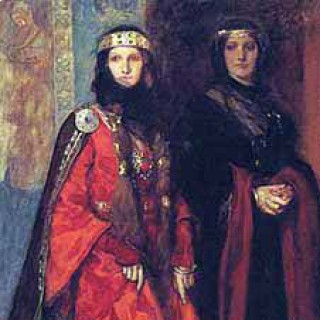
character in King Lear
POPULARITY

12 episodes with Goneril

8 episodes with Goneril

2 episodes with Goneril

2 episodes with Goneril

2 episodes with Goneril
4 episodes with Goneril

2 episodes with Goneril

2 episodes with Goneril

3 episodes with Goneril

Chaque soir, la metteuse en scène Andrea Jiménez invite un nouvel acteur à monter sur scène pour endosser le rôle du Roi Lear… mais sans aucune répétition préalable et sans avoir appris le texte : un véritable saut dans le vide ! Le comédien est uniquement guidé par la metteuse en scène en direct… à l'aide d'un acteur souffleur. Mathieu Amalric, Nicolas Bouchaud, Pascal Gregory, Arthur Nauziciel, Laurent Pointrenaux, Pascal Reneric et Dorcy Rugmaba, Marcel Bozonnet : un casting de luxe avec des acteurs majeurs du théâtre et très célèbres qui acceptent de se jeter dans le vide pour jouer le Roi Lear ! le spectateur ne sait pas à l'avance quel comédien jouera le vieux roi shakespearien « c'est pour créer cet effet de surprise de l'irrépétible, de l'unique », explique Andrea Jimenez. « Les comédiens eux-mêmes acceptent pour ce désir d'être toujours surpris, de faire face à quelque chose de nouveau. » « C'est même plus qu'une expérience, c'est un voyage. », précise Marcel Bozonnet. Sur scène, Andrea Jimenez joue le rôle de Cordélia, la fille de Lear, et il y a un acteur qui souffle le texte à l'acteur qui joue Lear avec une oreillette... Cet acteur ne sait rien du texte... La metteuse en scène a appliqué ce dispositif 135 fois avec 135 acteurs différents et notamment au festival d'Avignon. Le Roi Lear, tragédie de Shakespeare, a été écrite entre 1603 et 1606. La pièce raconte l'histoire d'un vieux roi qui décide de partager son royaume entre ses trois filles en échange de déclarations d'amour. Trompé par les flatteries de Goneril et Regan, il déshérite Cordélia, la seule sincère. Les deux aînées, une fois au pouvoir, l'humilient et le chassent, tandis qu'un complot parallèle oppose le duc de Gloucester à son fils légitime Edgar, trahi par l'ambitieux Edmund. Lear sombre alors progressivement dans la folie en découvrant la trahison de ses deux filles et la fragilité du pouvoir. Cordélia revient avec une armée pour le sauver, mais la défaite, les exécutions et les meurtres se succèdent, aboutissant à la mort de Cordélia et de Lear, et à une fin profondément tragique qui interroge la justice humaine et divine... Avec cette pièce, la metteuse en scène Andrea Jimenez entend faire le lien entre son histoire personnelle et celle contée par William Shakespeare : ainsi que le Roi Lear a répudié Cordélia, la metteuse en scène a elle-même été répudiée par son père... Invités : Andrea Jiménez, autrice et metteuse en scène de Casting Lear et Marcel Bozonnet, l'un des comédiens qui joue le rôle du Roi Lear. Andrea Jiménez est metteuse en scène, interprète, auteure et productrice espagnole. Marcel Bozonnet est un acteur, metteur en scène et pédagogue français né à Semur-en-Auxois, le 18 mai 1944. Ancien directeur du Conservatoire national, ancien administrateur de la Comédie française, il a joué des dizaines de rôles sur toutes les scènes d'Europe avec les plus grands metteurs en scène. Il joue le rôle du Roi Lear. Casting Lear, d'après Le Roi Lear, de William Shakespeare : à voir au Théâtre de la Ville, aux Abbesses jusqu'au 18 septembre 2026. Et la chronique Ailleurs au Canada avec Sherry Simon, professeure émérite de l'Université Concordia. Elle participe à une conférence consacrée aux Langues minorisées, pour fêter les 30 ans de la Déclaration universelle des droits linguistiques qui aura lieu le jeudi 17 septembre 2026 à l'Université Concordia Montréal. Programmation musicale : Le groupe Java et Winston « Macanuf » avec le titre En fait.

Chaque soir, la metteuse en scène Andrea Jiménez invite un nouvel acteur à monter sur scène pour endosser le rôle du Roi Lear… mais sans aucune répétition préalable et sans avoir appris le texte : un véritable saut dans le vide ! Le comédien est uniquement guidé par la metteuse en scène en direct… à l'aide d'un acteur souffleur. Mathieu Amalric, Nicolas Bouchaud, Pascal Gregory, Arthur Nauziciel, Laurent Pointrenaux, Pascal Reneric et Dorcy Rugmaba, Marcel Bozonnet : un casting de luxe avec des acteurs majeurs du théâtre et très célèbres qui acceptent de se jeter dans le vide pour jouer le Roi Lear ! le spectateur ne sait pas à l'avance quel comédien jouera le vieux roi shakespearien « c'est pour créer cet effet de surprise de l'irrépétible, de l'unique », explique Andrea Jimenez. « Les comédiens eux-mêmes acceptent pour ce désir d'être toujours surpris, de faire face à quelque chose de nouveau. » « C'est même plus qu'une expérience, c'est un voyage. », précise Marcel Bozonnet. Sur scène, Andrea Jimenez joue le rôle de Cordélia, la fille de Lear, et il y a un acteur qui souffle le texte à l'acteur qui joue Lear avec une oreillette... Cet acteur ne sait rien du texte... La metteuse en scène a appliqué ce dispositif 135 fois avec 135 acteurs différents et notamment au festival d'Avignon. Le Roi Lear, tragédie de Shakespeare, a été écrite entre 1603 et 1606. La pièce raconte l'histoire d'un vieux roi qui décide de partager son royaume entre ses trois filles en échange de déclarations d'amour. Trompé par les flatteries de Goneril et Regan, il déshérite Cordélia, la seule sincère. Les deux aînées, une fois au pouvoir, l'humilient et le chassent, tandis qu'un complot parallèle oppose le duc de Gloucester à son fils légitime Edgar, trahi par l'ambitieux Edmund. Lear sombre alors progressivement dans la folie en découvrant la trahison de ses deux filles et la fragilité du pouvoir. Cordélia revient avec une armée pour le sauver, mais la défaite, les exécutions et les meurtres se succèdent, aboutissant à la mort de Cordélia et de Lear, et à une fin profondément tragique qui interroge la justice humaine et divine... Avec cette pièce, la metteuse en scène Andrea Jimenez entend faire le lien entre son histoire personnelle et celle contée par William Shakespeare : ainsi que le Roi Lear a répudié Cordélia, la metteuse en scène a elle-même été répudiée par son père... Invités : Andrea Jiménez, autrice et metteuse en scène de Casting Lear et Marcel Bozonnet, l'un des comédiens qui joue le rôle du Roi Lear. Andrea Jiménez est metteuse en scène, interprète, auteure et productrice espagnole. Marcel Bozonnet est un acteur, metteur en scène et pédagogue français né à Semur-en-Auxois, le 18 mai 1944. Ancien directeur du Conservatoire national, ancien administrateur de la Comédie française, il a joué des dizaines de rôles sur toutes les scènes d'Europe avec les plus grands metteurs en scène. Il joue le rôle du Roi Lear. Casting Lear, d'après Le Roi Lear, de William Shakespeare : à voir au Théâtre de la Ville, aux Abbesses jusqu'au 18 septembre 2026. Et la chronique Ailleurs au Canada avec Sherry Simon, professeure émérite de l'Université Concordia. Elle participe à une conférence consacrée aux Langues minorisées, pour fêter les 30 ans de la Déclaration universelle des droits linguistiques qui aura lieu le jeudi 17 septembre 2026 à l'Université Concordia Montréal. Programmation musicale : Le groupe Java et Winston « Macanuf » avec le titre En fait.

Episode 218:Last time I looked at the first part of ‘King Lear' from the opening scene where Lear makes his disastrous decision to split his kingdom between his children, through to the renowned scene where the ex-king and his fool are caught in a raging storm on the moor and saved only by the loyalty of Kent. On the way I looked at the deliciously evil Edmund, the poor judgement of his father Gloucester, and the scheming of Lear's oldest daughter Goneril. Now I will complete this look at the play and discuss it's place as a very Jacobean play addressing the concerns of its time when King James was working hard at an attempt to unite his disparate kingdom. The role, character and purpose of the FoolThe mock trial sceneThe blinding of GloucesterThe character and cruelty of ReganEdgar and Gloucester on the cliffs at DoverHope before tragedy as Lear and Cordelia are reunitedA family dispute as the heart of the playWhy Lear resonates so strongly with audiencesThe sense of ‘no place' in the playKing Lear as a message for King James The significance of the non-Christian setting of the playThe play as a tragedy and a history playA brief view of the later critical and performance history of the playA small selection of ‘King Lear' on filmSupport the podcast at:www.thehistoryofeuropeantheatre.comwww.patreon.com/thoetpwww.ko-fi.com/thoetpYou can find an advertisement free version of the latest podcast episodes by joining on Patreon at the lowest paid tier level – that's for just £1 per month. Hosted on Acast. See acast.com/privacy for more information.

What a delight to talk to laura thompson about Agatha Christie. Above all, this episode was fun. Laura really does know more than anyone about Agatha and we covered a lot. What did Agatha Christie read? What did she love about Shakespeare? Was she pro-hanging? Why so much more Poirot than Marple? Why was she so productive during the war? We also talked Wagner, modern art, the other Golden Age writers, nursery rhymes, TV adaptations, poshness, nostalgia, Mary Westmacott, and plenty more. TranscriptHENRY OLIVER: Today I am talking to the very splendid Laura Thompson. All of you will know Laura's Substack. She has also written books about the Mitfords, heiresses, Lord Lucan, many other subjects, and most importantly today, Agatha Christie, who died 50 years ago. And there's a new book coming from Laura about Agatha Christie's 1926 disappearance.Laura, welcome.LAURA THOMPSON: So lovely to be here, Henry. I'm such a fan of your Substack, as you know.OLIVER: Well, same. Same. This is a mutual admiration call.THOMPSON: Well, thank you. Well, that's what we like.Christie's Favorite WritersOLIVER: Now tell me, what did Agatha Christie like to read?THOMPSON: Oh, a lot the same as us. I discovered she was a huge fan of Elizabeth Bowen, as we are. And Nancy Mitford, Muriel Spark. But her big love really was Dickens. She absolutely adored Dickens. I mean, she grew up in a house full of books, you know, and she wrote a screenplay of Bleak House for which she was handsomely paid. And it was never—I know, don't you long to know what that was like? Can you imagine—OLIVER: We've lost it? We don't have the typescript?THOMPSON: I've never seen it. I mean, maybe—I don't know whether it exists somewhere. But I just wonder how she tackled it, what she did. But yes, so that happened. And of course, Shakespeare, as we know from her books, which are full of subliminal and—I mean, you kind of notice them, but you don't have to.OLIVER: Yes. There's Shakespeare in every book?THOMPSON: No, but it's there, particularly Macbeth, which I suppose figures.OLIVER: Yeah.THOMPSON: Like The Pale Horse is completely Macbeth themed. And when I was a kid reading them, I think she really—Tennyson she uses a lot—she affected my reading in a good way.OLIVER: She sent you back to Shakespeare and the poets?THOMPSON: Well, sent me to them as a kid, probably. And also, there's a lot of Bible in her books, as I'm sure you've noticed.OLIVER: Yes. Yes.THOMPSON: Very easy facility with quoting the Bible.Christie and ShakespeareOLIVER: Now, what did she learn from Shakespeare? Because she clearly knows the plays in detail. She sees them a lot. She reads them. She and he are, I think, quite good plotters.THOMPSON: Is she even better than he is?OLIVER: Well, let's not get into that. But there is a sort of, in a funny way, a kind of affinity between them as writers.THOMPSON: That's so interesting.OLIVER: What do you think she learned from him?THOMPSON: Tell me how you—how you see that.OLIVER: Well, do you know that Margaret Rutherford adaptation, which probably you don't like and I do—THOMPSON: Go on.OLIVER: It's called Murder Most Foul, isn't it?THOMPSON: Yes.OLIVER: And there's something about the way that they can both walk the line between the sort of dark and deadly and the histrionic. Margaret Rutherford can't walk that line, but Agatha Christie can, right?THOMPSON: That's really interesting.OLIVER: And Miss Marple could come onstage in a couple of the plays. She's not so far off from being a Queen Margaret or some—in her angry moments maybe, do you think?THOMPSON: More rational, maybe.OLIVER: Much more rational.THOMPSON: Not so mad. Well, she's not mad, Margaret, is she? But she's upset.OLIVER: She starts off as a much sort of nastier character—Murder at the Vicarage, right?THOMPSON: Yes, she does. She was more acidic and then gradually—OLIVER: Waspish.THOMPSON: Waspish, and sort of mellowed. I see what you mean. And almost in the way that she calls herself—although that's obviously not Shakespeare—calls herself Nemesis.OLIVER: And the sense of atmosphere.THOMPSON: Yes, and the way they're structured. That's not necessarily just true of Shakespeare, but there is this sort of act three entanglement and this beautiful act five resolution that goes on with a soliloquy, I suppose.OLIVER: And some people think they both get confused in act four, but that's obviously not true, that this is the real mess of the plot. I think she might have learned quite a lot from Shakespeare, right?THOMPSON: That's really interesting. But, you know, the way she writes about Shakespeare in her letters to her second husband, Max, because when she was living in London during the war and almost at her most productive—I mean, her productivity levels are insane. And hitting every ball for six, really, you know: Towards Zero, Five Little Pigs, a couple of Westmacotts, which I'm sure we'll talk about. But she spent a lot of time going on her own to see Shakespeare.She's very—I hope I'm right in saying this—she's very sort of Ernest Jones [CB1] in her approach. She doesn't regard them so much as the products of words on a page; she regards them as rounded characters. Why were Goneril and Regan the way they were? What's wrong with Ophelia? You feel like saying, “Well, whatever Shakespeare wanted it to be,” but she sees them in that way. And Iago particularly—OLIVER: Yes.THOMPSON: —is the one that gets her. Yes. In one of her, I better not say which, but a major, major novel.And the book that she wrote under the name Mary Westmacott, The Rose and the Yew Tree, which I think might well be her best book of all. I think—well, I'll just say she wrote these six books under a pseudonym, Mary Westmacott. People call them romantic novels; that's sort of the last thing they are. And they're very, very interesting mid-20th-century human condition novels, and they're full of lots of stuff that she had to distill for the detective fiction. And she talks a lot about Iago in The Rose and the Yew Tree really interestingly, I think.Christie on Shakespeare?OLIVER: Now, Max said she should just write a book about Shakespeare, all this Shakespeare all the time. But she didn't. Why?THOMPSON: No. I don't think she ever liked being told what to do.OLIVER: [laughs]THOMPSON: His letters to her are quite annoying, aren't they?OLIVER: Yes, yes. I've only read what's in your book, but yes, I didn't warm to him.THOMPSON: I'm glad because people do. He gets a really good press even though he was unfaithful. But it worked, the marriage, because they both got what they wanted from it. But he said that, yes, and she says, “Oh no, they're just thoughts for you.” I don't think she would've felt the need, somehow. I think she liked saying things in her own more oblique way.OLIVER: Save it for the novels.THOMPSON: Yes, she's a great mistress of the indirect, I think, really. The way she writes about Macbeth in The Pale Horse, which I think is a really underrated novel, including thoughts on how it should be staged, which are really interesting and very, very good. I think she would've preferred to do that and use it to her ends.And of course, she has an incredibly powerful sense of evil, which I suppose is also in Shakespeare. Hers is a Christian sensibility, I mean, no question. People never talk about that, but it really is.OLIVER: Was she pro hanging?THOMPSON: Well, I think she took a kind of utilitarian approach that the innocent must be protected. And she took a view that if you've killed once, it becomes very easy to kill again because something in you has shifted, so you become a danger to the community. So I suppose in that sense she was.I mean, Miss Marple was. She's quite—“I really feel quite glad to think of him being hanged.”OLIVER: It's one of her most striking lines.THOMPSON: It is, isn't it?OLIVER: Yes.THOMPSON: So I suppose she was. I mean, I suppose she was. You know, she's very modern, she's very subtle in her thinking, but at the same time, she is a late Victorian product of her society. Yes.Dickens and Christie's FamilyOLIVER: Now, you mentioned this Bleak House script. She loved Bleak House. Do we know what she loved about it? It's obviously the first detective novel. Are there other factors?THOMPSON: You are going to know—this is when I'm going to start coming across as an idiot. Is it written before The Moonstone? Yes, of course it is.OLIVER: I think so. Yes. Yes. It's the first time there's a police detective in a major English novel.THOMPSON: Okay. I think she—do you know, this is a really good question. I don't actually know why she loved Dickens so much. She grew up—she had that rather intriguing upbringing whereby she had two much older siblings, a sister who was 11 years older, a brother who was 10 years older. Father died when she was 11.So she grew up incredibly close with a really rather intriguing mother, Clara. This is in the house at Torquay. And her mother encouraged her in a way that, it seems to me, quite unusual for the time and for the class to which she belonged. Because it was never deemed that it would interfere with her marrying and leading a more conventional life. But she always wanted to express herself creatively. And I think her mother possibly was a frustrated creative. I don't know. She had a lot of go in her.And whether it was just something she read with—I think anything she did at an early age with her mother would've made a huge impression on her. I think what you read when you're that age, you never quite—I never read Dickens at that age, so I've never quite got the habit.OLIVER: But if she's born in 1890, presumably her mother is just about old enough to have been alive when Dickens was alive. And so she's got a somewhat direct—THOMPSON: Yes, she was.OLIVER: You know, it's sort of back to the original culture of it, as it were.THOMPSON: Yes. Isn't that extraordinary?OLIVER: Yes. Yes. It's crazy to think. So she must have taken it in maybe in a more original way, somehow?THOMPSON: Possibly. Certainly Tennyson, I get that feeling, because her mother wrote this rather leaden sub-Tennysonian poetry. [laughter] It's like Tennyson on the worst day he ever had, but worse than that.OLIVER: But worse, yes.THOMPSON: Yes. And she wrote poetry like that, the mother, which is really rather sweet and touching to read. And obviously she would've been alive at the same time as Tennyson. So, yes, I'd never, ever thought of that before. Isn't that extraordinary? I mean, they went to see Henry Irving.OLIVER: Yes.THOMPSON: Yes. And yet she feels—it just amazes me, this—so I'm leaping slightly here, but this 21st-century halo of cool that she has around her, Agatha Christie. [laughter] I know, it's awful in a way, but the way she can be reinterpreted—that is a bit Shakespearean, in a way.I don't mean to make extravagant claims, but there's a sort of translucent quality to what she writes that means that people can impose and pull it and twang it and know that she won't let them down, as we are seeing constantly at the moment.Art and MusicOLIVER: Yes. No, I agree. Other arts—we know about all this, she loves reading. What music did she enjoy, for example? Did she like paintings?THOMPSON: Yes, she loved paintings. She liked modern art. She was painted by Kokoschka. It's very good. And she writes about modern art. In Five Little Pigs, the painter in that is a modern artist.And then music was her grand passion. I mean, music was her original career choice, as you know, of course. She must have had a good voice. She thought she could make a career of it. And she could play the piano. Beautiful piano at Greenway, it's still there.And they used to do this thing—I think it's a lovely idea—as a family. They would fill in what they called the book of confessions, and it would be questions like, “What is your state of mind? If not yourself, who would you be?” And at the age of 63, which is the last time she filled it in, she wrote, “An opera singer.” So that was still what she would've dreamed of doing. She loved Wagner very, very deeply.OLIVER: Okay. Interesting.THOMPSON: And there's a Wagner theme in a very late book, Passenger to Frankfurt, the one that everybody hates except me. And music, I mean, as a girl when—so her voice wasn't strong enough for opera. I think her ultimate—same as I grew up wanting to be a ballet dancer, I think her ultimate would've been to sing Isolde at Covent Garden.And in some of her short stories and in her first Mary Westmacott, which is called Giant's Bread, which is about a musician—and she really inhabits this character, Vernon, and it's all about modern music. And somebody who knew about this stuff, which I don't, told me, “No, she knew. She knew what was going on. She knew about the trends.” This is in the late twenties.And she always went to Beirut, and that was her real, real, real passion. She was one of those restlessly creative people. And her mother, God bless her, encouraged it.Christie's UniquenessOLIVER: What is it that distinguishes her from the other detective fiction writers? Because she doesn't, to me, feel—she's obviously part of this whole generation, this whole golden age, whatever you want to call it, but she doesn't feel the same as them somehow.THOMPSON: No.OLIVER: What is that?THOMPSON: Do you think it's her simplicity, that distilled simplicity that she has? She doesn't write linear; she writes geometric, I always think.OLIVER: Tell me what you mean.THOMPSON: Well, if you think of a book, the one I admire the most, as I constantly go on about, which is Five Little Pigs—you think about the amount of stuff that's in that book. It's a meditation on art versus life. The solution is unbelievably intriguing, I think. There's a whole family psychodrama in there. And every move of the plot, she's also moving on a—every move of the plot is impelled by a revelation of character. So plot and character are utterly intertwined, distilled together.I don't think any of the others can do that. I think Dorothy Sayers would take twice as many pages. And she'd dot every i and cross every t, and she couldn't bear loose ends or anything, could she? And she liked to reveal her knowledge of other things, almost to—I think the others like you to know that they're a bit better than the genre, maybe. Their detectives are superhuman, almost; wish-fulfillment man, almost.She doesn't do that with Poirot. He's just pure omniscience, really, plus a few tics and traits and, you know, mustache. I think it's that distillation and simplicity and the way she inhabits the genre in a way that the others don't quite do. And at the same time, she's redefining it from within.OLIVER: There's something as well, I think, about—she gets past the kind of Sherlock Holmes model in a different way. They still all have a bit of an overreliance on that, maybe.THOMPSON: Yes.OLIVER: Whereas Poirot in, what is it? In something like, is it Murder in the Mews? Very sort of Sherlock and Watson—THOMPSON: Yes.OLIVER: —kind of dynamic. But within, I don't know, two or three novels, that's gone, and he's Poirot as we know him, as it were.THOMPSON: Yes, yes.OLIVER: And she kind of, as you say, makes it her own thing and goes off in new directions.Christie and the TheaterTHOMPSON: Yes. She's sort of conceptual and the others aren't quite, I think. She doesn't do—she does something completely different with the whole concept of what a solution is, it seems to me. She doesn't—it's not Cluedo, is it? It's not, there's six of them, and eventually it has to be one of them; however many tergiversations or however you say that word, you sort of know that. Whereas with her, it's: it's nobody, or it's everybody, or it's the policeman, or it's a child, or there's something bigger and bolder going on.And she writes—I think she writes very theatrically. I think she writes scenically. I think she's incredibly good at character and action. That scene where you know the girl's a thief because Poirot leaves out 23 pairs of silk stockings, and he goes back in the room and there's 19 or something like that, tells you everything. It's all in there.OLIVER: The solution to 4.50 from Paddington, which we shan't reveal, but—THOMPSON: That's Cards on the Table. But what I mean is, she's given us a little scene that tells us all we need to know about that person, really: a sort of timid thief who can't resist—OLIVER: Yes, but that's what I'm saying. At the end of 4.50, the solution is staged.THOMPSON: Oh, sorry. Yes.OLIVER: It is literally a little re-creation of the drama, if you see what I mean.THOMPSON: Yes, I do. Sorry, Henry. Yes, absolutely.OLIVER: No, no. We're crossed wires.THOMPSON: Yes, yes, yes.OLIVER: But she is very theatrical, yes.THOMPSON: No, you are absolutely right. That's a reenactment.OLIVER: Of something that was seen almost like in a—you know, the whole thing is very—THOMPSON: Yes, yes. Well, she was a great—I mean, obviously Shakespeare, but she was a great lover of the theater as a medium. And of course, she wrote plays, as we know, which I think are far weaker than her books, myself.OLIVER: Even The Mousetrap?THOMPSON: Especially. [laughter] When did you last see it? Or have you not—OLIVER: I've seen it once. I've seen it—you know, I don't know, before I had children, a long time ago. And I thought it was great. It was a lot of fun. The ending of act one, when someone opens a door and they say, “Oh, it's you.” It's very dramatic moments. You don't like it?THOMPSON: No, I think you're right. I wouldn't mind seeing it done really, really well. There's something strong at the heart of it, that theme that haunts a lot of her books about what happens to children who are unwanted.OLIVER: Yes.THOMPSON: Which is in loads of her—no, not loads. It's in Ordeal by Innocence. It's in Mrs. McGinty. That's, I think, because that happened to her mother. Her mother was given away as a child. Her own mother was a poor widow and gave up her daughter to be raised by her rich sister, which is not—it's not abandonment, but I think—OLIVER: Well, yes.THOMPSON: — it's not great. And I think all these things were absorbed by Agatha as a child. She grew up in what we would today call a house of—I hate this—strong women. I hate that “strong woman” thing, but they were strong women. Her mother was very, you know, as we've said, a sort of driving little person. And the rich grandmother, the poor sister, the dynamic there, they both fed into Miss Marple.And then her older sister, Madge, who was a big personality and actually had a play on in the West End before Agatha did, which I've always thought was extraordinary, just to write a play and have it on in the West End in 1924.And the men were—the father was feckless and charming and a rather grand New Yorker, he grew up as, and then settled in Torquay. And the brother was the Branwell Brontë. [laughter] He ended up a drug addict, which is also a type that feeds into her fiction: the man who could have made something of his life and goes wrong.The TV AdaptationsOLIVER: So all this theatricality in the books is obviously why she adapts so well to TV, and again, a lot of the others don't.THOMPSON: Yes, that's true.OLIVER: How famous would she be now without the TV adaptations?THOMPSON: Well, by 1990, so the centenary, she was a hell of a lot less—and that's really when the Poirots got going, which she never wanted. She never wanted—she didn't really want Murder on the Orient Express. It was only because it came via Lord Mountbatten. I don't know. I don't know because I think they're mostly not very good. I don't know what you think about the adaptations. But maybe that's deliberate, that they're less—if they drove you back to the books, you'd probably get quite a pleasant surprise.OLIVER: It's hard for me to say because I saw them all more or less after I'd finished reading her.THOMPSON: What did you think?OLIVER: I love Joan Aiken—not Joan Aiken, what's she called?THOMPSON: Yes, Joan Hickson is marvelous. Yes, absolutely.OLIVER: Hickson. I think she's just perfect because as you say, the simplicity, the not overstating. The “Pocketful of Rye” episode where she turns up and quotes the Bible, and the vicious older sister is there, and they have that moment. It's all so cleanly done.THOMPSON: Yes, I agree.OLIVER: David Suchet, I quite like him. I think he has those wonderful moments. “I cannot eat these eggs. They are not the same.” I think that's very good. It's very funny, you know, he gets it.THOMPSON: You prefer him in spats and art deco mode to when he became—he became like a de facto member of the House of Atreus by the end, hadn't he? It had gone very, very—OLIVER: I mean, I certainly didn't watch them all, no, no.THOMPSON: No. Well, I sort of had to.OLIVER: Yes, you did.THOMPSON: But I could never get through those short story ones. I don't think I've ever got—OLIVER: The moral sort of doom of it all, yes.THOMPSON: Well, the early ones, when they always had—you could see they'd hired a car for the day. [laughter] And I don't think I've ever got to the end of one of those.But I think—sorry, going back to your question, I think they probably did make a massive difference. You know, they're really, really popular. And whether she would have—what you think her—she might be read as much as somebody like Sayers if it weren't for all those adaptations. But then the fact of all those adaptations tells its own story in a way, because that wouldn't happen to one of the others, as you rightly said.Resurgence and PopularityOLIVER: No, they don't have that quality. And also, she was bigger than them. That's why they picked her, because she was bigger than them anyway.THOMPSON: And simpler. Because when I used to read them at university between the pages of Beowulf or whatever, like porn, [laughter] it was a bit mal vu. You read her for entertainment. But you certainly—I don't think—she's always been admired by a certain kind of French intellectual, hasn't she, for that subtextual quality that she has, that sort of fathomless quality that she has.But when I researched that biography, which I started in 2003, I can remember going on the radio. And names will not be named, but I was like a figure of fun with a couple of other detective writers, quite well known, who just sort of openly mocked me for taking her seriously and more or less said, “Oh yeah, we love her, but she's terrible” kind of thing. “Why are you taking her seriously?” I mean, it was regarded as a bit of a joke to take her seriously.I'm not saying I changed the game or anything like that, but I think there must have been a movement around that time in the early twenty-naughties—whatever the damn thing, decade's called—to start seeing that she is an interplay of text and subtext, facade and undercurrents, and these powerful foundations that underpin her books. Murder on the Orient Express is, you know, “Does human justice have the right to exert itself when legal justice has let it down?”There are these very strong—I think this is part of why she's survived the way she has. We intuit powerful truths underneath the Christie construct, if you like. I always say she's not real, she's true. I think she's incredibly wise about human nature, possibly more than any of them.You take a book like Evil Under the Sun, and there's a femme fatale who's murdered. “Oh, the femme fatale. No man can resist her.” Turns out she can't resist men. She's prey; she's not a predator. And of course, women who are so dependent on their looks and so on, that is what they are. They are prey. They're not predators. They're very, very vulnerable. Just a really small thing like that. And I just think, oh, you're very—there's so much easy wisdom in there somehow.And she deploys it perhaps differently—I mean, Ruth Rendell is wise, but it's very, “I am wise and you're going to pay attention to me.” You know what I mean? It's all very, “I'm very dark and very wise and very,” you know. I love her, but everything's so easy with Agatha. It's so, to coin a phrase, two tier. You can read them and have fun with them. You can read them and there's so much stuff going on underneath, and yet she presents this smooth face. I don't think any of the others are quite that resolved, if you like.Self-AdaptationsOLIVER: Now, you wrote that her own stage adaptations of The Hollow and Five Little Pigs lack the subtlety of the original books, quote, “almost as if Agatha herself did not realize what made them such good books.” How much of her talent do you think was unconscious in that way?THOMPSON: Yes. That's such a good question. I do think that, about those plays, it could have been that she just thought, “That's not what my audiences are going to want from me. They're just going to want to be entertained by”—we know she can do the other thing because of her Mary Westmacott books, where everything is laid out. They're not distilled at all; they're quite the opposite.I think they must have been such a pleasure for her to write because she didn't have to constantly—they're unresolved; they ask questions that don't have to be answered. She could have done that with those plays, I'm sure, but I think she would've thought people aren't coming to see them for that. I think she had a very good opinion of herself, in the best possible way.OLIVER: Hmm.THOMPSON: Like I said to you earlier, she didn't take a lot of notice of anything anybody said to her. Because it is like writing this other little book, the one I've just done about 1926. She was very acclaimed right from the start. I didn't emphasize that enough in the biography. And she was really recognized as very special right from the start.And I think it's extraordinary to me how—it's so difficult for us today, isn't it? We're so at the mercy of “That won't sell, don't do that, blah, blah, blah.” She really did not just plow her own furrow, but create that furrow in a way that you can only compare with, like, Lennon and McCartney. Or whether the time was absolutely right that they let her run, they trusted her to do what she wanted, and because she had the gift of pleasing readers . . .You do really feel, although those books are very tight and taut, you do feel an instinctive ease in what she's doing, an instinctive sort of—there's a kind of liberated—which sounds perverse because they are so controlled, the books. But I always feel she's doing exactly what she wants to do because she knows what it is and she knows how to do it. Because I think, would she be amazed that you and I are having this conversation now? I don't know that she would be, really. What do you think?OLIVER: No, I agree with you. I think she had what Johnson said, the felicity of rating herself properly. I think she knew she was really good.THOMPSON: You might know he'd say it right.OLIVER: Yes. [laughs] But there's a—I think there must have been something about—I think it's in Poirot's Christmas, one of those, where someone gets killed in the night in their bedroom, and they go up. And one of the women says, “Who would've thought the old man had so much blood in him?”And the quotation just sort of occurs to—I think there's quite a lot of that in Christie, right? Things are coming up and it fits. And she's good enough to run on instinct at times.THOMPSON: That's right. That's it. Exactly. That's absolutely right. Like the way she quotes from the—yes, I love the bit when she quotes from the Book of Saul in One, Two, Buckle My Shoe, which is really quite a profound novel about whether—I mean, it's terribly timely—whether it's better to be run by a corrupt capitalist or to let in the radicals. And as I said in the biography, the corrupt capitalist wins on points. But then another element enters, which is what power does to people. And that's when she quotes from the Book of Saul.And it's just like you said, this—an instinctive that she—I do always feel her as an instinctive writer, even though—her notebooks are intriguing because obviously some plots she really has to work away at. And yet they feel felicitous. A coup like The ABC Murders, and she's really—that went through lots and lots of iterations. But what she'll often do is scribble down a line of dialogue, a line of “There they are.” It's the whole—it's not bullet points, which is a loathsome concept. It reminds me of a bee going from flower to flower and knowing exactly which—and she's got this gift of knowing what flowers we're going to need.I sometimes fear I overdo it. I don't want be like one of those people who's writing a PhD on, what was the thing I said on Substack, gynocracy in St. Mary Mead or whatever. It's not—I do think that's a bit overdone these days, the rummaging in the subtext, because she's an interplay. And that's why I write that chapter in the book called “English Murder,” which is about the facade, you know, “smile and smile and be a villain.” And there's nothing more interesting. There's nothing more interesting than murder among classes who are trying to cover things up.And she does that—that's at the heart of golden age murder, I suppose. And I just think she does that better than anybody because she's so all the things we've been talking about. She's so distilled, she's so simple, she's so smooth, she's so instinctive. And she's doing it the way she wanted to do it because of your wonderful Dr. Johnson quote. She knew not to take notice of other people, including her—Quick Opinions on ChristieOLIVER: Should we have—THOMPSON: Yes. Go on.OLIVER: Sorry, sorry. Should we have a quick-fire round?THOMPSON: Please.OLIVER: I will say the name first of a few of her books—THOMPSON: Oh, god.OLIVER: —and then a few other detective writers, and you will just give us your unfiltered opinion: good, bad, ugly, indifferent.THOMPSON: Okay. What fun.OLIVER: You can “nothing” them if you want to.THOMPSON: Okay. [laughter]OLIVER: Hallowe'en Party.THOMPSON: Underrated. Very interesting on sixties counterculture and the effects of societal breakdown, et cetera. What do you think?OLIVER: I think it's a real page turner. I remember reading that for the first time. I loved it. Yes. Nemesis.THOMPSON: I can't keep saying the same thing. Underrated. [laughter] Very interesting philosophy of love in that book, I think. I think it harks back to her first marriage. However badly it turns out, it's better to have experienced it. It's quite a mournful novel.OLIVER: The Mr. Quin—THOMPSON: Oh.OLIVER: Oh, sorry.THOMPSON: No, no. Sorry. You carry on. Marvelous. So inventive, don't you think? Such a clever character.OLIVER: Why didn't she do more of him?THOMPSON: Yes, that would've been good. And she was always interested in the commedia dell'arte. She wrote poems about it as a girl. And the concept of Mr. Quin, yes, as this sort of evanescent figure who's also a moral force, isn't he really? Or—yes, I wish she'd done more. They're marvelous.OLIVER: Towards Zero.THOMPSON: Oh, top notch, don't you think?OLIVER: One of the best.THOMPSON: Yes, I agree. Frightening motive. Very Ruth Rendell.OLIVER: It's very distinct in her. I haven't read all of her novels, but it's very distinct.THOMPSON: But the plot is, again, typical of her because it redefines the word contingent. [laughs] I mean, Dorothy Sayers would be having palpitations. She's very bold and grand like that. “Oh, there's a loose end. Oh, who cares?” You know, I mean, it's so—it just drives along that book, doesn't it? Yes. But I agree with you, one of her best.OLIVER: Death on the Nile.THOMPSON: Quite moving, I think. I think it's one of those ones from the thirties that, again, is talking about love in a way that—I think it just strikes a personal note to me because she was very in love with her first husband, Archie Christie. And he did fall in love with another woman, and it did cause her extreme pain that some people said to me she never quite got over.And I feel that a little bit in that book. There's a shadow of something quite powerful in that book, I think. Again, very, very loose and lovely plot, but powerful. Would you agree? Very good on the place as well, I think, Egypt.OLIVER: I love it. I think the solution is great.THOMPSON: Yes.OLIVER: And it makes a really good film.THOMPSON: It's a great film, yes. Wonderful film.Other Mystery WritersOLIVER: Yes. Okay. A few other detective writers: Michael Innes.THOMPSON: You've got me. I haven't read him. Should I?OLIVER: Oh, I think you will like him. Yes. Try Hamlet, Revenge!THOMPSON: Okay. Okay. Oh, I like it already.OLIVER: Yes, yes, yes. Oh, this is exciting. Gladys Mitchell.THOMPSON: Can't get into her.OLIVER: No.THOMPSON: What do you think? Should I try a bit harder?OLIVER: I read two. I thought they were good. I was not intrigued.THOMPSON: No, somebody told—OLIVER: The ones I read—Spotted Hemlock is a wonderful, like, wow, that's great.THOMPSON: Okay. Okay. Somebody said to me, I know she really—no, I didn't—I read it in a book that she really hadn't liked Agatha Christie, but you know, who knows? All that Detection Club rivalry, you can imagine. But okay, Spotted Hemlock—if I'm going to read one, try that, yes?OLIVER: Yes, that's a great book. Margery Allingham.THOMPSON: Kind of love her, but I never understand her plots. I always feel I'm in a bit of a fog, but she's quite a good writer. Do you think? Or what do you think?OLIVER: She's good at the fog. She's good at that sort of whirligig sense that there's a lot going on—THOMPSON: Yes, whirligig.OLIVER: —and you've got to get to the end before they do, kind of thing.THOMPSON: Also, she had a pub in her sitting room. Now, I like a woman who has a pub in their sitting room.OLIVER: [laughs] E. C. Bentley.THOMPSON: You've got me again, Henry.OLIVER: Oh, The Blotting Book mystery. You'll like this.THOMPSON: Okay. Okay.OLIVER: The other one is not so good, but you'll like that a lot.THOMPSON: Okay.OLIVER: Edmund Crispin.THOMPSON: Didn't get on with him.OLIVER: Why not?THOMPSON: Don't know. Don't know. It sounds like I don't read the men, doesn't it? Which is not the truth at all.OLIVER: I think that's fair enough, isn't it?THOMPSON: Well, I don't know. I don't think anyone's ever come up with a really good reason why women have shone so brightly in this genre. I don't know. Why didn't I—I read that one, the toyshop one [The Moving Toyshop] or whatever. I don't know. I just didn't get on with it.OLIVER: Too glib?THOMPSON: Possibly.OLIVER: Bit flippant, bit sort of funny-funny?THOMPSON: Possibly. I just couldn't quite get hold of it in some way. I don't know.OLIVER: I quite like Edmund Crispin, but I do think he's got a bit of a “he's a very clever boy” about him.THOMPSON: Maybe that's what it was. Maybe that.OLIVER: Something, yes. G. K. Chesterton.THOMPSON: I haven't read Father Brown. Oh, this is awful, isn't it? I'm starting to sound like a radical feminist by accident.OLIVER: [laughs] Maybe that's what you are, Laura. Maybe you just need to admit it. [laughs]THOMPSON: No, it does. It sounds really bad because I do really love almost all the women. I just, I don't know why I haven't read him.Christie and NostalgiaOLIVER: Was Agatha a nostalgia writer?THOMPSON: No, I don't think so. I don't think so. I don't think anyone who was a nostalgia writer would've written At Bertram's Hotel, which is an entire spin on the riff of nostalgia. Really clever. I think that's such a clever book. The way she traps us in her golden age, you know, this phantasmagoria of the re-created golden age. And then she says, “Ha, really fooled you.”I've written about this. I think she moved with the 20th century far more than is realized. I love those Cold War novels she writes about her dislike of ideologies. I love her postwar books about the fragmentation of the hierarchical society. I think she's—well, she's an incidental social historian, as are, I think, P. D. James and Ruth Rendell, but they're much more underlined about it. Again, I'm intrigued what you think. Do you think she is?OLIVER: I think there's definitely some quality, particularly to the Miss Marple stories—as you say, the social history sort of becomes a way of preserving something that's disappearing. One of them, written in the sixties—you can tell me which one—it opens with that description of all the new houses in the village and the mothers who give their children cereal for breakfast. And what sort of a thing is that to give a child? They should have bacon and eggs. Bacon and eggs is a real—you know, and she does have a real something heartfelt and real sense that this part of England is going, and this new thing is coming in.THOMPSON: That's true. That's absolutely true. That's The Mirror Crack'd. And it's—OLIVER: The Mirror, yes, yes.THOMPSON: Yes, and that whole thing of Mrs. Bantry's house has now been bought by a film star and blah, blah, blah. Yes, no, you are absolutely right. I didn't think hard enough before I answered your question.OLIVER: But no, what you said is also true. I can't sort of work out to what extent she regrets it, to what extent it's just useful material for her, you know?THOMPSON: Both. I mean, some of her late books, including Endless Night, I think, which is an incredibly modern book—that whole “me, me, me” culture of “I want, therefore I will have now,” which is written when she was quite an old lady. And then a book like Passenger to Frankfurt, which is—it's a bit sub–Brave New World, but it's very honest and pessimistic about a future—well, the one we are living in, really—full of fear and uncertainty and almost dystopian.She was a realist. You know, she is Miss Marple in a lot of ways. She was a realist in a way that I think a lot of us would find it difficult to be. And her American publishers were often—would sort of say, can she tone this down? Can she not have a young person who's completely evil? Readers want to know, is she going get any therapy? [laughter] And it's so true. There's quite a lot of that going on.She's very clear-eyed. So if she—I'm a bit nostalgic for Blur, do you know what I mean? I mean, you can't help it, in a way, like that brilliant example you give at the start of The Mirror Crack'd. But I would say her image is quite at odds with the reality of her in that way. But the image—OLIVER: And the adaptations don't help with that.THOMPSON: No. No. But at the same time, that Christie image, you know, the gentlewoman, the tea or the eternal bridge party, blah, blah, blah, that has a huge power of its own. So just being too iconoclastic about her, I think, is also a lie. Because I think, again, it's that interplay. She used the image, and the image—I hate the word cozy. I loathe the word cozy, but there's no denying that any book of that kind does have that quality. So I suppose even that's nostalgic in a way.Christie's PoshnessOLIVER: In a way, yes. How posh was she?THOMPSON: Good question. I've been thinking about that a lot. Quite, I would say. Quite grand, with that confidence. Her father really was—as I said, he was a young blade in New York dancing with Jennie Jerome and blah, blah, blah. And then it so happened that he ended up in Torquay, which of course then was very posh. And the fact that when she disappears, she disappears to Harrogate, [laughs] which is like the Torquay of the north.I remember her grandson saying to me, “She dealt with her literary agent. To her, he was staff.” You know, that kind of thing. Her sister, there is a—well, her sister ended up very grand indeed with a huge house up in Cheshire.I think she just had that internal confidence, really. She wasn't—and that there wasn't much money. I mean, there was very little money when she was growing up, as of course you know, but that didn't matter. I mean, her voice is insane. Her voice is, [affecting a posh voice] “Oh, it's lucky it just happens.” [laughter] But yes, there's a part of her that is real late Victorian upper middle class that, again, underpins her books.It's amazing really how broad-minded and cosmopolitan she was. But possibly, I mean, possibly that does—she was—you know, when she disappeared, she was described in foreign newspapers as an Anglo-American, the embodiment of Englishness, and that's how she was described. And then of course she was genuinely cosmopolitan in her love of travel and her love of other cultures and all that obvious stuff. Yes.Inspirations for Miss MarpleOLIVER: How much of her grandmothers is in Miss Marple?THOMPSON: Quite a lot, I would say, particularly the—OLIVER: Drawn from life?THOMPSON: Well, in an essential way not, because Miss Marple has no real experience of life in that way. We're occasionally told about some chap who came calling who wasn't suitable or whatever, but she's almost defined by nonexperience of life in a sense, but observation of life. She's an observer. She's not an outsider in the way that Poirot is. She has a place within the social hierarchy and whatever, and that village has a reality to it. And the way it changes has a reality to it. But she is defined by being an observer, I would say.But Margaret Miller, who was the rich grandmother, who is the one who had the big house at Ealing and was—you know, she's the one who would go to the Army and Navy stores and all that stuff that's in At Bertram's Hotel. She was—there's a lot of her in Miss—I think, as I say in the book, she grew up with the sound of female wisdom in her ears. You know, her grandmother was the sort of—if she'd seen her up in Harrogate, she would've known exactly what was going on. You know, one of those kind of women who could spot an affair at a hundred paces, just a wise sort of woman, worldly, worldly woman.And Miss Marple is worldly in her thinking, but not in her experience, particularly in a book like A Caribbean Mystery, which I think is—she's a real sophisticate, Agatha. I mean, I'm reading The Hollow again at the moment. And it's really astounding to me how there's a love affair at the center of it with a young woman who's kind of a self-portrait and this married man. And not only, there's not—it's not only nonjudgmental; there's literally no concept of judgment being in the vicinity. It's really, really sophisticated, grown-up stuff, I think. And again, I think that's maybe not recognized about her that much.Nursery RhymesOLIVER: What are the importance of nursery rhymes to her?THOMPSON: Yes, that's interesting. They're part of that distilled quality she had, I suppose, that really simple ability to catch hold of something that is simple and familiar in itself and then subvert it. There's books where she—I don't think she needs it in Five Little Pigs. I think the book is almost too good for that.But is it not to do with that—like her titles, which are really, really simple with a faint frisson of the sinister about them. Is it not that ability she has to catch, to take something really, really simple and subvert it for her own ends? What do you think? Do you think that's right? Or do you think it's something more than that?OLIVER: No, I think the simplicity is the point, and I think it probably gives her a way of talking, of showing how fundamental the wickedness is. And as you say, the children can be evil, and it's part of the darkness in a way, but it gives the appearance of innocence and, oh, One, Two, Buckle My Shoe? You know, children do this. And so it leads you through and makes it worse somehow. [laughs]THOMPSON: Yes. Exactly. Exactly. But I know I've—how many times have I said the word simple? But I really do feel that's the heart of her. And I also feel it's the heart of why she was misunderstood when I was growing up reading her because it was mistaken for simplistic.Wartime ProductivityOLIVER: Why was she so productive during the war? I mean, there were four books one year.THOMPSON: Yes.OLIVER: And as you say, they're some of the best. I mean, what is it about the war that gets her so busy?THOMPSON: Well, she was on her own, which she had never been, really. Well, obviously she divorced her first husband in 1928. So there's a couple of very bleak, dead years before she met her second husband and married him in 1930. But she wasn't completely on her own because she had her friend Charlotte Fisher, who was a sort of secretary-companion, but much more than that—really, really good friend.But in the war, Max Mallowan was abroad. Her daughter—she had one child—her daughter was married and living in Wales. And she was living in the Isokon building in North London, which I love because that's like, “You think I'm chintzy and old fashioned. And here I am socializing with the sort of left-wing intelligentsia at the Isokon building.” And there's something about being in that adorable little flat—they're so fabulous, those flats—and being alone but not feeling abandoned, as she had after her first marriage.And I suppose also, you know, war is, you either cower in despair or you think, “Right, well, better get on with it.” War is stimulating in that way. I think it was to quite a few writers, maybe, or quite a few creatives. The shadow of death. But there was something about that solitude but not abandonment, plus the stimulation of not knowing whether it was your last day on earth that did—it did. I mean, it's absolutely insane how productive she is.And then she wrote—she had a week off. She was also working as a dispenser at a London hospital, and she had a week off. And she wrote a Mary Westmacott, Absent in the Spring, which is one of her best Westmacotts, I think. I mean, she's got a week off and she writes a book. I mean, Jesus, there's a challenge to us, Henry. [laughter]The Mary Westmacott NovelsOLIVER: What are those Mary Westmacotts like? Because I've never read them, but you seem very—THOMPSON: Oh, have you not?OLIVER: You're very up on them. You like them?THOMPSON: I am. I really am. Well, for a biographer, they were a treasure trove because they're very revealing. Unfinished Portrait is, I think, as close as you are ever going to come to a true autobiography, as opposed to the actual autobiography, which is charmingly disingenuous.OLIVER: And also dull. No? I mean, it's just so dull.THOMPSON: Do you think? It is a bit.OLIVER: I couldn't read it. I couldn't read it. No, it was so long and so leaden. I felt like she didn't really want to tell me the story of her life. Just couldn't.THOMPSON: Well, I think that's probably right. It was very heavily edited after her death. And her daughter was very, very protective of her. So, Max Mallowan as well. So maybe there was a much better book in there somewhere. Who knows?OLIVER: So we should read Mary Westmacott if we want the unfiltered Agatha?THOMPSON: I would say Unfinished Portrait. It really fascinates me because the worst time you've ever gone through in your life—so in 1926, she lost her mother and her husband in the space of four months. And I think an awful lot of people, even writers, would think, “I'm going to put that behind me and get on.” But she had to reopen the wound. She had to go through it all again eight years later. I find that really, in itself, incredibly revealing about her.Poirot vs. MarpleOLIVER: Why is there so much more Poirot than Marple?THOMPSON: Yes, I've wondered that because there is this little thing that she hated him, which I don't really think she did. It's just something people say, isn't it?OLIVER: Well, it's a common thing about artists. They're supposed to hate their most successful work, but—THOMPSON: Yes. Yes. All I could come up with was that he was easier to put in different places. He could conceivably be on the Nile or in Mesopotamia or—I mean, it would be a—she does manage to get Miss Marple to the West Indies, but it's certainly—OLIVER: There are only so many holidays your nephew can send you on.THOMPSON: He was really successful, that nephew, wasn't he? Who do you think he was like? Sort of Ian McEwan or—OLIVER: [laughs] I know. It was sort of crazy, isn't it?THOMPSON: And very kind to her.OLIVER: It might be to her credit that she doesn't do a Midsomer Murders thing and just sort of wave away and say, “Oh, we can just have as many of these murders as we want.” She says, “No, we can only fit—” Do you think maybe that's it?THOMPSON: I think there might be a bit of that. I mean, her notebooks sort of—some of the books were originally Marples, like Cat Among the Pigeons and Death on the Nile, in fact. And then they became Poirots. I just wonder whether he's a bit more malleable because she is a more rooted, fixed entity.And he is—I don't mean to denigrate David Suchet because he's a fantastic actor, but he does root him more than I think the written version. I think he is a sketch on the page. And one of her great skills, I think, is how she can sketch, and they've got that quality of aliveness on the page, which you just can't analyze, really. I don't—well, I can't. And that's how I see Poirot. So he was more movable in that sense.And she's incredibly good at certain—like Sleeping Murder, there's no way you could have him in that. And Miss Marple is—her qualities are so perfect for a book like that, which has suddenly reminded me of how she got me into John Webster. I never read John Webster until—OLIVER: [laughs] That's great.THOMPSON: The way she uses The Duchess of Malfi is so clever. Do you think that's right about Poirot? Do you think there's something more . . .Reader Preferences and SalesOLIVER: I can see that. I wondered if there was some reader's prejudice involved.THOMPSON: Oh.OLIVER: Poirot is the sort of exotic—Sherlock Holmes, one thing that makes him popular is that he's a bit wacky, you know. And Poirot—he's always talking about, “You English are so xenophobic. Excuse me, I am Belgian.” And with the eggs and all the little—whereas Miss Marple's just the kind of old lady that we all wish there were more of. And how much of that will readers take? I don't know.THOMPSON: Yes. Although, as I say, she, she did—I mean, I think her publishers did like her to do Poirot, but I don't know that she would've been influenced by that necessarily. I mean, maybe she was—maybe I'm overdoing her—OLIVER: Well, she had these terrible money problems. Didn't she have to be a little bit focused on the dollar?THOMPSON: She did. She did, but she didn't—well, I mean, the money problems are insane because they were absolutely no fault of her own. They were to do with test cases, and it was just this sort of accumulation of horror that put her in tax problems during the war. And she really never could dig her way out of them and was advised to go bankrupt twice, which is unbelievable, just as a way of clearing it. I mean, it's terrible.But I don't know that she—I think her attitude was a bit more, “Well, why should I even bother if they're just going to take it away from me?” In 1948 she didn't write anything at all because I think she thought, “What's the point?” But then, that wasn't her way. But I don't know that she thought of writing as a way of digging out of it necessarily. But I could be—OLIVER: The Marples, did they make less money? Were they, did they sell less?THOMPSON: Not really. I think they all sold. Even poor old Passenger to Frankfurt sold hugely, absolutely hugely. I think people—I mean, my parents would—it was like people just wanted them, the Christie for Christmas.Rereading ChristieOLIVER: How many times have you read these books? Do you ever get bored?THOMPSON: No.OLIVER: Really?THOMPSON: Well, I have them on rotation, and I don't—as you know, I do interleave them with our beloved Elizabeth Bowen, who's my passion at the moment, and other people. But they are consolatory, I suppose. They are—there's bits of—there is this kind of—there's bits of them that I just know completely off by heart, like the gramophone record in And Then There Were None and all that.But there's something—and maybe I should have said this earlier, when I say—I've said it on Substack—that they're fairy tales for adults. There's something about that. There's an almost physical sensation of pleasure, really, when the resolution comes. It is a bit like act five of Shakespeare. I'm not going to say she's quite on that level. Not even I am going to say that.But there is—and it is like being a child again and reading the end toward the happy-ever-after, even though her happy-ever-afters are sometimes compromised. And there is something almost primal in that pleasure. And it almost sounds borderline mad, me saying it like that, but I do think there's something in it because the resolution is so—because it's character based, and at her best, she's character and plot as one, as in Five Little Pigs or The Hollow or Murder on the Orient Express or blah, blah, blah.Her resolutions do tell you something about human nature. You do think, “Oh, yes, that is what that would be. Yes, it would be all about money. Yes. Yes, doctors are untrustworthy,” or something on a more profound level than that. There's something that is a satisfaction, both childlike and I'm experiencing it as an adult. In my defense, P. G. Wodehouse said you can never read them too many times. [laughs] It doesn't matter if you know who did it. There's so much pleasure in them.Thompson's CareerOLIVER: Now, I want to ask a little bit about your career.THOMPSON: Mm-hmm.OLIVER: You were at a sort of stage school, then you studied at Merton, and then you worked at The Times.THOMPSON: Yes. Very briefly. Yes.OLIVER: How does one therefore go from all of this to being the biographer?THOMPSON: Well, I did always think I would have a career in—I wanted to direct plays. I directed Hamlet after university, which is probably the thing I'm still proudest of. But what it was, was that I wrote a couple of books. I won an award when I was quite young.And then I had an agent who—I said to him, “I want to write a biography of Nancy Mitford.” And he wasn't very keen on the idea, but I must have written an okay proposal. Again, because I thought Nancy Mitford was a little bit undervalued, that she's a lot more than just a posh girl. And at the time her reputation was quite low. And so somebody bought into that idea, and it sort of went from there, really.But it's a bit—I sometimes look back at the books I've written, including a memoir of my publican grandmother, and I think, gosh, this is all quite scatter-gun, but maybe that's okay. Maybe you should just write the books you really want to write. But it was a passion for Nancy Mitford that sort of started that particular ball rolling.And then I had the idea of—oh, no. I was down in Devon with a boyfriend, and he said, “You never stop talking about Agatha Christie. Why don't you try and write her biography?” And that was just a luck of timing because her daughter was still alive. So I met her, and she liked me because I knew the Mary Westmacotts so well, and that sort of happened. I mean, quite often these things are very fortuitous, don't you think? Did you not find that with your book?OLIVER: Yes, yes. No, I did. I did. I think some writers, as you say—I don't think of it as scatter-gun. I think of it, it's sort of an emergent thing, and you happen to have these different interests, and you just follow your nose, and that's fine.THOMPSON: Yes, exactly.OLIVER: Tell us about this production of Hamlet.THOMPSON: Oh. Do you know, I think it was not bad. I had a very good Hamlet. I think if you've—well, you're in trouble without—who is now quite a successful actor. And we were all really young, but he was—I saw him in something and said, “Do you want to play Hamlet for me?” And he said, “Okay then.” And it was a room above a pub in Chelsea, and it was very spare and very quick.And it was about—I can't bear when people overanalyze the character of Hamlet, and why does he delay? He delays because Shakespeare wants him to, so that he can write all those incredible speeches. That's a bit simplified, but it was—he was so, he so understood the translucent power of those soliloquies, this actor. So it just sort of worked because we didn't do too much to it. And it was, yes, it was good. I think it was good. But then I did Macbeth, and that was much less good.Secretly Reading ChristieOLIVER: And you've said here, and I think you said it in your book, that when you were at Merton, you were reading Agatha Christie between the covers of what you were supposed to be reading.THOMPSON: Yes, yes, I was.OLIVER: That can't be—is that a slight exaggeration, or did you really not get on with the syllabus?THOMPSON: Well, hang on. I was a bit stuck in the first term. Can you imagine coming from a performing arts school—OLIVER: Yes.THOMPSON: —and then being told, “Read that bloody, you know.OLIVER: Yes, yes. No, it's intense.THOMPSON: All I knew was French. How I got in is a minor mystery, but there it was. I've tried to do it honor ever since by writing as best books I possibly can. But I was okay once I got over that bit. Once I got into my beloved Tennyson and all the people we've been talking about, Hardy and blah, blah, blah. Larkin, about whom the best thing I've ever read—the best thing I've ever read about Larkin is your Substack about him, without a shadow of a doubt.OLIVER: Oh, thank you.THOMPSON: Just wonderful. So I sort of winged it a bit, but I had a very nice don. And the autodidact side of me, which is very like Agatha Christie, who barely went to school, and Nancy Mitford—I think it can be a good thing in a way, because you have such a respect for learning and truth. I always try to be truthful in my biographies, which as we know, not everybody is. [laughter]And I think you carry on wanting to learn and carry on wanting to fill all the gaps because I only had half an education, because in the morning you would do ballet and drama and all that kind of thing. So it is a bit odd, but in some ways I think it's been a good thing.OLIVER: Now, the new book is about the 1926 disappearance. When can we expect it to be published?THOMPSON: It's only a short book—OLIVER: Yes.THOMPSON: —because obviously I covered it a lot in the biography, and it doesn't—but I have found out a couple of new things. And that will be out in August here and in November in America. And I have come up with a slightly different slant on it, but mainly—and I treat it a little bit like a cold case. And it was—I had to write—I wrote it in five weeks, but it was incredibly good fun. Oh, and I reenacted her journey, which was very interesting, to Harrogate.But mainly it's such a pleasure because I, you know, on Substack, and I think, “Oh, you can't write about Agatha Christie again.” There always seems to be quite a lot to say. I'm intrigued by how you, who I think of as a true intellectual, how you have clear regard for her.Henry on Agatha ChristieOLIVER: I started reading her when I was about 12, and I just thought she was great, and I went through most of them. But I read them at intervals. So I was reading her into my twenties, thirties. And before this interview I tried to—I thought, “Laura's always saying Five Little Pigs is the best one. I'm going to read it.” And I just sort of found that I've lost the taste, in a way.THOMPSON: Okay.OLIVER: Which I was quite, I don't know, just maybe—I feel like this is my failing. Maybe I should take a week off and sit by the pool and read it properly. But I've always thought she's really, really great, and very few people can do that many very compelling stories without you sort of thinking, “Oh, I've read this one. I know. Yes. It's the same as the other one, isn't it? Yes. Yes, it was the”—as you say, it's not Cluedo. Even Dorothy L. Sayers, I don't think I could read much more by her, frankly. Great, she's great, but it's enough. [laughs]THOMPSON: Well, I quite like her. The whole—most girls who went to Oxford are quite keen on Gaudy Night, and the character of Harriet Vane is quite satisfying, I think.OLIVER: Indeed, indeed. And Strong Poison is great. And there—but I just mean if she'd written as many books as Agatha, you can't imagine it would've sustained the level of quality.THOMPSON: No, no. There is that lightness in Agatha and that terrible cliché of, “I wrote a long book because it was too—I didn't have enough time to write a short book,” and all that kind of thing. The brevity amazes me. When I said at the start, most writers would take twice as many pages to get all that in.She has style—I don't know if you can call it a style, but there is something blindingly effective about it that nobody can imitate. And it does—there's something so fathomless about her, and that's what continues to compel me. But I think it's very lovely of you to do this if you are no longer an admirer because you've let me sort of—OLIVER: Well, it's not that I'm not an admirer. It's just that I don't—I had this with P. G. Wodehouse. I read quite a lot of it, and now, I don't know, somehow I've reached a point where it's—I sort of get it, but it's just not that funny anymore. I don't know, just need some time away.THOMPSON: Well, maybe. Maybe, but you know, I'm a bit—she's part of my life now. It's like if somebody said, “You can't read her anymore,” it would be like, “You can't listen to the Rolling Stones anymore.” I mean, it'd be like a kind of death. She's part of my life the same way they're part of my life. She's now inseparable from just the way I go on, as is Shakespeare. And if I had to lose one of them, trust me, it would be her, you'll be reassured to know. [laughter]OLIVER: Very good. Laura, this has been a lot of fun. Thank you very much.THOMPSON: Oh, I've really enjoyed it. I really have. And I was really looking forward to it, and it's been even nicer than I thought it would be. So thank you.OLIVER: Oh, it's been delightful.THOMPSON: Thank you so much, Henry.OLIVER: Thank you. This is a public episode. If you would like to discuss this with other subscribers or get access to bonus episodes, visit www.commonreader.co.uk
The Hamlet Podcast - a weekly exploration of Shakespeare's King Lear. Act V Scene i - Edgar makes his suit to Albany, and then Edmund reveals how he really feels about Regan and Goneril. Written and presented by Conor Hanratty
The Hamlet Podcast - a weekly exploration of Shakespeare's King Lear. Act V Scene i - At Dover, Edmund, Albany, Regan and Goneril start to plan for the impending battles. Written and presented by Conor Hanratty

On this episode it's all about Shakespeare. A comedy. A tragedy. And a tale of utter savagery. The many moods of William Shakespeare – starting in a happy place with actors Alison Bell and Faysal Bazzi, and Shakespeare specialist Mark Wilson, who directs them in a tale of love and mischief – Much Ado About Nothing at the Melbourne Theatre Company. Original music excerpted is by composer and sound Designer Joe Paradise Lui.Then the Prague Shakespeare Company teams up with local company Th' Unguarded Duncan to offer a Japanese-horror influenced Titus Andronicus at Melbourne's Theatre Works. Original music excerpted is by Max Hopkins.And we finish with a new production of King Lear with villainous sisters Goneril and Reagan, played by Charlotte Friels and Jana Zvedeniuk — who assure us that they're really not so bad. The True History of the Life and Death of King Lear & His Three Daughters is on at Belvoir St Theatre in Sydney.Want more of the Bard? Don't miss Wherefore, Shakespeare? The Stage Show's special podcast series.

So obdobja, ko je svet navrtan in v krču. To je čas Leara – in njegovo poslanstvo, da nas ové, naj se oblast preda brez ostanka – ali z besedami teatrologa Dina Pešuta: »Svet, ki se upira minevanju in koncu, v smrt potegne vsako prihodnost …« Sinoči ob pol polnoči se je ob gromkem aplavzu poklonila ekipa tokratne postavitve Shakespearjeve drame Kralj Lear v ljubljanski Drami. Nekaj vtisov je strnil Dušan Rogelj. Premiera 8. 11. 2025 Avtorska ekipa uprizoritve: prevajalec Milan Jesih režiser in dramaturg Jernej Lorenci asistent režiserja in oblikovalec zvoka Žiga Hren lektorica Tatjana Stanič scenograf Branko Hojnik kostumografinja Belinda Radulović avtor glasbe Andraž Polič koreograf in umetniški svetovalec Gregor Luštek oblikovalca svetlobe Jernej Lorenci in Branko Hojnik oblikovalec maske Tomaž Erjavec. Igrajo: Janez Škof – Lear, britanski kralj Tamara Avguštin k. g. – Goneril, njegova najstarejša hči Mina Švajger – Regan, njegova srednja hči Ivana Percan Kodarin k. g. – Cordelia, njegova najmlajša hči Gorazd Logar – Vojvoda Albany, poročen z Goneril Marko Mandić – Grof Gloucester Timon Šturbej – Edgar, Gloucestrov starejši sin Domen Novak – Edmund, Gloucestrov mlajši, nezakonski sin Jure Henigman – Grof Kent Peter Podgoršek k. g. – Oswald, Gonerilin strežnik.
A Messenger brings news of Cornwall and Gloucester, which horrifies Albany. Goneril has new plans for the future too...
The Hamlet Podcast - a weekly exploration of Shakespeare's King Lear. Act IV Scene ii - Albany arrives but does not give Goneril the welcome she is expecting. Written and presented by Conor Hanratty
The Hamlet Podcast - a weekly exploration of Shakespeare's King Lear. Act IV Scene ii - Goneril arrives back to her home, with Edmund by her side. She has plans for him... Written and presented by Conor Hanratty

I'm Nicholas Gordon, host of the Asian Review of Books podcast, done in partnership with the New Books Network. On this show, we interview authors writing in, around, and about the Asia-Pacific region.King Lear, one of Shakespeare's most famous tragedies, starts with Lear dividing up his kingdom between his three daughters: Goneril, Regan and Cordelia. Goneril and Regan win the kingdom through flattery, Cordelia's honesty is rewarded with exile. That opening–and the other developments in Lear's tragic story–hold special resonance for Nan Z. Da, who uses Shakespeare's play as a way to grapple with China's history, and her own personal experiences with it. The result is The Chinese Tragedy of King Lear (Princeton UP, 2025)Nan Z. Da is associate professor of English at Johns Hopkins University and the author of Intransitive Encounter: Sino-US Literatures and the Limits of Exchange (Columbia University Press: 2018) You can find more reviews, excerpts, interviews, and essays at The Asian Review of Books, including its review of The Chinese Tragedy of King Lear. Follow on Twitter at @BookReviewsAsia. Nicholas Gordon is an editor for a global magazine, and a reviewer for the Asian Review of Books. He can be found on Twitter at @nickrigordon. Learn more about your ad choices. Visit megaphone.fm/adchoices Support our show by becoming a premium member! https://newbooksnetwork.supportingcast.fm/new-books-network

I'm Nicholas Gordon, host of the Asian Review of Books podcast, done in partnership with the New Books Network. On this show, we interview authors writing in, around, and about the Asia-Pacific region.King Lear, one of Shakespeare's most famous tragedies, starts with Lear dividing up his kingdom between his three daughters: Goneril, Regan and Cordelia. Goneril and Regan win the kingdom through flattery, Cordelia's honesty is rewarded with exile. That opening–and the other developments in Lear's tragic story–hold special resonance for Nan Z. Da, who uses Shakespeare's play as a way to grapple with China's history, and her own personal experiences with it. The result is The Chinese Tragedy of King Lear (Princeton UP, 2025)Nan Z. Da is associate professor of English at Johns Hopkins University and the author of Intransitive Encounter: Sino-US Literatures and the Limits of Exchange (Columbia University Press: 2018) You can find more reviews, excerpts, interviews, and essays at The Asian Review of Books, including its review of The Chinese Tragedy of King Lear. Follow on Twitter at @BookReviewsAsia. Nicholas Gordon is an editor for a global magazine, and a reviewer for the Asian Review of Books. He can be found on Twitter at @nickrigordon. Learn more about your ad choices. Visit megaphone.fm/adchoices Support our show by becoming a premium member! https://newbooksnetwork.supportingcast.fm/east-asian-studies

I'm Nicholas Gordon, host of the Asian Review of Books podcast, done in partnership with the New Books Network. On this show, we interview authors writing in, around, and about the Asia-Pacific region.King Lear, one of Shakespeare's most famous tragedies, starts with Lear dividing up his kingdom between his three daughters: Goneril, Regan and Cordelia. Goneril and Regan win the kingdom through flattery, Cordelia's honesty is rewarded with exile. That opening–and the other developments in Lear's tragic story–hold special resonance for Nan Z. Da, who uses Shakespeare's play as a way to grapple with China's history, and her own personal experiences with it. The result is The Chinese Tragedy of King Lear (Princeton UP, 2025)Nan Z. Da is associate professor of English at Johns Hopkins University and the author of Intransitive Encounter: Sino-US Literatures and the Limits of Exchange (Columbia University Press: 2018) You can find more reviews, excerpts, interviews, and essays at The Asian Review of Books, including its review of The Chinese Tragedy of King Lear. Follow on Twitter at @BookReviewsAsia. Nicholas Gordon is an editor for a global magazine, and a reviewer for the Asian Review of Books. He can be found on Twitter at @nickrigordon. Learn more about your ad choices. Visit megaphone.fm/adchoices Support our show by becoming a premium member! https://newbooksnetwork.supportingcast.fm/literary-studies

I'm Nicholas Gordon, host of the Asian Review of Books podcast, done in partnership with the New Books Network. On this show, we interview authors writing in, around, and about the Asia-Pacific region.King Lear, one of Shakespeare's most famous tragedies, starts with Lear dividing up his kingdom between his three daughters: Goneril, Regan and Cordelia. Goneril and Regan win the kingdom through flattery, Cordelia's honesty is rewarded with exile. That opening–and the other developments in Lear's tragic story–hold special resonance for Nan Z. Da, who uses Shakespeare's play as a way to grapple with China's history, and her own personal experiences with it. The result is The Chinese Tragedy of King Lear (Princeton UP, 2025)Nan Z. Da is associate professor of English at Johns Hopkins University and the author of Intransitive Encounter: Sino-US Literatures and the Limits of Exchange (Columbia University Press: 2018) You can find more reviews, excerpts, interviews, and essays at The Asian Review of Books, including its review of The Chinese Tragedy of King Lear. Follow on Twitter at @BookReviewsAsia. Nicholas Gordon is an editor for a global magazine, and a reviewer for the Asian Review of Books. He can be found on Twitter at @nickrigordon. Learn more about your ad choices. Visit megaphone.fm/adchoices Support our show by becoming a premium member! https://newbooksnetwork.supportingcast.fm/literature

I'm Nicholas Gordon, host of the Asian Review of Books podcast, done in partnership with the New Books Network. On this show, we interview authors writing in, around, and about the Asia-Pacific region.King Lear, one of Shakespeare's most famous tragedies, starts with Lear dividing up his kingdom between his three daughters: Goneril, Regan and Cordelia. Goneril and Regan win the kingdom through flattery, Cordelia's honesty is rewarded with exile. That opening–and the other developments in Lear's tragic story–hold special resonance for Nan Z. Da, who uses Shakespeare's play as a way to grapple with China's history, and her own personal experiences with it. The result is The Chinese Tragedy of King Lear (Princeton UP, 2025)Nan Z. Da is associate professor of English at Johns Hopkins University and the author of Intransitive Encounter: Sino-US Literatures and the Limits of Exchange (Columbia University Press: 2018) You can find more reviews, excerpts, interviews, and essays at The Asian Review of Books, including its review of The Chinese Tragedy of King Lear. Follow on Twitter at @BookReviewsAsia. Nicholas Gordon is an editor for a global magazine, and a reviewer for the Asian Review of Books. He can be found on Twitter at @nickrigordon. Learn more about your ad choices. Visit megaphone.fm/adchoices Support our show by becoming a premium member! https://newbooksnetwork.supportingcast.fm/performing-arts

I'm Nicholas Gordon, host of the Asian Review of Books podcast, done in partnership with the New Books Network. On this show, we interview authors writing in, around, and about the Asia-Pacific region.King Lear, one of Shakespeare's most famous tragedies, starts with Lear dividing up his kingdom between his three daughters: Goneril, Regan and Cordelia. Goneril and Regan win the kingdom through flattery, Cordelia's honesty is rewarded with exile. That opening–and the other developments in Lear's tragic story–hold special resonance for Nan Z. Da, who uses Shakespeare's play as a way to grapple with China's history, and her own personal experiences with it. The result is The Chinese Tragedy of King Lear (Princeton UP, 2025)Nan Z. Da is associate professor of English at Johns Hopkins University and the author of Intransitive Encounter: Sino-US Literatures and the Limits of Exchange (Columbia University Press: 2018) You can find more reviews, excerpts, interviews, and essays at The Asian Review of Books, including its review of The Chinese Tragedy of King Lear. Follow on Twitter at @BookReviewsAsia. Nicholas Gordon is an editor for a global magazine, and a reviewer for the Asian Review of Books. He can be found on Twitter at @nickrigordon. Learn more about your ad choices. Visit megaphone.fm/adchoices Support our show by becoming a premium member! https://newbooksnetwork.supportingcast.fm/chinese-studies

I'm Nicholas Gordon, host of the Asian Review of Books podcast, done in partnership with the New Books Network. On this show, we interview authors writing in, around, and about the Asia-Pacific region.King Lear, one of Shakespeare's most famous tragedies, starts with Lear dividing up his kingdom between his three daughters: Goneril, Regan and Cordelia. Goneril and Regan win the kingdom through flattery, Cordelia's honesty is rewarded with exile. That opening–and the other developments in Lear's tragic story–hold special resonance for Nan Z. Da, who uses Shakespeare's play as a way to grapple with China's history, and her own personal experiences with it. The result is The Chinese Tragedy of King Lear (Princeton UP, 2025)Nan Z. Da is associate professor of English at Johns Hopkins University and the author of Intransitive Encounter: Sino-US Literatures and the Limits of Exchange (Columbia University Press: 2018) You can find more reviews, excerpts, interviews, and essays at The Asian Review of Books, including its review of The Chinese Tragedy of King Lear. Follow on Twitter at @BookReviewsAsia. Nicholas Gordon is an editor for a global magazine, and a reviewer for the Asian Review of Books. He can be found on Twitter at @nickrigordon.

I'm Nicholas Gordon, host of the Asian Review of Books podcast, done in partnership with the New Books Network. On this show, we interview authors writing in, around, and about the Asia-Pacific region.King Lear, one of Shakespeare's most famous tragedies, starts with Lear dividing up his kingdom between his three daughters: Goneril, Regan and Cordelia. Goneril and Regan win the kingdom through flattery, Cordelia's honesty is rewarded with exile. That opening–and the other developments in Lear's tragic story–hold special resonance for Nan Z. Da, who uses Shakespeare's play as a way to grapple with China's history, and her own personal experiences with it. The result is The Chinese Tragedy of King Lear (Princeton UP, 2025)Nan Z. Da is associate professor of English at Johns Hopkins University and the author of Intransitive Encounter: Sino-US Literatures and the Limits of Exchange (Columbia University Press: 2018) You can find more reviews, excerpts, interviews, and essays at The Asian Review of Books, including its review of The Chinese Tragedy of King Lear. Follow on Twitter at @BookReviewsAsia. Nicholas Gordon is an editor for a global magazine, and a reviewer for the Asian Review of Books. He can be found on Twitter at @nickrigordon. Learn more about your ad choices. Visit megaphone.fm/adchoices Support our show by becoming a premium member! https://newbooksnetwork.supportingcast.fm/asian-review
The Hamlet Podcast - a weekly exploration of Shakespeare's King Lear. Act III Scene vii - Cornwall starts plotting Gloucester's punishment, while Goneril leaves to rejoin her husband. Written and presented by Conor Hanratty
The Hamlet Podcast - a weekly exploration of Shakespeare's King Lear. Act II Scene ii - With Lear gone, Regan and Goneril head indoors out of the storm - despite Gloucester's reservations. Written and presented by Conor Hanratty

Studying King Lear for your Leaving Cert? Studyclix has you covered! Listen to expert teacher Peter Tobin, as he takes a deep dive into the play, providing useful analysis and theories that you can use in your Shakespeare essays. In this episode, Studyclix expert teacher Peter Tobin will be talking us through the characters of Goneril & Regan. For more excellent (and free) Leaving Cert English content to help you excel in your exams, we highly recommend checking out Peter's YouTube channel: https://www.youtube.com/channel/UC92KBWQhZ6bpEZe9x62Et3Q As always, we love to hear from you. If you have any questions, comments or feedback, please get in touch by email at info@studyclix.ie. Alternatively, you can contact us via the chatbox on Studyclix.ie. You can also reach us through any of our social media channels. ——— Follow Studyclix on social media for updates, study tips, competitions, memes and more! Facebook, Twitter, and Instagram: @studyclix TikTok: @studyclix.ie Snapchat: study_clix
The Hamlet Podcast - a weekly exploration of Shakespeare's King Lear. Act II Scene ii - Goneril arrives, and the stakes start to get higher. Written and presented by Conor Hanratty

[Note: If you subscribe on Apple Podcasts, please resubscribe to this feed. The other one will be going away in the near future.] Chad and Kaija go it alone this week, talking about some of the more uncomfortable parts of the book to read in 2024, the Goneril story and the "evil touch," how almost every beat in this novel has a counterpart, the wonderful authorial intrusion discussing the "consistency" of characters, and, with glee in their hearts, the Herb-Doctor. This week's music is "Is This What I Have Missed?" by Jerome Blazé. Next episode will cover Chapters 20-26 of The Confidence-Man. You can find the full reading schedule here. You can find all previous seasons of TMR on our YouTube channel and on Apple Podcasts, Spotify, etc. Please rate and review! It helps more than you know. Follow Open Letter, Two Month Review, Chad Post, Kaija Straumanis, and Brian Wood for random thoughts and information about upcoming guests.

[Note: If you subscribe on Apple Podcasts, please resubscribe to this feed. The other one will be going away in the near future.] Chad and Kaija go it alone this week, talking about some of the more uncomfortable parts of the book to read in 2024, the Goneril story and the "evil touch," how almost every beat in this novel has a counterpart, the wonderful authorial intrusion discussing the "consistency" of characters, and, with glee in their hearts, the Herb-Doctor. This week's music is "Is This What I Have Missed?" by Jerome Blazé. Next episode will cover Chapters 20-26 of The Confidence-Man. You can find the full reading schedule here. You can find all previous seasons of TMR on our YouTube channel and on Apple Podcasts, Spotify, etc. Please rate and review! It helps more than you know. Follow Open Letter, Two Month Review, Chad Post, Kaija Straumanis, and Brian Wood for random thoughts and information about upcoming guests.
The Hamlet Podcast - a weekly exploration of Shakespeare's King Lear. Act I Scene iv - Goneril and Albany regroup and end the scene.. Written and presented by Conor Hanratty
The Hamlet Podcast - a weekly exploration of Shakespeare's King Lear. Act I Scene iv - Lear answers Goneril's claims with a shocking curse. Written and presented by Conor Hanratty
The Hamlet Podcast - a weekly exploration of Shakespeare's King Lear. Act I Scene iv - Goneril appears, thoroughly enraged at her father and his retinue. Bumper episode this week, since I wasn't able to record one last time. I hope you enjoy it! Written and presented by Conor Hanratty

Lizzie joins Regina Botros to talk about Shakespeare and in particular King Lear a Bell Shakespeare production. She plays Goneril and has been performing and directing the bard's work since graduating from WAAPA. Lizzie Schebesta has worked extensively in Film, Television and Theatre as an actor, director, choreographer.
Welcome to the Instant Trivia podcast episode 1208, where we ask the best trivia on the Internet. Round 1. Category: Cello 1: This cellist founded a music collective called the Silkroad Ensemble, with whom he plays cello. Yo-Yo Ma. 2: When you think of a cello solo, you're probably thinking of this Baroque composer's cello prelude from around 1720. Bach. 3: The uncrowned king of the cello, David Popper has a work titled this, what you'd sing under the window of your beloved. a "Serenade". 4: An excellent piece for the cello is "The Swan", from this work by Camille Saint-Saens. The Carnival of the Animals. 5: Portrayed on film in "Hilary and Jackie", the life of this British cellist was cut short by MS at age 42. Jacqueline du Pré. Round 2. Category: Shakespeare Play By Gradually Easier Character 1: Bianca,Roderigo,Desdemona. Othello. 2: Baptista Minola,Gremio, Lucentio,Hortensio,Petruchio. The Taming of the Shrew. 3: Doctor,Duke of Cornwall,Goneril. King Lear. 4: Snug, Helena,Oberon. A Midsummer Night's Dream. 5: Flavius,Cicero,Calpurnia. Julius Caesar. Round 3. Category: Frontwords And Backwords 1: Bosses do this, to writers' dismay; also, what happens at sea twice a day. edit/tide. 2: A part of the body where the food goes; flip it around, it's a ship that tows. gut/tug. 3: This type of container can hold ale or mead; turn it around, it's a mouth part indeed. mug/gum. 4: Rivers do this, bend upon bend; reverse it for one who sends sheep to their end. flow/wolf. 5: Your colorless dress may earn this adjective, I fear; not so for this minstrel or other balladeer. drab/bard. Round 4. Category: Stock Up On Candy 1: You definitely want to trick-or-treat at the house that gives out candy from this company with the stock symbol HSY. Hershey. 2: KRFT is Kraft Foods, maker of these Jet-Puffed treats that come in spooky shapes for Halloween. marshmallows. 3: Warren Buffett liked See's Candies so much that he bought it and folded it into BRK.B, this company. Berkshire Hathaway. 4: Mondelez, MDLZ, owns a slew of brands, including these Scandinavian candies. Swedish Fish. 5: If you're stocking up on candy at Costco (symbol COST), you'll know this house brand is named for a city in Washington. Kirkland. Round 5. Category: On The Wall 1: ...of this museum is a portrait of Elizabeth Petrovna as a child (1712-13) by Ivan Nikitin. the Hermitage Museum. 2: A special black paint from Rust-Oleum will turn any wall into one of these writing slates. a chalkboard. 3: A large, concave one of these on your wall will make your room look bigger. a mirror. 4: Divided into 20 sections, it's often made of cork; take a shot!. a dartboard. 5: Perfect for your bedroom, this item is thought to provide protection through the night. a dream catcher. Thanks for listening! Come back tomorrow for more exciting trivia!Special thanks to https://blog.feedspot.com/trivia_podcasts/ AI Voices used
The Hamlet Podcast - a weekly exploration of Shakespeare's King Lear. Act I Scene iii - Goneril is losing temper with her father and his hundred knights. Written and presented by Conor Hanratty
The Hamlet Podcast - a weekly exploration of Shakespeare's King Lear. Act I Scene i - Cordelia, Regan and Goneril are left on stage to end this first scene of the play. Written and presented by Conor Hanratty
The Hamlet Podcast - a weekly exploration of Shakespeare's King Lear. Act I Scene i - Goneril and Regan make their protestations of love. Written and presented by Conor Hanratty

A new week means new questions! Hope you have fun with these!Which actor has the highest average gross revenue of all time? Hint: He played the titutlar character in both Leprauchan and Willow and was in the Star Wars and Harry Potter FranchisesWhich console's controller features square, triangle, circle, and X buttons on the right-hand side?What autonomous robotic vauum cleaner that is made by iRobot was originally called Dust Puppy?What is the other widely used name for the French Riviera which is a reference to its sky being as blue as its sea?Which actor, has starred in the following shows; How I Met Your Mother, Freaks and Geeks, and Shrinking?Who's Star on the Hollywood walk of fame is the only one not on the sidewalk?Which Mexican musician was the most streamed musician on YouTube in 2023?How frequent are quotidian tasks?What author who wrote "Silent House" and "My Name is Red" was the first Turkish person to win the nobel prize for literature?Cordelia, Goneril and Regan are characters in which Shakespeare show?"Truth alone triumphs", was adopted as the national motto on Janary 26th 1950 when what country became a republic?MusicHot Swing, Fast Talkin, Bass Walker, Dances and Dames, Ambush by Kevin MacLeod (incompetech.com)Licensed under Creative Commons: By Attribution 3.0 http://creativecommons.org/licenses/by/3.0/Don't forget to follow us on social media:Patreon – patreon.com/quizbang – Please consider supporting us on Patreon. Check out our fun extras for patrons and help us keep this podcast going. We appreciate any level of support!Website – quizbangpod.com Check out our website, it will have all the links for social media that you need and while you're there, why not go to the contact us page and submit a question!Facebook – @quizbangpodcast – we post episode links and silly lego pictures to go with our trivia questions. Enjoy the silly picture and give your best guess, we will respond to your answer the next day to give everyone a chance to guess.Instagram – Quiz Quiz Bang Bang (quizquizbangbang), we post silly lego pictures to go with our trivia questions. Enjoy the silly picture and give your best guess, we will respond to your answer the next day to give everyone a chance to guess.Twitter – @quizbangpod We want to start a fun community for our fellow trivia lovers. If you hear/think of a fun or challenging trivia question, post it to our twitter feed and we will repost it so everyone can take a stab it. Come for the trivia – stay for the trivia.Ko-Fi – ko-fi.com/quizbangpod – Keep that sweet caffeine running through our body with a Ko-Fi, power us through a late night of fact checking and editing!This show is part of the Spreaker Prime Network, if you are interested in advertising on this podcast, contact us at https://www.spreaker.com/show/5857487/advertisement
Sounds & Sweet Airs - The Complete Works of Shakespeare King Lear Act 4 Whilst Edmund stirs up disharmony between Goneril and Regan, Cordelia returns to England in the hope of saving her father. Soon the fallen king is reunited with former allies on the coast, but war is approaching, and Lear's tempest is far from over... CAST King Lear - Philip Donnelly Regan - Kati Herbert Goneril - Jo Emery Cordelia - Hannah Rogers Edmund - Luke Martin Edgar - TJ Lea Kent - Andrew Faber Gloucester - Robert Aldington Albany - Alistair Sanderson Oswald - Jacki Dann Old Woman / Doctor / Gentlewoman - Mary Hall CREW Writer - William Shakespeare Producer / Director - Dario Knight Sound Engineer - Gareth Johnson Music - Dream Cave, Kevin MacLeod, August Wilhelmsson, Magnus Ringblom, Johannes Bornlof
Sounds & Sweet Airs - The Complete Works of Shakespeare King Lear Act 2 Having fled Goneril's house in a rage, Lear calls upon Regan in expectation of a kinder reception, only to find she and Cornwall have already taken measures to undermine him. Meanwhile, Edmund's plot to usurp Edgar gathers pace, and a storm approaches the kingdom... CAST King Lear - Philip Donnelly Regan - Kati Herbert Goneril - Jo Emery Edmund - Luke Martin Edgar - TJ Lea Kent - Andrew Faber Gloucester - Robert Aldington Fool - David Ault Cornwall - Andrew Shaw Oswald - Jacki Dann CREW Writer - William Shakespeare Producer / Director - Dario Knight Sound Engineer - Gareth Johnson Music - Dream Cave, Magnus Ringblom & Kikoru

Best. Fucking. Insult. Speech. Ever!!! A little background on messengers and what their responsibilities were - not what you think. Oswald represents Goneril and Kent represents Lear, and never the twain shall meet. Well, they meet, but it does NOT go well. Then we have a discussion about the treatment of the insane back in the day. Also not ideal. --- Support this podcast: https://podcasters.spotify.com/pod/show/fckshakespeare/support

Spanish-American actor Marta Milans reprises her role as Mama Rosa in the second installment of the “Shazam” saga, which hits theaters March 17th. If you binged “White Lines” during the pandemic, you appreciated her work in that Netflix hit series. On this episode, we go way back to when she played Goneril in “King Lear”…at age 8! She takes us on a journey of her life as an actor, a job she says you cannot do well unless you “must do it to breathe.” She tells us the reason why language comes easy for her, how music plays a big part in her preparation, why Covid restrictions were rough on set, the next mountain she has her sights set on to conquer, plus much more. Back To One is the in-depth, no-nonsense, actors-on-acting podcast from Filmmaker Magazine. In each episode, host Peter Rinaldi invites one working actor to do a deep dive into their unique process, psychology, and approach to the craft. Follow Back To One on Instagram
Welcome to the Instant Trivia podcast episode 627, where we ask the best trivia on the Internet. Round 1. Category: It's A Girl! 1: This 1960 Pulitzer Prize-winning novel is set in a small Alabama town and narrated by a young girl. To Kill a Mockingbird. 2: Short story shorter: "Grimm" girl, loves power colors and older relatives, has problems with wolf. (Little) Red Riding Hood. 3: In this 1900 book a farm girl encounters some rough weather and ends up, well, not in Kansas anymore. The Wizard of Oz. 4: Proving once again that pig's blood and proms just don't mix, this Stephen King title girl puts mind over matter. Carrie. 5: This 9-year-old novel heroine has superhuman strength and lives in Sweden in her house, Villa Villekulla. Pippi Longstocking. Round 2. Category: Kids' Songs 1: "I'm a little" one of these "short and stout, here is my handle, here is my spout". a teapot. 2: According to the song title, it "helps the medicine go down, in a most delightful way". a spoonful of sugar. 3: He "lived by the sea and frolicked in the autumn mist in a land called Honah Lee". Puff the Magic Dragon. 4: It includes the lines "Dinah, won't you blow, Dinah, won't you blow, Dinah, won't you blow your horn?". "Working On The Railroad". 5: It's the question that precedes "do they wobble to and fro, can you tie them in a knot, can you tie them in a bow". "Do your ears hang low?". Round 3. Category: Steven Spielberg 1: As a child, the first film Steven ever saw was this Cecil B. DeMille circus extravaganza. The Greatest Show on Earth. 2: Vilmos Zsigmond won an Oscar as Steven's cinematographer on this 1977 sci-fi hit. Close Encounters of the Third Kind. 3: A critic once compared the panic on the beach scene in "Jaws" to this film's "Odessa Steps" sequence. Battleship Potemkin. 4: Steven directed Joan Crawford in the pilot for this innovative Rod Serling anthology. Night Gallery. 5: This 22-minute Spielberg film about 2 people who hitchhike west lends its name to one of his companies. Amblin'. Round 4. Category: Shakespeare's Tragic Cast 1: Duncan, Banquo, Macduff. Macbeth. 2: Bianca, Iago, Desdemona. Othello. 3: Cinna, Cassius, Cicero. Julius Caesar. 4: Goneril, Regan, Cordelia. King Lear. 5: Mercutio, Benvolio, Tybalt. Romeo and Juliet. Round 5. Category: Colorful Geography 1: Contrary to name, this world's largest island is primarily icecap. Greenland. 2: The city of Santa Ana is the seat of this southern California county. Orange County. 3: No rivers flow into this sea between Africa and the Arabian Peninsula. Red Sea. 4: A 1951 agreement with Denmark gave the U.S. rights to military bases on this island. Greenland. 5: Dijon is the largest city in this historic French region famous for its grapes and wine. Burgundy. Thanks for listening! Come back tomorrow for more exciting trivia! Special thanks to https://blog.feedspot.com/trivia_podcasts/
Below The Belt Show (www.belowthebeltshow.com) presents an amazing show as we present two on-location interviews from The Creative Coalition (thecreativecoalition.org) Right to Bear Arts Gala! Don't miss these great interviews with actress Kyla Pratt (Call Me Cat) and singer songwriter KT Tunstall (Black Horse and the Cherry Tree) Closing out the show we present our second interview with the Armorer herself from The Book of Boba Fett and Mandalorian, actress Emily Swallow! Emily talks about reprising her role in Book of Boba Fett, the Star Wars Fandom and Star Wars Celebration and also her role as Goneril in Shakespear's King Lear currently showing at the Wallis Anneberg Center in Los Angeles! This is the way! BTB's host with the most Al Sotto brings to you another entertaining program! Also joining us on the panel is "The Adorable One" Ali Dash and Dean "On The Scene" Rogers from http://therogersrevue.com/. The panel discusses the DC premiere of Downton Abbey and what our favorite junk foods/fast foods are! Also joining the panel is Siren "The Entertainer" Davis who talks about her upcoming Sister Act Musical that has shows in Baltimore through June! Check out www.suburbanplayers.com for more information! So expect all the late-breaking news on pop culture, entertainment, and more! Listen to our gut busting humor, insightful commentary, and thought provoking opinions on the world of entertainment uncensored only on Below The Belt Show (www.belowthebeltshow.com)! Song Credits: Classic Cut: Nine Inch Nails "Piggy"
Below The Belt Show (www.belowthebeltshow.com) presents an our second interview with the Armorer herself from The Book of Boba Fett and Mandalorian, actress Emily Swallow! Emily talks about reprising her role in Book of Boba Fett, the Star Wars Fandom and Star Wars Celebration and also her role as Goneril in Shakespear's King Lear currently showing at the Wallis Anneberg Center in Los Angeles! This is the way!

Goneril and Regan falsely swore they loved their father, King Lear, more than life itself. Cordelia could find no words to express her sincere devotion. Then King Lear made the decision that started a series of exciting events. (Volume 46, Harvard Classics) Shakespeare's first daughter, Susanna, baptized May 26, 1583.
Heyo, as you can see this episode is about the three sisters Goneril, Regan, and Cordelia. With a surprise guest called Daffodil my dog! I hope y'all enjoy this episode and continue to listen to my ramblings! Wattpad: UndertalAdditT
The epic series concludes with Edmund confronting his challenger in a public fight to the death. Edgar survives to tell of his saga as “Poor Tom” and of his journey with his blinded father. News arrives of Goneril and Regan's death as Edmund uses his last breaths to try to save Lear and Cordelia from the executions he ordered. But it's too late. King Lear arrives with his dead daughter in his arms and mourns her inconsolably until his heart stops beating. Edgar is left to pick up the pieces of Lear's broken kingdom as bulldozers roar and the neighborhood is razed to the ground. The Play On Podcast series KING LEAR, was translated into modern English verse by MARCUS GARDLEY and directed by ERIC TING. The Cast is as follows: KEITH DAVID as King Lear GINA DANIELS as Goneril AMY KIM WASCHKE as Regan FRANCESCA FERNANDEZ McKENZIE as Cordelia CHRISTIANA CLARK as the Earl of Kent ALDO BILLINGSLEA as The Fool BERNARD WHITE as the Earl of Gloucester TRAMELL TILLMAN as Edmund DANIEL JOSE MOLINA as Edgar and the Duke of Burgundy LANCE GARDNER as Oswald and The King of France J.D. MOLLISON as the Duke of Albany and the Doctor REX YOUNG as the Duke of Cornwall Casting by THE TELSEY OFFICE: KARYN CASL, CSA, and ADA KARAMANYAN. Voice and Text Coach: REBECCA CLARK CAREY Episode scripts were adapted and produced by CATHERINE EATON. Original Music, Sound Design, and Sound Mix by LINDSAY JONES. Sound engineering by SADAHARU YAGI. Additional Engineering by DANIEL BEN-SHIMON. Mix Engineer and Dialogue Editor: LARRY WALSH. Podcast Mastering by GREG CORTEZ at New Monkey Studio. Line Producer: JORDAN MOORE. Managing Producer: ROBERT CAPPADONA. Senior Producer: MIRIAM LAUBE. Executive Producer: MICHAEL GOODFRIEND. The Senior Manager of Business Operations and Partnerships at Next Chapter Podcasts is SALLYCADE HOLMES. The Play On Podcast Series King Lear is produced by NEXT CHAPTER PODCASTS and is made possible by the generous support of THE HITZ FOUNDATION. Visit N C PODCASTS DOT COM for more about the Play On Podcast Series. Visit PLAY ON SHAKESPEARE DOT ORG for more about Play On Shakespeare. New episodes go live every Friday. Please subscribe, rate & review on your app of choice. Visit ncpodcasts.com/playonpodcast for bonus content including interviews, images and bios of the full cast & creative team. Visit playonshakespeare.org for more about Play On Shakespeare.
Kent reunites with Cordelia at the Highland Hospital in Oakland, where with a doctor they witness King Lear's awakening and recognition of his youngest daughter. Meanwhile, at the Cow Palace in San Francisco, Regan confesses to Edmund that she fears he is not loyal only to her, but also to her sister. Edmund tries to reassure her, but he is interrupted by Goneril and Albany, who arrive to negotiate on how to proceed with their battle plans. Once Goneril, Regan and Edmund are gone, Edgar slips in, disguised, and delivers a message to Albany to summon him upon their victory. Elsewhere, Edmund takes a moment to contemplate his future, vowing to win the battle and dispense with Albany when the time comes. Later, on Market Street in The Warfield, Edgar finds a place for Gloucester to take refuge as the battle rages. Once he learns that Lear's forces have been defeated, he encourages his father not to lose hope and together, they flee to another refuge. In the Fillmore Auditorium in The Cow Palace, Edmund savors his victory as Lear and Cordelia comfort each other in shackles. Edmund sends them to prison and instructs an army captain to follow his command concerning their fate. Albany arrives to challenge Edmund's authority in dealing with the prisoners, leading to an argument between Edmund, Albany, Goneril, and Regan, who becomes increasingly unwell as the scene progresses. The fight culminates in Albany accusing Edmund and Goneril of treason, vowing to present his proof when the trumpets sound. Edmund accepts the challenge and dares his accuser to approach. The Play On Podcast series KING LEAR, was translated into modern English verse by MARCUS GARDLEY and directed by ERIC TING. The Cast is as follows: KEITH DAVID as King Lear GINA DANIELS as Goneril AMY KIM WASCHKE as Regan FRANCESCA FERNANDEZ McKENZIE as Cordelia CHRISTIANA CLARK as the Earl of Kent ALDO BILLINGSLEA as The Fool BERNARD WHITE as the Earl of Gloucester TRAMELL TILLMAN as Edmund DANIEL JOSE MOLINA as Edgar and the Duke of Burgundy LANCE GARDNER as Oswald and The King of France J.D. MOLLISON as the Duke of Albany and the Doctor REX YOUNG as the Duke of Cornwall Casting by THE TELSEY OFFICE: KARYN CASL, CSA, and ADA KARAMANYAN. Voice and Text Coach: REBECCA CLARK CAREY Episode scripts were adapted and produced by CATHERINE EATON. Original Music, Sound Design, and Sound Mix by LINDSAY JONES. Sound engineering by SADAHARU YAGI. Additional Engineering by DANIEL BEN-SHIMON. Mix Engineer and Dialogue Editor: LARRY WALSH. Podcast Mastering by GREG CORTEZ at New Monkey Studio. Line Producer: JORDAN MOORE. Managing Producer: ROBERT CAPPADONA. Senior Producer: MIRIAM LAUBE. Executive Producer: MICHAEL GOODFRIEND. The Senior Manager of Business Operations and Partnerships at Next Chapter Podcasts is SALLYCADE HOLMES. The Play On Podcast Series King Lear is produced by NEXT CHAPTER PODCASTS and is made possible by the generous support of THE HITZ FOUNDATION. Visit N C PODCASTS DOT COM for more about the Play On Podcast Series. Visit PLAY ON SHAKESPEARE DOT ORG for more about Play On Shakespeare. New episodes go live every Friday. Please subscribe, rate & review on your app of choice. Visit ncpodcasts.com/playonpodcast for bonus content including interviews, images and bios of the full cast & creative team. Visit playonshakespeare.org for more about Play On Shakespeare.
Bathing seductively in her home, Regan uses all her powers of persuasion to delay Oswald's delivery of a message from Goneril to Edmund (and to warn Goneril to back off of Edmund, whose heart she thinks she's won), telling Oswald to kill Gloucester at once if he ever sees him. Meanwhile, Gloucester asks Poor Tom (Edgar) to lead him to the top of the Golden Gate Bridge, where he intends to jump to his death. Edgar tricks his father into thinking he's at the railing of the bridge, and Gloucester, falling forward, faints on level ground. As his father wakes, Edgar takes on a new persona, convincing Gloucester that Poor Tom was a phantom and that Gloucester has miraculously survived his fall, giving him renewed faith and hope. They are interrupted by King Lear, who rides in on a rusted bicycle, railing in fits of madness and clarity at everything he encounters until he recognizes and soothes Gloucester, only to run away again when Cordelia's soldiers spot him. Edgar leads his father from the bridge to a cable car, where Oswald, riding in the back of the cable car, sees them and tries to stab Gloucester to death. He is killed instead by Edgar, who discovers Goneril's letter to Edmund in Oswald's pocket. Father and son flee from the scene as the police approach. The Play On Podcast series KING LEAR, was translated into modern English verse by MARCUS GARDLEY and directed by ERIC TING. The Cast is as follows: KEITH DAVID as King Lear GINA DANIELS as Goneril AMY KIM WASCHKE as Regan FRANCESCA FERNANDEZ McKENZIE as Cordelia CHRISTIANA CLARK as the Earl of Kent ALDO BILLINGSLEA as The Fool BERNARD WHITE as the Earl of Gloucester TRAMELL TILLMAN as Edmund DANIEL JOSE MOLINA as Edgar and the Duke of Burgundy LANCE GARDNER as Oswald and The King of France J.D. MOLLISON as the Duke of Albany and the Doctor REX YOUNG as the Duke of Cornwall Casting by THE TELSEY OFFICE: KARYN CASL, CSA, and ADA KARAMANYAN. Voice and Text Coach: REBECCA CLARK CAREY Episode scripts were adapted and produced by CATHERINE EATON. Original Music, Sound Design, and Sound Mix by LINDSAY JONES. Sound engineering by SADAHARU YAGI. Additional Engineering by DANIEL BEN-SHIMON. Mix Engineer and Dialogue Editor: LARRY WALSH. Podcast Mastering by GREG CORTEZ at New Monkey Studio. Line Producer: JORDAN MOORE. Managing Producer: ROBERT CAPPADONA. Senior Producer: MIRIAM LAUBE. Executive Producer: MICHAEL GOODFRIEND. The Senior Manager of Business Operations and Partnerships at Next Chapter Podcasts is SALLYCADE HOLMES. The Play On Podcast Series King Lear is produced by NEXT CHAPTER PODCASTS and is made possible by the generous support of THE HITZ FOUNDATION. Visit N C PODCASTS DOT COM for more about the Play On Podcast Series. Visit PLAY ON SHAKESPEARE DOT ORG for more about Play On Shakespeare. New episodes go live every Friday. Please subscribe, rate & review on your app of choice. Visit ncpodcasts.com/playonpodcast for bonus content including interviews, images and bios of the full cast & creative team. Visit playonshakespeare.org for more about Play On Shakespeare.
Cornwall is gravely injured by a servant trying to defend Gloucester, who has been captured and tortured for aiding King Lear. Gloucester is blinded and cast out of his own home into Golden Gate Park, where he encounters “Poor Tom” (Edgar), who comes to his aid without revealing his true identity as Gloucester's son. The next morning, Goneril receives Edmund in her home and allies herself with him before a bitter feud with her now estranged husband, Albany. They are interrupted by news of Cornwall's death and Gloucester's blinding, which drives a wedge even further between Goneril and Albany. Meanwhile, Kent confers with Lear's gentleman in the French camp at Joaquin Miller Park in Oakland and advances plans with him to further assist the King. Elsewhere in the camp, Cordelia receives news of her father's poor health and sends soldiers to find him and bring him to her for aid and comfort. The Play On Podcast series KING LEAR, was translated into modern English verse by MARCUS GARDLEY and directed by ERIC TING. The Cast is as follows: KEITH DAVID as King Lear GINA DANIELS as Goneril AMY KIM WASCHKE as Regan FRANCESCA FERNANDEZ McKENZIE as Cordelia CHRISTIANA CLARK as the Earl of Kent ALDO BILLINGSLEA as The Fool BERNARD WHITE as the Earl of Gloucester TRAMELL TILLMAN as Edmund DANIEL JOSE MOLINA as Edgar and the Duke of Burgundy LANCE GARDNER as Oswald and The King of France J.D. MOLLISON as the Duke of Albany and the Doctor REX YOUNG as the Duke of Cornwall Casting by THE TELSEY OFFICE: KARYN CASL, CSA, and ADA KARAMANYAN. Voice and Text Coach: REBECCA CLARK CAREY Episode scripts were adapted and produced by CATHERINE EATON. Original Music, Sound Design, and Sound Mix by LINDSAY JONES. Sound engineering by SADAHARU YAGI. Additional Engineering by DANIEL BEN-SHIMON. Mix Engineer and Dialogue Editor: LARRY WALSH. Podcast Mastering by GREG CORTEZ at New Monkey Studio. Line Producer: JORDAN MOORE. Managing Producer: ROBERT CAPPADONA. Senior Producer: MIRIAM LAUBE. Executive Producer: MICHAEL GOODFRIEND. The Senior Manager of Business Operations and Partnerships at Next Chapter Podcasts is SALLYCADE HOLMES. The Play On Podcast Series King Lear is produced by NEXT CHAPTER PODCASTS and is made possible by the generous support of THE HITZ FOUNDATION. Visit N C PODCASTS DOT COM for more about the Play On Podcast Series. Visit PLAY ON SHAKESPEARE DOT ORG for more about Play On Shakespeare. New episodes go live every Friday. Please subscribe, rate & review on your app of choice. Visit ncpodcasts.com/playonpodcast for bonus content including interviews, images and bios of the full cast & creative team. Visit playonshakespeare.org for more about Play On Shakespeare.

26I GOT AROUND on crutches fairly well, but it wasn't really any fun. Most of the kids in Mrs. Graham's class signed my cast. Spike wrote, “You had it coming to you.” Veronica wrote, “Thanks for everything.” Clarissa signed several times. Each time she wrote, “Can you ever forgive me?” The play was quite a success. Veronica did a creditable job as Cordelia, Spike was an excellent Regan, and Clarissa was outstanding as Goneril. To tell the truth, I had wanted all along to play Lear myself, but I knew that no one could do a better job than Matthew, and so I gave the part to him. He was superb. I played the Fool. Judging from the applause, I was good enough, but some people may have been applauding only out of sympathy for my broken foot.27VERONICA'S PARENTS threw a cast party in their playroom. They had set up a number of card tables around the room, covered with white paper tablecloths, and at each place was a fluted paper container of candy, a snapper, a paper hat, a paper plate, a paper napkin, and a paper cup with a fold-out handle. For a while, I felt a little sick, partly because I was reminded of all the birthday parties at which I had eaten too much ice cream and had had to throw up on the ride home, and partly because being in the playroom with Veronica beside me, the closet door right behind me, and Mr. and Mrs. McCall bustling around made me apprehensive, but the camaraderie was infectious, and I soon began to relax and enjoy myself. I was sitting at a table with Veronica, Spike, and Clarissa. Spike was sitting on my right, and now and then she would pause in the wolfing down of her ice cream and cake, chuckle, and give me a friendly knock on the shoulder or punch in the stomach. I'm quite sure that Spike would have broken my foot when she learned that I had given the part of Cordelia to Veronica if Clarissa hadn't already broken it. As it was, seeing that my foot had been broken by someone seemed to be enough to satisfy her. Veronica was sitting on my left. At one point she poked me and pointed downward. She had part of her skirt pulled up, and I saw that she was wearing my underpants. She hadn't returned them to me even after I had given her the part. When I told her the news, she had given me an extravagant hug, and while she was hugging me she whispered in my ear that she would hang on to them for a while just in case. I pulled back from her and told her not to forget that I had hers. “I guess that makes us even,” she said. Clarissa was sitting opposite me, smiling and telling whoever passed that she wished she had been able to do a better job as Goneril. She had her muff in her lap, and she stroked it like a pet. “Say,” I said. “I'd like to make a toast.” The girls sat up straight. They raised their paper cups as I had raised mine. “To Regan, to Goneril, and to Cordelia,” I said, saluting each of them in turn with my cup. “I'm glad it's over, and I'm glad we're friends.” “To Peter,” they answered, and we touched our raised cups. When we lowered them again, I was looking into Clarissa's big eyes. The reflection in them of the fluorescent light overhead brought on an annoying itch inside the cast on my foot.Have you missed an episode or two or several?You can begin reading at the beginning or you can catch up by visiting the archive or consulting the index to the Topical Guide.You can listen to the episodes on the Personal History podcast. Begin at the beginning or scroll through the episodes to find what you've missed.You can ensure that you never miss a future issue by getting a free subscription. (You can help support the work by choosing a paid subscription instead.)At Apple Books you can download free eBooks of “My Mother Takes a Tumble,” “Do Clams Bite?,” “Life on the Bolotomy,” “The Static of the Spheres,” “The Fox and the Clam,” “The Girl with the White Fur Muff,” “Take the Long Way Home,” and “Call Me Larry,” the first eight novellas in Little Follies.You'll find an overview of the entire work in An Introduction to The Personal History, Adventures, Experiences & Observations of Peter Leroy. It's a pdf document. Get full access to The Personal History, Adventures, Experiences & Observations of Peter Leroy at peterleroy.substack.com/subscribe
Edgar goes into hiding as “Poor Tom”, a beggar in Golden Gate Park. Lear arrives at Gloucester's mansion to find his servant Caius (Kent) locked in restraints. Furious, he lashes out at Cornwall, who defends his actions, and Regan, who tells him to return to Goneril and ask her forgiveness. As Lear fumes at her, Goneril arrives in the courtyard to the open embrace of her sister. Together, they whittle away at Lear's entourage as a storm approaches, eventually telling him to dismiss all his knights. Lear rails at them and vows revenge before blindly setting out into the storm alone. Caius follows him with The Fool as Cornwall orders Gloucester to shut the doors. Later, as the storm rages in the Marin Headlands, Kent finds Lear's Gentleman and informs him that French troops are secretly gathering in the ports to take advantage of the division between Albany and Cornwall. She urges him to deliver a message to Cordelia on Lear's behalf. The Play On Podcast series KING LEAR, was translated into modern English verse by MARCUS GARDLEY and directed by ERIC TING. The Cast is as follows: KEITH DAVID as King Lear GINA DANIELS as Goneril AMY KIM WASCHKE as Regan FRANCESCA FERNANDEZ McKENZIE as Cordelia CHRISTIANA CLARK as the Earl of Kent ALDO BILLINGSLEA as The Fool BERNARD WHITE as the Earl of Gloucester TRAMELL TILLMAN as Edmund DANIEL JOSE MOLINA as Edgar and the Duke of Burgundy LANCE GARDNER as Oswald and The King of France J.D. MOLLISON as the Duke of Albany and the Doctor REX YOUNG as the Duke of Cornwall Casting by THE TELSEY OFFICE: KARYN CASL, CSA, and ADA KARAMANYAN. Voice and Text Coach: REBECCA CLARK CAREY Episode scripts were adapted and produced by CATHERINE EATON. Original Music, Sound Design, and Sound Mix by LINDSAY JONES. Sound engineering by SADAHARU YAGI. Additional Engineering by DANIEL BEN-SHIMON. Mix Engineer and Dialogue Editor: LARRY WALSH. Podcast Mastering by GREG CORTEZ at New Monkey Studio. Line Producer: JORDAN MOORE. Managing Producer: ROBERT CAPPADONA. Senior Producer: MIRIAM LAUBE. Executive Producer: MICHAEL GOODFRIEND. The Senior Manager of Business Operations and Partnerships at Next Chapter Podcasts is SALLYCADE HOLMES. The Play On Podcast Series King Lear is produced by NEXT CHAPTER PODCASTS and is made possible by the generous support of THE HITZ FOUNDATION. Visit N C PODCASTS DOT COM for more about the Play On Podcast Series. Visit PLAY ON SHAKESPEARE DOT ORG for more about Play On Shakespeare. New episodes go live every Friday. Please subscribe, rate & review on your app of choice. Visit ncpodcasts.com/playonpodcast for bonus content including interviews, images and bios of the full cast & creative team. Visit playonshakespeare.org for more about Play On Shakespeare.
Synopsis. The King curses Goneril for her inhospitable treatment and sends Caius (Kent) to find Regan. Back in his car with the Fool, Lear worries about his sanity and the Fool does his best to cheer him up. Later, outside Gloucester's mansion, Edmund gets word from Curan that Cornwall and Regan will soon arrive at his father's house, and that there is likely going to be a war between Cornwall and Albany over their territory. Edmund makes the most of the opportunity by convincing Edgar to flee from the house for his own safety, then pretends he was attacked by his brother for not going along with his plot against their father. He's immediately embraced by Cornwall, who promises to promote him. That evening, Caius arrives at Gloucester's mansion and gets into a fight with Regan's servant, Oswald. Gloucester, Edmund and Cornwall break it up and question Caius, who insults the Duke and all his company with his blunt talk. In return, Cornwall and Regan order that Caius be put in restraints for the rest of the night, despite Gloucester's objection. Once alone, Kent drops his “Caius” disguise and reads a letter he secretly received from Cordelia, in which she says she may be able to resolve the conflict in Lear's kingdom. The Play On Podcast series KING LEAR, was translated into modern English verse by MARCUS GARDLEY and directed by ERIC TING. The Cast is as follows: KEITH DAVID as King Lear GINA DANIELS as Goneril AMY KIM WASCHKE as Regan FRANCESCA FERNANDEZ McKENZIE as Cordelia CHRISTIANA CLARK as the Earl of Kent ALDO BILLINGSLEA as The Fool BERNARD WHITE as the Earl of Gloucester TRAMELL TILLMAN as Edmund DANIEL JOSE MOLINA as Edgar and the Duke of Burgundy LANCE GARDNER as Oswald and The King of France J.D. MOLLISON as the Duke of Albany and the Doctor REX YOUNG as the Duke of Cornwall Casting by THE TELSEY OFFICE: KARYN CASL, CSA, and ADA KARAMANYAN. Voice and Text Coach: REBECCA CLARK CAREY Episode scripts were adapted and produced by CATHERINE EATON. Original Music, Sound Design, and Sound Mix by LINDSAY JONES. Sound engineering by SADAHARU YAGI. Additional Engineering by DANIEL BEN-SHIMON. Mix Engineer and Dialogue Editor: LARRY WALSH. Podcast Mastering by GREG CORTEZ at New Monkey Studio. Line Producer: JORDAN MOORE. Managing Producer: ROBERT CAPPADONA. Senior Producer: MIRIAM LAUBE. Executive Producer: MICHAEL GOODFRIEND. The Senior Manager of Business Operations and Partnerships at Next Chapter Podcasts is SALLYCADE HOLMES. The Play On Podcast Series King Lear is produced by NEXT CHAPTER PODCASTS and is made possible by the generous support of THE HITZ FOUNDATION. Visit N C PODCASTS DOT COM for more about the Play On Podcast Series. Visit PLAY ON SHAKESPEARE DOT ORG for more about Play On Shakespeare. New episodes go live every Friday. Please subscribe, rate & review on your app of choice. Visit ncpodcasts.com/playonpodcast for bonus content including interviews, images and bios of the full cast & creative team. Visit playonshakespeare.org for more about Play On Shakespeare.
13I ALSO ENGAGED the help of Matthew Barber. Matthew wasn't enthusiastic at first. In fact, he was convinced that the production was going to be a farce. “Peter,” he said, “all of you are going to look like a bunch of idiots when this hits the boards.” “‘Hits the boards'?” I asked. “That's theater talk,” he said. “You're not very familiar with the theater, are you?” he asked. I thought of reminding him about my success as an elf, but from the way Matthew's mouth was twisted I could tell that it wouldn't go very far toward making him think that I was “familiar with the theater.” “No,” I confessed. He shook his head and let out a long sigh. “I'll never understand school,” he muttered. “Look, Peter,” he said, looking me in the face and putting his hands on my shoulders, “it's not going to be easy, you know. You can't just have a bunch of kids running around the stage like madmen and fools. This is a very complicated play.” “Oh,” I said, “we're using a simple version, just for kids.” “I should have known,” he said. “But that doesn't make any difference. It's complicated no matter how simple they make it. This didn't make any sense to me, but I nodded my head gravely, as if I recognized that it would be impossible not to agree. “You've got to create an atmosphere of gloom,” said Matthew. “At the end, we've got to see that Lear has lost everything. You see? Did you read the play?” “Oh, yeah!” I said. I was hurt that Matthew would think I hadn't. “Well, don't you see what I'm talking about?” “Well—” “Worst of all,” said Matthew, “he loses the illusion that his daughters loved him. Only when he's blind does he finally see the truth. Then he understands that Goneril and Regan think he's just a crazy old fool.” I nodded my head in the way that adults did when they meant to indicate by the nodding, “Too true, too true.” “There's no fool like an old fool,” I offered. I had heard my parents say this from time to time, and considered it an example of the kind of painfully acquired wisdom that adults laid claim to. Matthew looked at me incredulously. “‘No fool like an old fool,'” he repeated. “Oh, God, this is going to be just horrible,” he said. “All right, Peter. You really need my help. I'll do it.” “Great!” I said. “I knew you'd help me out, Matthew. We're going to have great fun with this, you'll see. Here.” I gave him a copy of The Story of King Lear and His Daughters. Matthew sneered at the book, but he did help me. In his heart of hearts, he must have been convinced that the play was doomed to failure, but part of him had decided to challenge fate on my behalf, to try with everything he had in him to make it a success for my sake. He had an apparently endless supply of ideas for staging the play, and yet he had no real enthusiasm for what he was doing. He would suggest things to me, or explain things to me, or listen tirelessly to my questions, all the time wearing a look that said, “We haven't got a chance in the world of pulling this off.” “The way I see the play is this,” Matthew announced one day. “Lear is in the clam-processing business. He owns a big plant. He's worth a lot of money.” “Matthew—” I said. “He knows he's going to die soon, so he wants his daughters to take over the family business.” “Matthew,” I said, “we have to use these scripts.” “Oh, yeah,” said Matthew, “we'll use those scripts, but we'll put the kids in costumes that make them look like people in the clam-processing business, and the scenery—” His eyes lit up, and something almost like a smile formed on his lips. “—the scenery will look like Babbington!” “Matthew,” I asked, “couldn't we just do it the regular way? Couldn't we just do it the way people usually do it, the way the book says to do it?” Matthew gave me a look of profound disappointment. “Peter,” he said, as if he were explaining something to a child, speaking as slowly and simply as he could, “you asked for my help, remember? This is our only chance to make something out of this. And it's my big chance. This is going to make me famous in the fourth grade.” He paused and went right for my weak spot. “It might even make me happy.” “Matthew,” I said, “I think this is going to get me into a lot of trouble.”Have you missed an episode or two or several?You can begin reading at the beginning or you can catch up by visiting the archive or consulting the index to the Topical Guide.You can listen to the episodes on the Personal History podcast. Begin at the beginning or scroll through the episodes to find what you've missed.You can ensure that you never miss a future issue by getting a free subscription. (You can help support the work by choosing a paid subscription instead.)At Apple Books you can download free eBooks of “My Mother Takes a Tumble,” “Do Clams Bite?,” “Life on the Bolotomy,” “The Static of the Spheres,” “The Fox and the Clam,” “The Girl with the White Fur Muff,” and “Take the Long Way Home,” the first seven novellas in Little Follies.You'll find an overview of the entire work in An Introduction to The Personal History, Adventures, Experiences & Observations of Peter Leroy. It's a pdf document. Get full access to The Personal History, Adventures, Experiences & Observations of Peter Leroy at peterleroy.substack.com/subscribe
Synopsis. In the garden outside Gloucester's Fillmore District mansion, a furious Edmund conspires to take from his brother what he feels he deserves from his father. Having set the trap, he drives to a nightclub where he sets up his brother Edgar for a fall from grace. Elsewhere, on an ocean beach outside of Goneril's mansion in outer-Richmond, San Francisco, Goneril instructs her servant, Oswald, to treat her father with disdain when he arrives, in the hope that it will push him to go to Regan's house instead. Inside Goneril's house, the exiled Kent has returned, disguised as a man-servant, Caius, in order to gain access to Lear. When the King arrives on the sundeck of the house, Kent (now Caius) greets him and wins his affection by shaming Oswald for disrespecting him. Soon after, the Fool arrives and berates Lear through thinly veiled humor for disowning Cordelia and giving his power over to his other two daughters. Finally, Goneril enters and greets her father coldly, telling him to get rid of his unruly knights and keep only the older ones who know their place. Lear defends his Knights and lashes out at Goneril, voicing his regret for shunning Cordelia. The Play On Podcast series KING LEAR, was translated into modern English verse by MARCUS GARDLEY and directed by ERIC TING. The Cast is as follows: KEITH DAVID as King Lear GINA DANIELS as Goneril AMY KIM WASCHKE as Regan FRANCESCA FERNANDEZ McKENZIE as Cordelia CHRISTIANA CLARK as the Earl of Kent ALDO BILLINGSLEA as The Fool BERNARD WHITE as the Earl of Gloucester TRAMELL TILLMAN as Edmund DANIEL JOSE MOLINA as Edgar and the Duke of Burgundy LANCE GARDNER as Oswald and The King of France J.D. MOLLISON as the Duke of Albany and the Doctor REX YOUNG as the Duke of Cornwall Casting by THE TELSEY OFFICE: KARYN CASL, CSA, and ADA KARAMANYAN. Voice and Text Coach: REBECCA CLARK CAREY Episode scripts were adapted and produced by CATHERINE EATON. Original Music, Sound Design, and Sound Mix by LINDSAY JONES. Sound engineering by SADAHARU YAGI. Additional Engineering by DANIEL BEN-SHIMON. Mix Engineer and Dialogue Editor: LARRY WALSH. Podcast Mastering by GREG CORTEZ at New Monkey Studio. Line Producer: JORDAN MOORE. Managing Producer: ROBERT CAPPADONA. Senior Producer: MIRIAM LAUBE. Executive Producer: MICHAEL GOODFRIEND. The Senior Manager of Business Operations and Partnerships at Next Chapter Podcasts is SALLYCADE HOLMES. The Play On Podcast Series King Lear is produced by NEXT CHAPTER PODCASTS and is made possible by the generous support of THE HITZ FOUNDATION. Visit N C PODCASTS DOT COM for more about the Play On Podcast Series. Visit PLAY ON SHAKESPEARE DOT ORG for more about Play On Shakespeare. New episodes go live every Friday. Please subscribe, rate & review on your app of choice. Visit ncpodcasts.com/playonpodcast for bonus content including interviews, images and bios of the full cast & creative team. Visit playonshakespeare.org for more about Play On Shakespeare.
Synopsis. As a large crowd of invited guests gather in the ballroom of King Lear's home in San Francisco's Fillmore District to hear his much-anticipated announcement regarding his plans for the future of his kingdom, the Earl of Gloucester gossips with Lear's trusted advisor, Kent, about the King's shaky health, which is evident in his plans to split the kingdom among his daughters and their husbands, including his unwed daughter, Cordelia, who will choose to marry either the Duke of Burgundy or the King of France this very evening. Gloucester introduces Kent to his illegitimate son, Edmund, who he describes as well-spoken, but not made of the same stuff as his legitimate son, Edgar. Their conversation is interrupted when the King enters with Cordelia and his two eldest daughters, Goneril and Regan, each accompanied by their husbands, Albany and Cornwall. In lavish fashion, Lear announces his plans to divide his kingdom equally among his three daughters, provided they try to out-do each other in a contest to say which of them loves him the most. Goneril and Regan oblige him with lofty pronouncements of devotion, for which they are rewarded with vast lands and resources. Cordelia, on the other hand, declines to participate in the contest, saying nothing but that she loves her father as a daughter should, no more nor less. In return, Lear disowns Cordelia and splits the kingdom between his two eldest daughters and their husbands. Kent tries to defend Cordelia and is exiled from the kingdom. The Duke of Burgundy abandons his suit of the now disinherited Cordelia. The King of France, however, sees Cordelia for who she is and asks for her hand in marriage, which Lear accepts, vowing never to see his daughter again. Cordelia says goodbye to her sisters and leaves with the King of France. Goneril and Regan linger afterward to marvel at their fortune, and talk privately about their need to ally themselves against their father if he tries to cling to power. The Play On Podcast series KING LEAR, was translated into modern English verse by MARCUS GARDLEY and directed by ERIC TING. The Cast is as follows: KEITH DAVID as King Lear GINA DANIELS as Goneril AMY KIM WASCHKE as Regan FRANCESCA FERNANDEZ McKENZIE as Cordelia CHRISTIANA CLARK as the Earl of Kent ALDO BILLINGSLEA as The Fool BERNARD WHITE as the Earl of Gloucester TRAMELL TILLMAN as Edmund DANIEL JOSE MOLINA as Edgar and the Duke of Burgundy LANCE GARDNER as Oswald and The King of France J.D. MOLLISON as the Duke of Albany and the Doctor REX YOUNG as the Duke of Cornwall Casting by THE TELSEY OFFICE: KARYN CASL, CSA, and ADA KARAMANYAN. Voice and Text Coach: REBECCA CLARK CAREY Episode scripts were adapted and produced by CATHERINE EATON. Original Music, Sound Design, and Sound Mix by LINDSAY JONES. Sound engineering by SADAHARU YAGI. Additional Engineering by DANIEL BEN-SHIMON. Mix Engineer and Dialogue Editor: LARRY WALSH. Podcast Mastering by GREG CORTEZ at New Monkey Studio. Line Producer: JORDAN MOORE. Managing Producer: ROBERT CAPPADONA. Senior Producer: MIRIAM LAUBE. Executive Producer: MICHAEL GOODFRIEND. The Senior Manager of Business Operations and Partnerships at Next Chapter Podcasts is SALLYCADE HOLMES. The Play On Podcast Series King Lear is produced by NEXT CHAPTER PODCASTS and is made possible by the generous support of THE HITZ FOUNDATION. Visit N C PODCASTS DOT COM for more about the Play On Podcast Series. Visit PLAY ON SHAKESPEARE DOT ORG for more about Play On Shakespeare. New episodes go live every Friday. Please subscribe, rate & review on your app of choice. Visit ncpodcasts.com/playonpodcast for bonus content including interviews, images and bios of the full cast & creative team. Visit playonshakespeare.org for more about Play On Shakespeare.

A banished queen receives word that her husband and three daughters are dead. Learwife, a new novel by J.R. Thorp, picks up where Shakespeare's King Lear leaves off: The queen is Berte, Lear's wife and Regan, Goneril, and Cordelia's mother, and she has been exiled in an abbey for the past fifteen years. Now, newly informed of her family members' deaths, she remembers her life with them and tries to plot her way forward. Thorp talks with Barbara Bogaev about her inspirations (including Eleanor of Aquitaine, The English Patient, and a stray line from an Agatha Christie novel), her new backstories for Lear's characters, and the roles of grief and nothingness in the book. J.R. Thorp is a librettist and writer working across a variety of forms, primarily with composers, choirs, orchestras, and musical organizations. Learwife is her first novel. It was published in the US by Pegasus Books in December 2021. From the Shakespeare Unlimited podcast. Published January 4, 2021. © Folger Shakespeare Library. All rights reserved. This podcast episode, “All Her Mother's Pains and Benefits,” was produced by Richard Paul. Garland Scott is the associate producer. It was edited by Gail Kern Paster. Ben Lauer is the web producer. Leonor Fernandez edits a trascript of every episode, available at folger.edu. We had technical help from Andrew Feliciano and Evan Marquart at Voice Trax West in Studio City, California, and Duncan O'Cleirigh at Blackwater Studios in Cork, Ireland.

“I had to create her out of nothing,” says JR Thorp of her debut novel Learwife, which explores the untold story of King Lear's wife, written out of literary history. The idea first occurred to Thorp at the age of eleven when she read Agatha Christie's The Moving Finger. “There's a girl in that with a complicated relationship with her parents who says as an offhand line, ‘I wonder why Goneril and Regan were like that? What it was like for them growing up?' It's just a thought that's mentioned and then discarded but it stayed with me.” It started her thinking about family dynamics, and she read and re-read Shakespeare's tragedy to see what had created those highly-competitive characters. She found only two fleeting references to Lear's unnamed wife in the entire play. “Something about her absence was creating this toxicity,” said Thorp. More: https://canongate.co.uk/books/3650-learwife/
A fantastic workshop of two scenes from Shakespeare's King Lear, featuring Tony Amendola as Lear (he played the part @ Utah Shakes) and Elizabeth Dennehy (yup, Brian's daughter!) as Goneril in Act 1, scene 4 (Lear curses) and Act 2, scene 4 (Lear is broken down). Director: Geoffrey Wade Dramaturg: Gideon Rappaport Lear: Tony Amendola Goneril: Elizabeth Dennehy Regan: Maggi Veltre Prefer to watch the session? Find it here on YouTube! -- Click here to grab an audience spot for our upcoming CHEKHOV session with director Libby Appel! -- Get your copy of "10 Ways to Stop Worrying and Start Working!" See additional content on Facebook, Twitter, Instagram, and YouTube.

The pianist Lars Vogt talks candidly to the presenter Kate Molleson about music making after his cancer diagnosis in February and his ongoing treatment to fight the disease. He tells Kate about his latest projects, including a recording of music by Janacek. We eavesdrop on rehearsals for a new production of Shakespeare's King Lear at The Grange Festival, set to music by the composer Nigel Osborne and directed by Keith Warner, which features singers in speaking roles – among them John Tomlinson as Lear and Susan Bullock as his daughter Goneril from whom we hear about the challenges and joys of this new project. We've a tribute, too, to pioneer Dutch composer Louis Andriessen who passed away last week – with contributions from composers Richard Ayres and Missy Mazzoli, as well as soprano Nora Fischer for whom he wrote one of his last works.

Ele cercou-se de bajuladores e expulsou quem lhe amava e lhe era leal, jogando o reino na guerra e no caos. Conheça essa grande tragédia de Shakespeare. Nesse episódio, Stefani Onesko convida Brás Oscar e Silvio Grimaldo para discutirem sobre uma das mais famosas e mais trágicas das obras de Shakespeare. A obra discutida neste podcast levará os ouvintes a refletir sobre a vida do homem, suas misérias, virtudes e sobre as consequências das ações humanas que podem resultar em glória ou ruína. Rei Lear, obra de Shakeaspeare, apresenta a história do rei da Bretanha que decide dividir o reino entre suas três filhas. As filhas mais velhas, Goneril e Regana, possuem ambições em torno do poder e dos recursos do pai e expõem todos seus falsos sentimentos para conseguir seus objetivos. Diferentemente da cobiça das irmãs, a filha mais nova, Cordélia, despojada de qualquer pretensão, prefere o silêncio, já que palavras não expressariam suficientemente o amor e a estima dela pelo pai e, por não corresponder à vaidade e ao orgulho do rei, acaba sendo desprezada. Rei Lear ao rejeitar a verdade representada por Cordélia, acabou escolhendo a ingratidão e, consequentemente, a própria ruína. Não deixe comprar esse e outras obras do Bardo na Livraria do BSM.
Goneril and Regan falsely swore they loved their father, King Lear, more than life itself. Cordelia could find no words to express her sincere devotion. Then King Lear made the decision that started a series of exciting events. (Volume 46, Harvard Classics) Shakespeare's first daughter, Susanna, baptized May 26, 1583.

What do King Lear and the NCAA have in common? Madness! Also, a lot of extremely capable and sometimes frightening women. But which terrifying trio would be able to spend an entire day handling Tami's extremely rambunctious dogs: King Lear's daughters, or this year's female Final Four coaches? Join Janelle and Tami as they avoid gouging any eyes out as they wildly search for an answer.
Three Favourite Quotes. Gloucester - ‘ O my follies! Then Edgar was abused. Kind gods, forgive me that, and prosper him. - Act 3 Scene 7 - Regan's use of animal imagery in Act 3 Scene 7 - In his anointed flesh stick boarish fangs. Goneril in Act 5 Scene 1 I'd rather lose this battle than allow that sister of mine to come between me and Edmund.
Lear's daughters Goneril and Regan gang up on Lear
Lear in Act 4 Scene 6, The Fool in Act 2 Scene 4, Goneril in Act 5 Scene 1, Lear in Act 3 Scene 2
Three Favourite Quotes - Lear in Act 5 Scene 3 - We two alone will sing like birds i' th' cage. Goneril in Act 1 Scene 1 - Sir, I do love you more than words can wield the matter, Dearer than eyesight, space, and liberty,.Beyond what can be valued, rich or rare. Edmund in Act 1 Scene 2 - Thou nature art my goddess

Jacki Wilkicki and Melissa Williams join their sister Stephanie Crugnola on this week's episode to argue which of the Lear girls is the most badass! They follow the birth order which has Jacki fighting for Goneril, Stephanie for Regan, and Melissa for Cordelia! Vote for who you think should be the winner on Facebook (/p2mpod) or Twitter (@p2mpod) and be ready to get judged HARSHLY no matter how you vote! Make sure to check out our Patreon for some of our great rewards, and our upcoming live shows! Our first Live Show is Monday 3/8 @8pm eastern on twitch.tv/srsbiz_network Special thanks to our new network: Serious Business for bringing us on board and giving us the space to discuss such an important element of Shakespearean Theatre. Check out their other two shows Adventure Incorporated (an actual play DnD 5e podcast) and Ask The Pokedexpert (a highly academic question and answer podcast/stream about Pokemon)!

Friends! This week's show features the phenomenal podcasters behind the Avant Bard podcast (@AvantBardPod), Megan and Marquez! This week, we discuss sexy blood orgies, the good servants, and how we thought Twitter would be the politician truth teller. Alas. Be sure to SUBSCRIBE to Avant Bard today! https://podcasts.apple.com/ca/podcast/avant-bard/id1519249531 LOVE FBOL? Follow us on Twitter: http://www.twitter.com/fuckboisoflit Follow us on Instagram: http://www.instagram.com/fuckboisoflit SUMMARY At the opening of the play, Gloucester announces to the room that his favorite kid is a bastard. It all gets worse from there when King Lear declares his daughters should beg for his benevolence by having an adoration competition to see who inherits his kingdom while he goes off into a Jimmy Buffett style retirement of drinking and carousing. The two oldest, Goneril and Regan, get into shenanigans while Cordelia just gets married off to the King of France. Literally everyone dies. Spoiler alert.

This episode is a Sistory Untold first! We are talking about three fictional women: Goneril, Regan, and Cordelia in William Shakespeare's beloved tragedy, King Lear. The older sisters in this play are often portrayed as pure evil, but is that the case? We talk about that and so much more in this episode! We also talk about the legend that inspired Shakespeare's play, and compare the way these women were represented in each version of the story. And, because this is a history podcast after all, we bombard you with a bunch of random (but interesting!) facts about women in Elizabethan England. For more information and our sources please check out our website sistoryuntold.com. Connect with us on twitter and instagram @sistoryuntold to see pictures and further information for each episode.

Director Dave Reynolds, Associate Professor of Theatre at King's College; Dr. Brian Pavlac, Professor of History, who plays Lear; Actors Ashley Surdoval, who is Goneril and Jarrett Gabriel who plays Edmund in the King's College Theatre Department production of Shakespeare's "King Lear" February 20-23, 2020, at the Maffei Theatre in the Administration Building on North River Street in Wilkes-Barre. Shows 2/20-22 at 7:30 pm and 2/23 at 2:00 pm. www.kings.edu 570 208-5825

This episode is about destroying the kids through incarceration mind trauma and continually repeating the genocide of the Western hemisphere in North America and in the United States in particular we continue to rape the indigenous people we continue to kill murder and exploit the people of North America and Mexico in particular is the target the children and stopping any good or growth or anything positive that can come of these people the United States is waging war continually against she Goneril's may gonerill's the indigenous the natives of North America and exploiting them and killing them and continually stealing every single aspect of their life including freedom and the ability to love have empathy compassion or even a solid working mind there is no infrastructure for these children it's despicable --- Send in a voice message: https://anchor.fm/chicano/message

BAAP heads to the Kingdom of England to talk with Goneril, Regan, and Edmond to hear their story. Big twist at the end that will surely leave you on the edge of your seat.

In this episode, we discuss Richard Eyre's film adaptation of King Lear starring Anthony Hopkins, Emma Thompson, Emily Watson, and Florence Pugh. Director Richard Eyre (The Hollow Crown Henry IV Part 1 & 2, The Children Act) adapted King Lear for the small screen in 2018, airing on the BBC in the UK and Amazon Prime in the US. (It's on iTunes in Canada). Set in the present day, Emma Thompson stars as Goneril, alongside Emily Watson as Regan, Florence Pugh as Cordelia, Andrew Scott as Edgar, Jim Broadbent as Gloucester, Tobias Menzies as Cornwall, Christopher Eccleston as Oswald, and Karl Johnson as The Fool. This production of Lear is really an ensemble piece, which takes the time to flesh out each of the daughters and their relationships to their husbands. The acting, across the board, is top notch. For detailed show notes, visit: http://21stfolio.com/2019/10/21/ep-26-richard-eyres-king-lear/ CREDITS Host: Alex Heeney, Editor-in-Chief of Seventh Row (@bwestcineaste) Guests: Seventh Row Editor at Large Mary Angela Rowe, of (@lapsedvictorian), Caitlin Merriman (@CaitlinSnark) and Laura Anne Harris (@lauraanneharri1) Editor: Edward von Aderkis Find us online at 21stfolio.com Follow the 21st Folio on Twitter @21stFolio.

Ekaterina Levental speelt deze zomer in de opera King Lear op Fort Rijnauwen in Bunnik. In de productie van Holland Opera speelt de zangeres de rol van Goneril. Levental studeerde zang aan het Koninklijk Conservatorium Den Haag en harp aan de Conservatoria van Enschede, Rotterdam en Detmold (Duitsland) en maakt carrière als operazangeres en theaterperformer. Presentatie: Jellie Brouwer

Whether it’s Lear calling Goneril a plague-sore, or Mercutio cursing the families in Romeo and Juliet by saying “A plague on both your houses!” Shakespeare’s works testify to the fact that rampant plague was a very real, and very prevalent, part of Shakespeare's daily life. But what were the concerns about plague that Shakespeare was considering when he wrote these works that refer to the disease? For Shakespeare and his contemporaries, there was a real plague culture in England that impacted the entertainment industry including theater, literature, and even music. Here today to help us unpack what we can learn about plague for Shakespeare’s lifetime is an expert on this subject, Rebecca Totaro professor of literature and culture of early modern England at Florida Gulf Coast University and author of several books on plague including The Plague in Print. joins us today to discuss her book, Plague in Print, a work that examines plague literature, and what surviving documents written about the experiences of living with plague can teach about the life of William Shakespeare.
In this episode, I want to discuss how this production changed the focus of the play, away from the madness of the king to the actions of the three daughters. Perhaps it was my perception of the play or perhaps it was the director’s intention but the focus in the first half of the play was clearly on the daughters and their families. Both Goneril and Regan played much more prominent roles throughout the first scene and their joint liaisons with Edmund, later the Earl of Gloucester, were key components of this production. Moreover, their husbands, the Duke of Cornwall and the Duke of Albany, also played prominent roles. The Duke of Cornwall, for instance his role in this production was more than the traditional highlight for him, which is the blinding of the original Earl of Gloucester. (Even in this production it still elicited gasps from the audience.) Even after the intermission, where some of the most powerful scenes in all of Shakespeare playout, including the blinded Earl of Gloucester and the mad Lear wandering the moor, this production held a distinct focus on Lear’s daughters and their families, adding in the complexity of Edmund, the new Earl of Gloucester, having an affair with Goneril while secretly pledged to wed Regan. In the most recent Harvard Business Review (HBR), Scott Berinato writes, in an article entitled “Data Science and the Art of Persuasion”, that most companies are not getting the value from data science initiatives and prescribes ways to remedy this phenomenon. Last year, at Compliance Week 2018, Hui Chen said on a panel that she expected the compliance team of the not-so-distant future would have a data scientist. As with most of her pronouncements, she was way ahead of the crowd. You must start with the premise that most CCOs and compliance professionals are legally trained, usually without any data analytics classes in law schools still operating under the Socratic Method. Even if a stat class is thrown in somewhere along the way in undergrad, grad school or even through some business school outreach to law students, that does not begin to prepare someone to understand the insights available through advanced data analytics. The key is to build a better data science operation. There are four suggestions, with the over-arching theme of defining the talents you need to understand and communicate the data. 1. The unpacking of data and creation of insights is a skill. 2. Data wrangling.3. Expertise.4. How to communicate the information. Learn more about your ad choices. Visit megaphone.fm/adchoices
In this episode, I want to discuss the opening scene where Lear bids his daughters express the breadth and scope of their love for him. Lear has called a conference to divide his kingdom between his three daughters, Goneril, Regan and Cordelia, his youngest who is clearly is favorite. Goneril professes her love is more than words alone can convey, saying “A love that makes . . . speech unable / Beyond all manner of so much I love you”. Regan professes, “Myself an enemy to all other joys, Which the most precious square of sense possesses, And find I am alone felicitate in your dear Highness’ love.” However, Cordelia refuses to play the flattering fool. Her father twice gives her the opportunity to redress this decision but she holds firm saying “Nothing, my lord”. This leads to the break in the family, the deaths of the sisters and the fullest scope of tragedy. Why do you need to engage your audience? I thought about this in the context of the Foreign Corrupt Practices Act, compliance and regime change. This is not Saddam Hussain regime change where the US government invades a country to throw out the old boss. This is a democratically elected-peaceful transfer of power. However, it now appears that regime change now means corruption investigations which impact not only the FCPA but also US companies. Every compliance officer needs to aware of this new reality. Take three recent regime changes, together with what they have meant; and perhaps one to come. 1. South Africa2. Malaysia3. Brazil4. Venezuela The bottom line is that every Chief Compliance Officer (CCO) must now watch local politics much more closely. If you are doing business in a high-risk country and there are new leaders brought in through democratically elected regime change, your company had better be ready for a robust corruption investigation. Certainly if Malaysia, South Africa and Brazil are any indication, prosecutors from nations with new regimes may well share their findings with the US Department of Justice (DOJ). This means that regime change could lead directly to a FCPA investigation, where the disclosure was by a foreign government and not the company self-disclosing. If there is no self-disclosure, a company is not eligible for the declination under the 2017 FCPA Corporate Enforcement Policy. Learn more about your ad choices. Visit megaphone.fm/adchoices

This week's guest is Tony and Olivier Award nominee Kate Fleetwood. Growing up in Stratford-upon-Avon, Kate began her career as a child actor with the Royal Shakespeare Company. In 2010 she played Lady Macbeth in Chichester Festival Theatre's production of the Scottish play, gaining a Tony Award nomination for the show's Broadway transfer. 2015 saw her play Tracy Lord in High Society at the Old Vic and the title role in Medea at the Almeida. At the National Theatre she has played Goneril in King Lear in 2014, was nominated for an Olivier Award for London Road in 2015, and now returns to star in Joe Hill-Gibbins' production of Rodney Ackland's Absolute Hell until 16 June.

Madi is an actress, writer, musician and singer about to appear in Punk Rock at The Granary Theatre, Cork. Madi is a graduate of Gaiety School of Acting full-time course 2015. Recent screen credits include the role of Stella Lyons on RTÉ’s Fair City and Goneril in WarTank Production’s King Lear for Shakespeare Unwrapped. Madi […] La entrada Madi O’Carroll plays Personality Bingo with Tom Moran se publicó primero en Headstuff.

EmmaClaire Brightlyn is an actor arrived in Toronto. With an MA in Classical and Contemporary Text Performance from the Royal Scottish Academy of Music and Drama, EmmaClaire has spent the last 8 years performing and making work in the UK. She has been a company member with Ipdip Theatre, creating engaging work for under 4 year olds and the big people who come with them, as well as an actor with Playwright’s Studio Scotland, workshopping new pieces of theatre. In 2012, EmmaClaire was part of the multi-award winning short film, Notes and has been involved with the production company Worrying Drake and director John McPhail ever since. Most recently she was seen as Apemantus in Timon of Athens, and Goneril in Queen Lear with Bard in the Botanics, Scotland’s largest Shakespeare Festival.EmmaClaire also works internationally as a Fight Director and Instructor.http://www.emmaclairebrightlyn.com/ Instagram: emcbrightlyn

This time on Your Taste we seek to avoid skirting all responsibility as Garrett and Trask talk all about the premiere wonderful form of wholesome pro wrestling content that is Global Force Total Impact Nonstop Action Wrestling - whatever it's called now. We bow to the owl. The owl is our leader. He will pluck out your eyes like Goneril from King Lear (that's a literary reference to make us look all classy and stuff). It takes us like six minutes to talk about wrestling but that's the whole point of this, isn't it? Also discussed - Shane McMahon action figures, Davey Richards' medical future, a thrilling guess the WCW figure game, the nature of podcasts and who Vince follows on Twitter, and Trask basically absorbing Garrett's TNA fandom. Plus some OTT, AAW, and Wrestle-1 (you're welcome Liam). https://yourtasteismytaste.com/ https://twitter.com/YourTasteisMine https://twitter.com/garrettkidney https://twitter.com/traskbryant We're available on the Wrestling With Words Audio Network, our feeds -- essentially anywhere podcasts can be found! (At least soon).
This collection of films offers performance extracts from the National Theatre's production of King Lear, alongside interviews with the cast and director about elements of the play.
This collection of films offers performance extracts from the National Theatre's production of King Lear, alongside interviews with the cast and director about elements of the play.

The Actor CEO Podcast: Acting Business | Interviews | Motivation
Elizabeth shared her experience and process working on King Lear with fellow TONY Nom. Austin Pendleton (Lear) at The Secret Theater Off Broadway in NYC. The post Episode 30: Tony Nominated Elizabeth A. Davis on playing Goneril in King Lear. appeared first on Actor CEO.

Off we go! Claire Curtis-Ward, Levi Morger, Sam Gibbs and Ariana Karp delve into Act I of Shakespeare's nihilistic masterpiece! This week we discuss:The family dynamic of Gloucester, Edmund & EdgarAre the knights riotous? Whose report of them do we trust?Difference between Goneril and Regan?Kent and the 'perfect' disguiseThe tenuousness of identity Dementia and Senility and their role from the beginning of the playThe repetition of the word "nothing" within the 1st act! The complicated switch of the child becoming the parent and the tensions within the father/daughter relationship Laurence Olivier as Lear in the opening scene of the play

King Lear – Act I scenes 3 & 4 – Goneril takes steps to remedy the burden of her father. A disguised Kent returns, and Lear's fool finally makes an appearance. Featuring: Kate Miller Kate Miller, IMDB I Know That Voice

Authors : Natalia Theodoridou and Austin H. Gilkeson Narrators : Katherine Inskip and Christiana Ellis Host : Marguerite Kenner Audio Producer : Allen Sale Artist : Barry J. Northern Discuss on Forums Of Pumpkin Soup and Other Demons was originally published in Coping: A Not One of Us Special Publication in 2014. The Ghost of Grammy […] The post Cast of Wonders 140: Of Pumpkin Soup and Other Demons and The Ghost of Grammy Goneril appeared first on Cast of Wonders.

Not in Print: playwrights off script - on inspiration, process and theatre itself
Brothers Wreck is about life, even though it begins with a death. On a hot morning under a house in Darwin, Ruben wakes to find his cousin, Joe, hanging from the rafters. What follows is the story of a family buffeted by constant tragedy, holding itself together. And little by little, they bring Ruben back from the edge.--Jada Alberts is a Larrakia, Bardi, Wadaman and Yanuwa performer from the Top End of Australia. She graduated in 2006 from the Adelaide Centre for the Arts and in 2007 won the Adelaide Critics’ Circle Award for Best Emerging Artist. Jada has appeared on stage in Frost/Nixon, The Birthday Party, Second to None and Yibiyung; most recently she played Goneril in the national tour of The Shadow King. Jada appeared in the feature film Red Hill and on television in Rush Series III, Redfern Now, Wentworth and the upcoming Wentworth Series II. Jada is also an accomplished musician and painter of contemporary Indigenous art, and in 2013 she won the Balnaves Foundation Indigenous Playwrights Award.
In the first event of the Platform series Kate Fleetwood (Goneril), Anna Maxwell Martin (Regan) and Olivia Vinall (Cordelia) discuss their characters, working with Sam Mendes and their first experiences of King Lear.

In the first event of the Platform series Kate Fleetwood (Goneril), Anna Maxwell Martin (Regan) and Olivia Vinall (Cordelia) discuss their characters, working with Sam Mendes and their first experiences of King Lear.
© 2020-2026 Ivy Podcast Discovery LLC
